
ETA's social support fuels debate on Basque society
Decades of social backing for ETA spark a debate on the collective responsibility of Basque society and its open wounds.
English · Original discussion in Spanish · Published
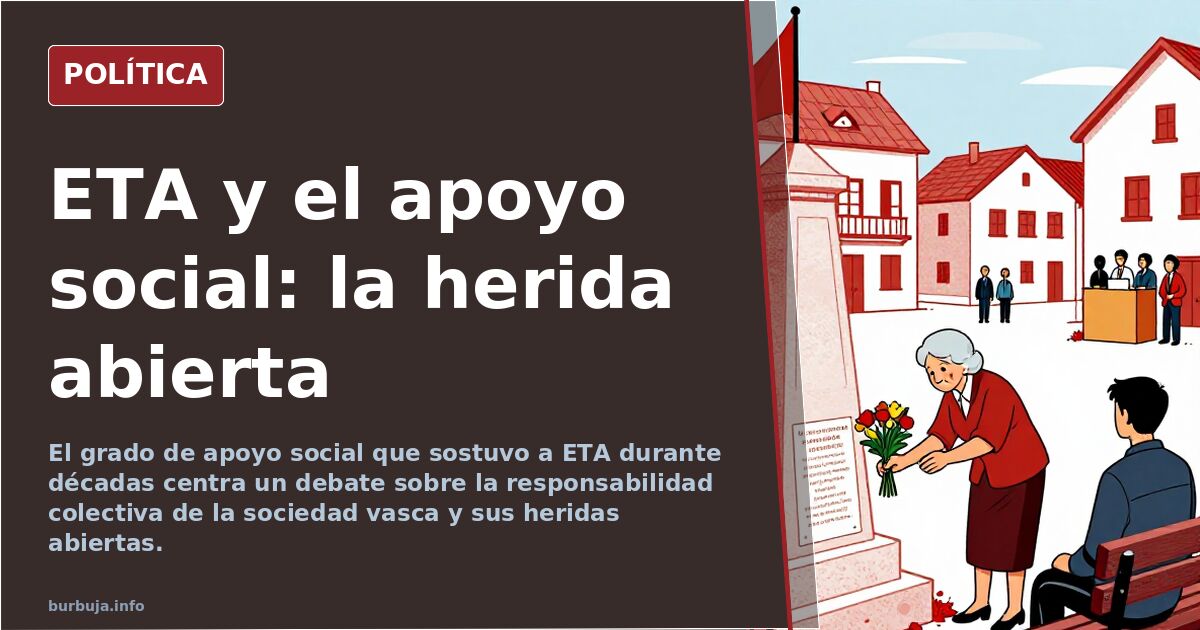
ETA and social support: the debate on Basque society
The level of social complicity that sustained ETA for decades is back at the center of discussion. An initial argument holds that an armed group cannot survive without backing from part of the population, recalling an episode where spectators at a cycling race allegedly pointed out an injured Civil Guard officer so attackers could finish him off. The thesis running through much of the exchange is uncomfortable: without tolerance or silence from a segment of Basque society, the organization would not have lasted.
The argument of social support as a survival condition
The central idea is that an armed gang unanimously rejected by its surroundings disappears in weeks. The same reasoning is applied to other conflicts, emphasizing that in the Basque case there were years of public acts with the organization's symbols and slogans chanted in packed squares. Support was not just ideological: there are mentions of information networks, people facilitating routines and movements, and a portion of the population preferring not to look.
Against this reading, another current distributes responsibility. It recalls that the organization had relevant external support for years, that other states and intelligence services tolerated or used its activity, and that indifference toward certain attacks existed in the rest of Spain. The conclusion of this block is that the phenomenon was not exclusive to one territory.
Internal exile and pressure on dissenters
One of the harshest contributions describes daily life under such pressure. Families of civil servants who left Navarre for security reasons, people who moved away leaving their lives behind, and a climate where staying silent was the rational option. A distinction is made between those who celebrated, those who stood aside, and those who suffered direct targeting.
This distribution is summarized in a repeated image: one third complicit, one third indifferent out of convenience, one third targeted. Cowardice, it is argued, is also a sarracena misery, even if it pays off until it hits you.
From armed past to electoral present
The jump to the present is the most contested point. It is claimed that today, masses still vote for formations inheriting that structure—people who did not live through the hard years—and that this prevents closing the wound. The response from another position is that the conflict was managed politically and that parties of all stripes measured every episode in votes for years.
Comparison with other European terrorism also appears, along with the thesis that many of its members were not from the territory, used to dismantle the identity-based narrative. The discussion gets stuck exactly there: on whether Basque society bears collective responsibility or if accountability dissolves among elites, states, and circumstances.
What remains unresolved is the pending account with victims whose bodies have not been found and their families, who still cannot bury their loved ones. This fact, more than any poll, leaves the analysis without closure.
The level of social complicity that sustained ETA for decades is back at the center of discussion. An initial argument holds that an armed group cannot survive without backing from part of the population, recalling an episode where spectators at a cycling race allegedly pointed out an injured Civil Guard officer so attackers could finish him off. The thesis running through much of the exchange is uncomfortable: without tolerance or silence from a segment of Basque society, the organization would not have lasted.
The argument of social support as a survival condition
The central idea is that an armed gang unanimously rejected by its surroundings disappears in weeks. The same reasoning is applied to other conflicts, emphasizing that in the Basque case there were years of public acts with the organization's symbols and slogans chanted in packed squares. Support was not just ideological: there are mentions of information networks, people facilitating routines and movements, and a portion of the population preferring not to look.
Against this reading, another current distributes responsibility. It recalls that the organization had relevant external support for years, that other states and intelligence services tolerated or used its activity, and that indifference toward certain attacks existed in the rest of Spain. The conclusion of this block is that the phenomenon was not exclusive to one territory.
Internal exile and pressure on dissenters
One of the harshest contributions describes daily life under such pressure. Families of civil servants who left Navarre for security reasons, people who moved away leaving their lives behind, and a climate where staying silent was the rational option. A distinction is made between those who celebrated, those who stood aside, and those who suffered direct targeting.
This distribution is summarized in a repeated image: one third complicit, one third indifferent out of convenience, one third targeted. Cowardice, it is argued, is also a sarracena misery, even if it pays off until it hits you.
From armed past to electoral present
The jump to the present is the most contested point. It is claimed that today, masses still vote for formations inheriting that structure—people who did not live through the hard years—and that this prevents closing the wound. The response from another position is that the conflict was managed politically and that parties of all stripes measured every episode in votes for years.
Comparison with other European terrorism also appears, along with the thesis that many of its members were not from the territory, used to dismantle the identity-based narrative. The discussion gets stuck exactly there: on whether Basque society bears collective responsibility or if accountability dissolves among elites, states, and circumstances.
What remains unresolved is the pending account with victims whose bodies have not been found and their families, who still cannot bury their loved ones. This fact, more than any poll, leaves the analysis without closure.
Also available in: Deutsch
Summary of a discussion on Burbuja.info - Foro de economía, actualidad y política., translated from Spanish and reviewed before publication. Read the full discussion (169 replies).
More summaries
-
Otegi's alleged alliance with Sánchez sparks fierce backlash
Otegi appears with Basque socialists in an image that triggers criticism: he asks PSOE to tackle corruption while offering support. Alliance or survival?
-
Judge in Koldo case moves to indict Ábalos
The judge moves to indict Ábalos after UCO report; PP summons Marlaska and Globalia CEO to Senate committee
-
'Galiza aos Galegos': Galicia's Identity Nationalism
A minority Galician nationalism revives the slogan 'home, race, language' and claims the 1932 Ultreya. Triskeles, camps, and social media.
-
Cantabria forum debate: wolves, fires and rural decline
Forum user proposes wolf tracking, grazing for fire prevention and Santo Toribio reforms in Cantabria.
-
It’s Not Class War, Arrogant
ABC columnist argues PSOE and Sumar turn the Nov 29 vote into a moral duel to avoid accountability for Spain's housing crisis.
-
Spain's Housing Minister Unaware of Her Own Decree
Lorenzo Bernaldo de Quirós criticizes Isabel Rodríguez's housing management in Vozpópuli, noting she didn't know her decree 48 hours after signing.