
Engineering in Spain: €30,000 gross with 10 years of experience
Offers of €30,000 gross requiring 10 years of experience: Spanish engineers question a career that no longer guarantees financial security.
English · Original discussion in Spanish · Published
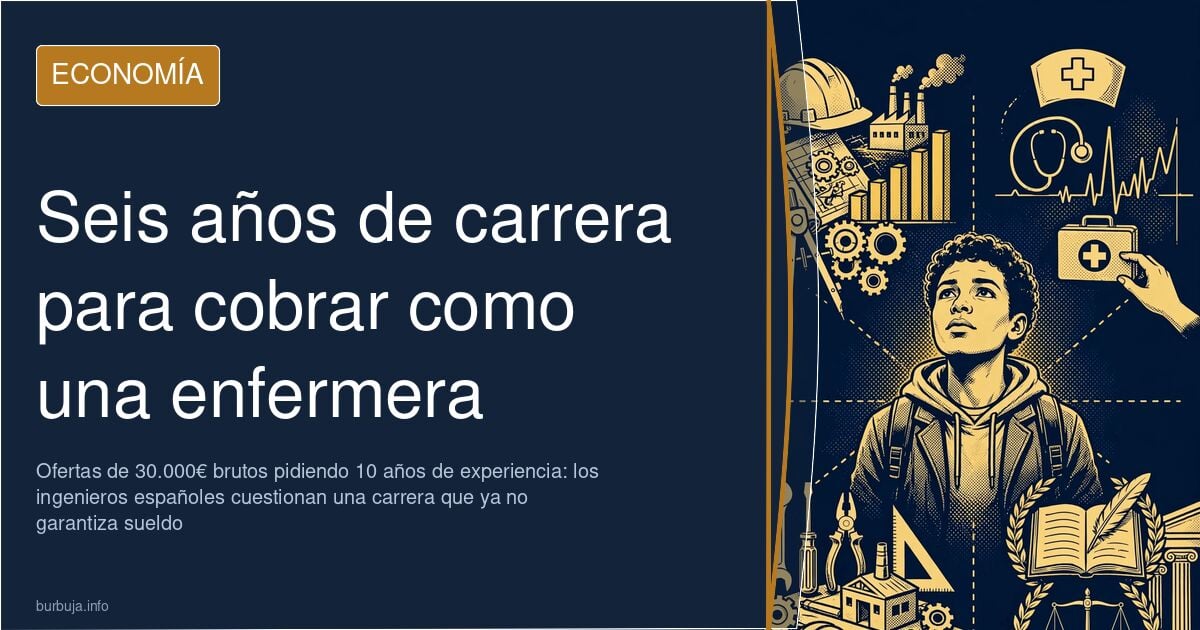
Engineering: six years of study for less than a nurse
The offer circulated on an ordinary job portal and explains the problem better than any official report. Civil engineer. Building Master's degree. Ten years of mandatory experience in bridge structures. Full-time presence from 8:00 to 18:00. Thirty thousand euros gross per year. Ten years of specialization, a master's degree on top, and the salary of a vocational training technician with just a few years of workshop experience. It is a portrait of why studying engineering in Spain has stopped being the secure ticket it was sold as in schools.
How much does an engineer earn in Spain
The calculation most circulated among graduates is uncomfortable: the gross salary barely exceeds that of an industrial vocational training technician by 10% or 20%, despite having the same seniority, and in exchange for more working hours. It is not the only difference that hurts. The comparison with Nursing—a shorter career, a more manageable course load, and almost immediate placement—is neck-and-neck or even advantageous for the nurse.
The ceiling doesn't help either. In a survey among engineers of all specializations, including executives and self-employed individuals working in Spain, none reported exceeding 100,000 euros gross per year. For a doctor, that threshold is easily reachable; for a lawyer, difficult but not impossible. For the average engineer, it is a frontier almost no one crosses.
The gap between the veteran and the newcomer
In a company with about a dozen engineers on staff, the most senior—60 years old, 17 in the company—earns around 4,800 euros net, paid through 15 payments per year, profit sharing, and 45 days of leave per year. The newest recruit, 25 years old with a recently completed master's degree, starts at around 2,400 euros net with the same 15 payments.
This is why technical management teams are full of profiles that don't drop below 55 years old: promotion comes late and for few.
The opportunity cost: four years for 70,000 euros
Those who finish vocational training (FP) at 20 are already earning; those who leave the university course at 24 have not yet earned a single euro. Four years of difference, which, with average technician salaries, equals about 70,000 euros advantage for those who skipped university. And a working life measured in decades: 45 years of work versus four or six years of study.
Nursing, teaching, and the civil service route
The most common case has a specific profile: chemical engineer, five years of study plus a master's in renewables and water management, senior at a major construction company, expert in osmosis, designing plants and visiting sites in Spain, the Mediterranean, and the Middle East. Thirty thousand euros gross.
She passed civil service exams (oposiciones), moved to Málaga, and earns more. As a celebration, she deleted her professional profile on LinkedIn.
The sarracena of the story is twenty years old: one acquaintance enrolled simultaneously in Teaching and Chemistry. For Teaching, he only attended exams and parties, and retired as a teacher without finishing his science degree.
In Catalonia, there is also work as a Technology professor without needing to pass civil service exams.
Why are there surplus engineers in Spain?
Because the narrative of scarcity is long expired. Spain is the second country in Europe with the most engineers, only behind Germany, and a market with excess supply does not raise salaries: it sinks them. Added to this is the degradation of the degrees themselves. With Bologna, subjects have been cut—in some courses, multivariable calculus has disappeared—and laboratory work and projects have been favored over theoretical foundation.
AI and the prescindible engineer
There is a new factor in the equation. The CEO of NVIDIA argued that studying programming was foolish, because what artificial intelligence does is precisely eliminate the need to program. Prediction may be exaggerated. The description of the actual job, however, is not so rosy: certifying documentation, reviewing inherited code, completing data sheets. An assembly line of office tasks where none of the technical challenge promised in the faculty brochure remains.
In California, a firefighter with five years of experience earns an average of 115,000 dollars per year, practically the same as an average engineer, but with a public sector job, stability, and pension. The gap is no longer Spanish. It is occupational.
The offer circulated on an ordinary job portal and explains the problem better than any official report. Civil engineer. Building Master's degree. Ten years of mandatory experience in bridge structures. Full-time presence from 8:00 to 18:00. Thirty thousand euros gross per year. Ten years of specialization, a master's degree on top, and the salary of a vocational training technician with just a few years of workshop experience. It is a portrait of why studying engineering in Spain has stopped being the secure ticket it was sold as in schools.
How much does an engineer earn in Spain
The calculation most circulated among graduates is uncomfortable: the gross salary barely exceeds that of an industrial vocational training technician by 10% or 20%, despite having the same seniority, and in exchange for more working hours. It is not the only difference that hurts. The comparison with Nursing—a shorter career, a more manageable course load, and almost immediate placement—is neck-and-neck or even advantageous for the nurse.
The ceiling doesn't help either. In a survey among engineers of all specializations, including executives and self-employed individuals working in Spain, none reported exceeding 100,000 euros gross per year. For a doctor, that threshold is easily reachable; for a lawyer, difficult but not impossible. For the average engineer, it is a frontier almost no one crosses.
The gap between the veteran and the newcomer
In a company with about a dozen engineers on staff, the most senior—60 years old, 17 in the company—earns around 4,800 euros net, paid through 15 payments per year, profit sharing, and 45 days of leave per year. The newest recruit, 25 years old with a recently completed master's degree, starts at around 2,400 euros net with the same 15 payments.
This is why technical management teams are full of profiles that don't drop below 55 years old: promotion comes late and for few.
The opportunity cost: four years for 70,000 euros
Those who finish vocational training (FP) at 20 are already earning; those who leave the university course at 24 have not yet earned a single euro. Four years of difference, which, with average technician salaries, equals about 70,000 euros advantage for those who skipped university. And a working life measured in decades: 45 years of work versus four or six years of study.
Nursing, teaching, and the civil service route
The most common case has a specific profile: chemical engineer, five years of study plus a master's in renewables and water management, senior at a major construction company, expert in osmosis, designing plants and visiting sites in Spain, the Mediterranean, and the Middle East. Thirty thousand euros gross.
She passed civil service exams (oposiciones), moved to Málaga, and earns more. As a celebration, she deleted her professional profile on LinkedIn.
The sarracena of the story is twenty years old: one acquaintance enrolled simultaneously in Teaching and Chemistry. For Teaching, he only attended exams and parties, and retired as a teacher without finishing his science degree.
In Catalonia, there is also work as a Technology professor without needing to pass civil service exams.
Why are there surplus engineers in Spain?
Because the narrative of scarcity is long expired. Spain is the second country in Europe with the most engineers, only behind Germany, and a market with excess supply does not raise salaries: it sinks them. Added to this is the degradation of the degrees themselves. With Bologna, subjects have been cut—in some courses, multivariable calculus has disappeared—and laboratory work and projects have been favored over theoretical foundation.
AI and the prescindible engineer
There is a new factor in the equation. The CEO of NVIDIA argued that studying programming was foolish, because what artificial intelligence does is precisely eliminate the need to program. Prediction may be exaggerated. The description of the actual job, however, is not so rosy: certifying documentation, reviewing inherited code, completing data sheets. An assembly line of office tasks where none of the technical challenge promised in the faculty brochure remains.
In California, a firefighter with five years of experience earns an average of 115,000 dollars per year, practically the same as an average engineer, but with a public sector job, stability, and pension. The gap is no longer Spanish. It is occupational.
Summary of a discussion on Burbuja.info - Foro de economía, actualidad y política., translated from Spanish and reviewed before publication. Read the full discussion (298 replies).
More summaries
-
August EV Sales: 13.4% Market Share Amid Doubts Over 'Exponential Phase'
While 13.4% of the electric quota in August boosts Luis Valdés' predictions, charging infrastructure and pricing raise serious doubts about growth...
-
Euthanasia in Old Age: Autonomy vs. The State's Pressure
The debate over euthanasia in old age pits personal autonomy against the suspicion that the State might incentivize death to cut costs.
-
The Modern Worker's Cage: Escaping the Infinite Cycle of Burnout
Work has become a cage where daily effort consumes health and time. Discover why we push ourselves so hard and how to break the cycle.
-
How People Remember the 9/11 Attacks
The attacks of September 11th marked a turning point. Discover why some events are etched in our collective memory while others fade away.
-
Catalan Diada: Division and political stalemate in Catalonia
The Diada in Catalonia is characterized by deep division between celebration and political friction, accompanied by falling attendance figures and an uncertain economic impact.
-
Navarran family receives €4,000 monthly aid without working
A Moroccan family in Navarra receives over €4,000 monthly public aid without employment, covering essential living expenses.