
Engineer with two paid-off homes and €2,500 monthly: middle class?
An engineer owns two paid-off properties worth €400k and €600k but earns only €2,500/month. Critics argue his assets don't match his fixed costs.
English · Original discussion in Spanish · Published
Two paid-off homes and €2,500 a month: assets that don't add up
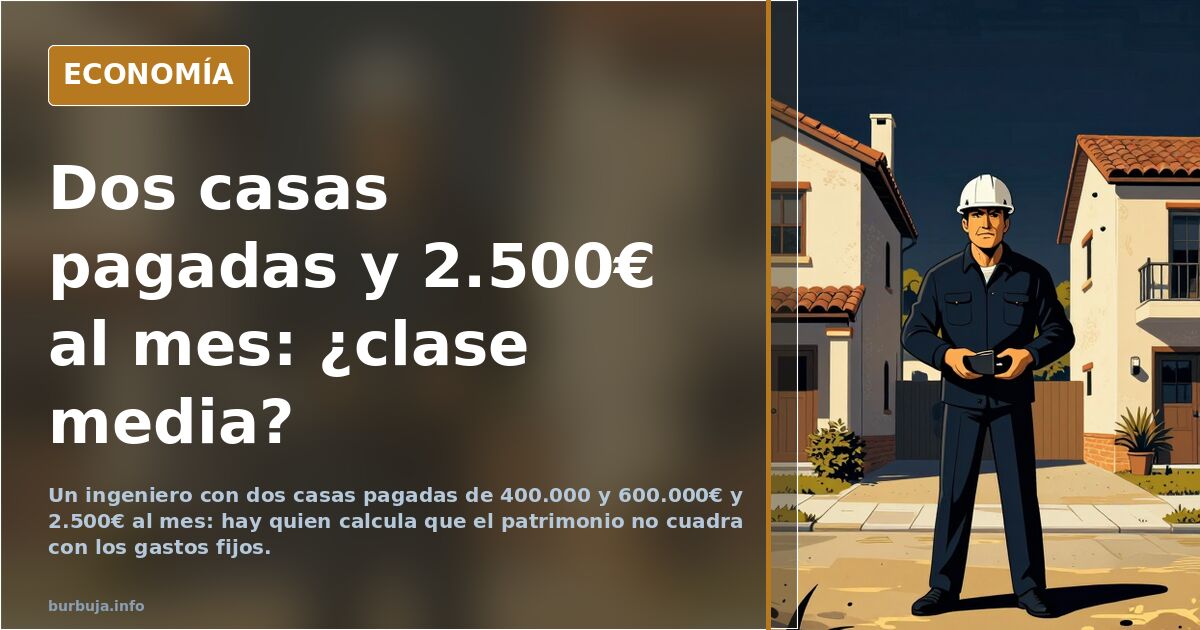
An engineer earns €2,500 a month in 14 payments. He owns an apartment in Chueca valued at €400,000, a townhouse in Aravaca worth €600,000, and has €100,000 saved. Everything is paid off, with no mortgage. With these numbers, the question isn't whether he's rich: it's whether that salary can sustain those assets without daily expenses eating them alive.
The premise, which starts with an income figure many Spaniards would sign up for, falls apart as soon as fixed costs are added. Property tax (IBI), insurance, community fees, and utilities for two homes take a significant chunk of the salary before the owner even steps into the kitchen. And that doesn't include special assessments, breakdowns, or insurance refusing to cover a claim.
How much does it cost to maintain two homes on €2,500 a month?
The breakdown circulating in the discussion is relentless. Just vehicle insurance, home insurance, property tax (IBI), and community fees for the two properties bring the minimum monthly bill close to €800, rising if the development has security, gardens, or a pool. Add utilities, maintenance, and groceries in central Madrid, which aren't the same as in a suburban bedroom community.
Several analyses conclude that the €100,000 cushion isn't growing; rather, it's bleeding out. It's not that the wealth is fake: it's that liquidity doesn't keep up. An owner with two properties and an average salary may be a millionaire on paper; in practice, they live on the edge, where one bathroom renovation or a building inspection assessment could eat half their paycheck.
Is having an apartment in Chueca and a townhouse in Aravaca middle class?
Here consensus breaks down. One school of thought argues this was always middle class and is perceived as luxury today only because the country has become poorer and envy plays its part. Another counters that middle class means being able to afford unexpected costs without trembling, and this profile can't: they have assets, not income.
The nuance matters. Only 26% of Spaniards own more than one home, and half of that group acquired it through inheritance, according to estimates used in the conversation. In other words, a second residence earned solely through work is a statistical exception, not the norm. Hence, many suspect there's an inheritance, divorce, or windfall behind these figures, although the premise insists on not speculating about the source.
The engineer's salary that doesn't match the assets
The most repeated objection points to the income-asset ratio. Some argue that an experienced engineer with two paid-off properties shouldn't earn just €2,500. Others remind us that some engineers make a fortune while others make peanuts, and that a PhD in mechanical engineering might chain together university external contracts for less than €600 a month. The degree guarantees nothing.
The alternative calculation proposed is simple: if the €600,000 from the townhouse had been invested in an asset with reasonable returns, the owner would have enough passive income to live without working. Instead, they have an empty property that only generates costs. The criticism isn't of the wealth itself, but of its low productivity.
Work or idle away: the debate on stopping work
Against the idea of living off rents comes the argument that anyone with a professional career doesn't stop working just because they already have money. No one with over two million quits their job, it's said. Work isn't just income: it's structure, identity, and often the only way to avoid boredom by age fifty.
The rebuttal is bitter: people want to stop working as soon as possible, and the vertigo of aging tied to debt or the need to hustle to eat is real. Those with careers don't stop working sounds good until illness or old age appear. Then wealth stops being a luxury and becomes the only safety net underfoot.
The question no one answers: where did the money come from?
The origin of the wealth is the blind spot of this entire exercise. You can inherit at any age, and it's common around forty. But the premise explicitly forbids speculating about inheritances and asks to judge only by the data: two paid-off homes, €100,000, and a salary of €2,500 in 14 payments.
With these pieces, the picture is of solid assets sustained by fragile income. They aren't rich: they're owners with liquidity problems. And that category, increasingly common in Spain, fits neither classic label. Neither comfortable middle class nor precarious worker. Something intermediate that economic vocabulary hasn't yet named.
If Euribor rates and the cost of living stay where they are, this profile will tend to multiply: people with paid-off bricks and tight paychecks, forced to choose between maintaining assets or living comfortably. The prediction has a catch, because it depends on variables no one controls. But the tension between having and being able to afford it? That's already here.
An engineer earns €2,500 a month in 14 payments. He owns an apartment in Chueca valued at €400,000, a townhouse in Aravaca worth €600,000, and has €100,000 saved. Everything is paid off, with no mortgage. With these numbers, the question isn't whether he's rich: it's whether that salary can sustain those assets without daily expenses eating them alive.
The premise, which starts with an income figure many Spaniards would sign up for, falls apart as soon as fixed costs are added. Property tax (IBI), insurance, community fees, and utilities for two homes take a significant chunk of the salary before the owner even steps into the kitchen. And that doesn't include special assessments, breakdowns, or insurance refusing to cover a claim.
How much does it cost to maintain two homes on €2,500 a month?
The breakdown circulating in the discussion is relentless. Just vehicle insurance, home insurance, property tax (IBI), and community fees for the two properties bring the minimum monthly bill close to €800, rising if the development has security, gardens, or a pool. Add utilities, maintenance, and groceries in central Madrid, which aren't the same as in a suburban bedroom community.
Several analyses conclude that the €100,000 cushion isn't growing; rather, it's bleeding out. It's not that the wealth is fake: it's that liquidity doesn't keep up. An owner with two properties and an average salary may be a millionaire on paper; in practice, they live on the edge, where one bathroom renovation or a building inspection assessment could eat half their paycheck.
Is having an apartment in Chueca and a townhouse in Aravaca middle class?
Here consensus breaks down. One school of thought argues this was always middle class and is perceived as luxury today only because the country has become poorer and envy plays its part. Another counters that middle class means being able to afford unexpected costs without trembling, and this profile can't: they have assets, not income.
The nuance matters. Only 26% of Spaniards own more than one home, and half of that group acquired it through inheritance, according to estimates used in the conversation. In other words, a second residence earned solely through work is a statistical exception, not the norm. Hence, many suspect there's an inheritance, divorce, or windfall behind these figures, although the premise insists on not speculating about the source.
The engineer's salary that doesn't match the assets
The most repeated objection points to the income-asset ratio. Some argue that an experienced engineer with two paid-off properties shouldn't earn just €2,500. Others remind us that some engineers make a fortune while others make peanuts, and that a PhD in mechanical engineering might chain together university external contracts for less than €600 a month. The degree guarantees nothing.
The alternative calculation proposed is simple: if the €600,000 from the townhouse had been invested in an asset with reasonable returns, the owner would have enough passive income to live without working. Instead, they have an empty property that only generates costs. The criticism isn't of the wealth itself, but of its low productivity.
Work or idle away: the debate on stopping work
Against the idea of living off rents comes the argument that anyone with a professional career doesn't stop working just because they already have money. No one with over two million quits their job, it's said. Work isn't just income: it's structure, identity, and often the only way to avoid boredom by age fifty.
The rebuttal is bitter: people want to stop working as soon as possible, and the vertigo of aging tied to debt or the need to hustle to eat is real. Those with careers don't stop working sounds good until illness or old age appear. Then wealth stops being a luxury and becomes the only safety net underfoot.
The question no one answers: where did the money come from?
The origin of the wealth is the blind spot of this entire exercise. You can inherit at any age, and it's common around forty. But the premise explicitly forbids speculating about inheritances and asks to judge only by the data: two paid-off homes, €100,000, and a salary of €2,500 in 14 payments.
With these pieces, the picture is of solid assets sustained by fragile income. They aren't rich: they're owners with liquidity problems. And that category, increasingly common in Spain, fits neither classic label. Neither comfortable middle class nor precarious worker. Something intermediate that economic vocabulary hasn't yet named.
If Euribor rates and the cost of living stay where they are, this profile will tend to multiply: people with paid-off bricks and tight paychecks, forced to choose between maintaining assets or living comfortably. The prediction has a catch, because it depends on variables no one controls. But the tension between having and being able to afford it? That's already here.
Summary of a discussion on Burbuja.info - Foro de economía, actualidad y política., translated from Spanish and reviewed before publication. Read the full discussion (145 replies).
More summaries
-
Income vs wealth: Social class is more than a salary
Social class in Spain is defined not by salary but by wealth and fixed expenses. We analyze how income alone is insufficient to classify reality.
-
Police Officer at 48 Receives €31,800 Incapacity Pension
A 48-year-old officer with 20 years of service receives €31,800 annually due to incapacity. The debate on privileges and sustainability resurfaces.
-
Trump Suggests Arresting California Governor for Treason
Donald Trump suggests arresting Gavin Newsom for treason as California sues the federal government over National Guard deployment.
-
Car explodes in Amsterdam's Dam Square; driver suspected of arson
A car exploded in Amsterdam's Dam Square, with the driver emerging on fire. Police are investigating whether the blaze was intentional.
-
Spain Considers Foreign Ministers in Cabinet
Spanish government amends parity law to allow foreign ministers into cabinet meetings, citing France and Morocco treaties.
-
Merry Christmas vs Happy Holidays: The West's Cultural Divide
The annual debate over holiday greetings reignites the cultural war regarding Western Christian roots and inclusive language.