
Energy crisis: naval blockade on Russia and the Hormuz risk
Ten European navies pressure Russia's shadow fleet while the scenario of €4.50 diesel and a closed Strait of Hormuz looms over the energy debate.
English · Original discussion in Spanish · Published
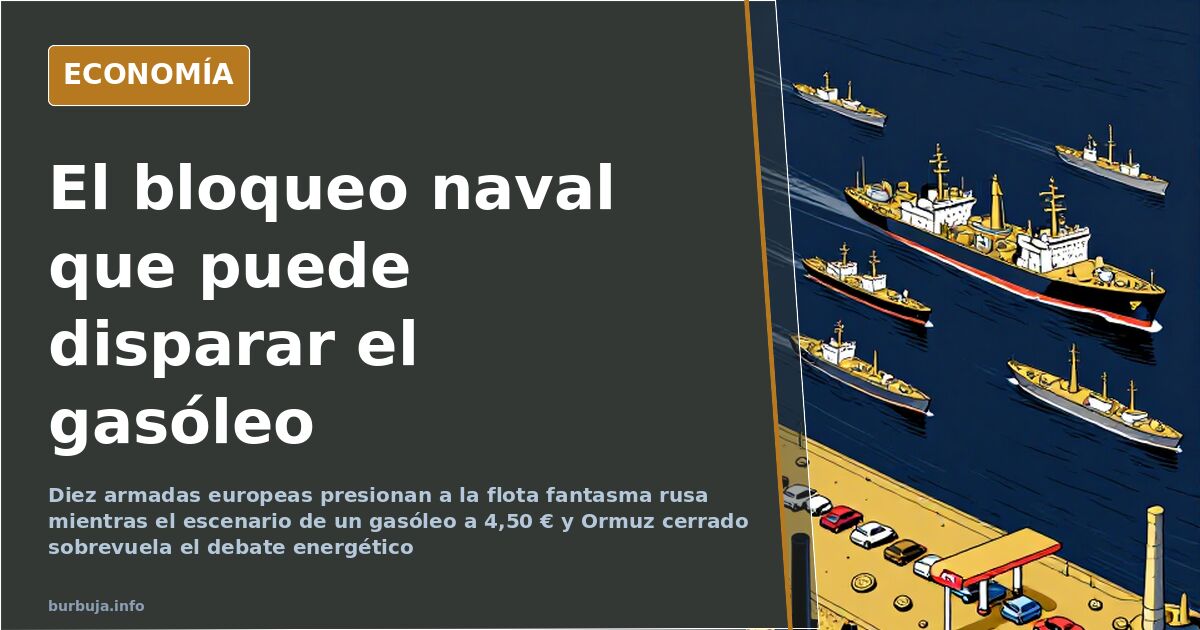
Ten navies against Russia's shadow fleet and the diesel to come
How high can diesel prices rise before the roads stop moving? That is the question hanging over everything else. The United Kingdom has ordered its warships to intercept and board Russian tankers, with the English Channel turned into a bottleneck, and ten European navies are coordinating pressure on the so-called shadow fleet. The prime ministers of Finland, Petteri Orpo, and the United Kingdom, Keir Starmer, closed ranks outside the JEF framework, according to Reuters.
The thesis of a manufactured energy crisis
There is a school of thought that sees no accident in this sequence. It argues that breaking supply chains is the goal, not collateral damage, and that expensive energy serves to shut down industry by suffocating those who cannot pay for it. In its harshest version, the energy crisis would be the result of a deliberate redesign of the economic order. The opposing reading is far more boring: a sanctions escalation that has run ahead of its own consequences. Neither has been settled, and that is precisely the uncomfortable part.
From Hormuz to €4.50 a litre
The second front is the Strait of Hormuz. Iran plays the card of letting ships pass or not depending on their flag and describes Spain as a country committed to international law, while Washington squeezes Tehran. If that passage closes or becomes a minefield, the circulating estimate points to a 30-40% increase in the price of oil not coming from Russia, with a scenario of diesel at €4.50 per litre, hauliers stopping and empty shelves within 72 hours. It is not a forecast: it is a working assumption. And there lies the trap, because an assumption repeated often enough stops seeming like one.
Ten navies mobilised, one channel blocked and one strait up in the air. All perfectly coordinated, except for the small detail that nobody quite explains who signs off on the plan.
Also available in: Deutsch
Summary of a discussion on Burbuja.info - Foro de economía, actualidad y política., translated from Spanish and reviewed before publication. Read the full discussion (15 replies).
More summaries
-
Iran’s Strait of Ormuz Threat Fades: No Oil Crisis Materializes
Iran’s 353-day threat to close the Strait of Ormuz failed to trigger the expected global oil crisis. We analyze the geopolitical tensions and actual economic impact.
-
Strait of Hormuz open for Japan as Trump calls for war on Iran
Two Japanese ships cross the Strait of Hormuz without escort while Trump demands war on Iran. Analysis challenges the official narrative, pointing to the real conflict: USA vs China.
-
Oil at $200 and the Strait of Hormuz: The Economics of an Imminent War with Iran
30% of global crude oil passes through the Strait of Hormuz. The US military buildup and sham negotiations point to an imminent war with Iran that would send oil to $200.
-
Ceuta: Civil Guard's inaction over taunts embarrasses Spain's government
The Civil Guard's passive response to taunts in Ceuta, Spain, divides opinion: each arrest leaves a zone unprotected for 30 minutes.
-
Greece jails NGOs over illegal immigration
Greece bans and threatens NGOs that facilitate illegal migrant entry with prison. In Spain, suspicions of covert trafficking are growing. A model to follow?
-
Bukele posters appear in Spain and political tempers flare
A 'universal president' poster of Bukele has appeared in Spain, fueling the debate between tough-on-crime policies and civil liberties. Corruption and security concerns heighten the tension.