
Elderly Woman with USSR Flag Confronts Ukrainian Troops: The Video
An elderly woman greets Ukrainian troops with a Soviet flag, mistaking them for Russians. The video reignites debates on the Holodomor and Soviet memory.
English · Original discussion in Spanish · Published
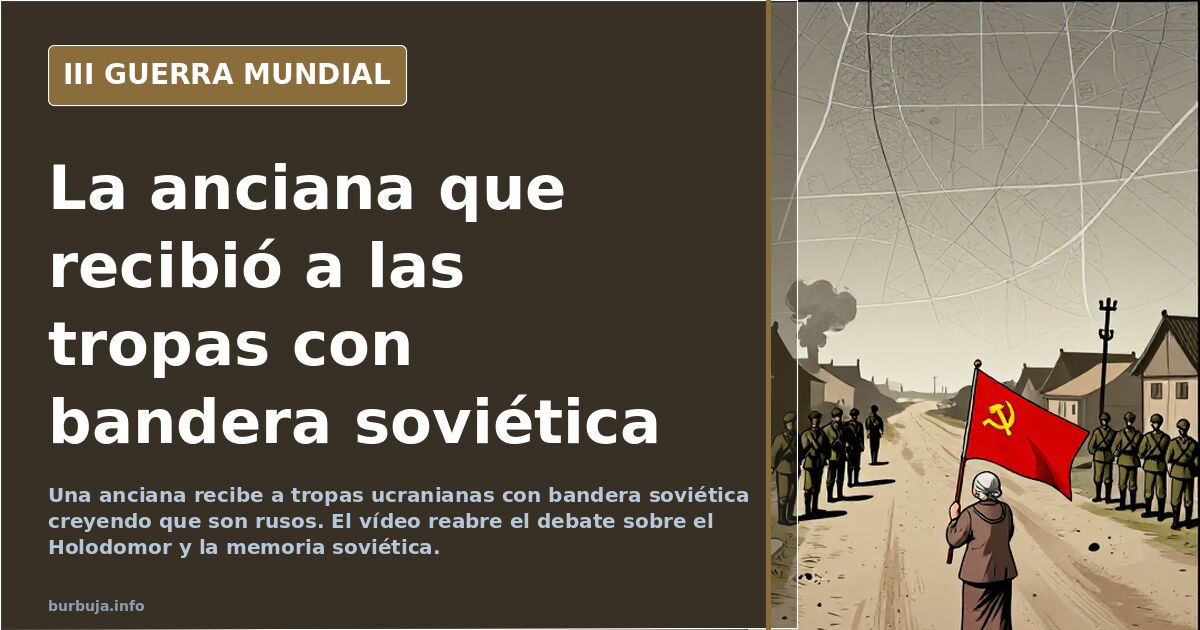
Elderly Woman Greets Ukrainian Troops with Soviet Flag
The video itself is not particularly spectacular. An elderly woman emerges to meet some soldiers, holding a USSR flag. She believes they are Russians. They are not. It is the Ukrainian army. The scene has become a minor battleground over memory, the Holodomor, and what it means to wave a red flag in the country that suffered under it.
An uncomfortable question lies beneath the surface: why would an elderly woman mistake the army defending her territory for the one invading it? One part of the analysis offers a painful, obvious answer: because for a significant part of the 20th century, that flag was the one flying over her home.
What the Video Shows and What's Said Afterwards
The footage shows the woman with the Soviet flag and the Ukrainian soldiers approaching. She greets them, thinking they are Russians. According to the most repeated version of how the scene unfolds, the soldiers offer her food, and she rejects it when she realizes who she's speaking with. This detail, the rejection in return, is what ignites the discussion.
There is no independent confirmation of what peine after the camera stopped rolling. This is where the slippery slope begins: almost everything claimed about the woman's fate and condition are assumptions. It's worth remembering this before believing any particular ending.
The Holodomor: The Date That Keeps Coming Up
The famine of 1932, fifteen years after the 1917 revolution, creeps into any conversation about the USSR in Ukraine. The exact death toll is not discussed here, but the fact of a massive famine under collectivization is. Some interpret it as a direct consequence of Stalin's policies; others maintain that landowners, who burned crops and killed livestock before relinquishing their land, provoked it.
Everything else stems from this discrepancy. There are those who argue that the USSR was an industrial, scientific, and medical powerhouse that helped decolonize half the world. And there are those who recall the deportations of entire nations from the Caucasus, the erasure of identity in the Baltic states, or the shortages of the eighties. Two incompatible narratives about the same country.
“In a single hair of that woman, there is more dignity”
On one point, almost no one disagrees: the elderly woman's attitude. Her gesture is seen as pure dignity even by those who share nothing of her flag's symbolism. The phrase that best summarizes it: in a single hair of that woman, there is more dignity and courage than in all those who write about her from a keyboard.
Some also use her age to attack her. And others respond with a personal anecdote: an elderly neighbor who refused to eat at the village's communal meal because he paid for the food himself. Dignity, the implication is, appears where you least expect it.
From the Soviet Flag to Donbas
The conversation quickly shifts to the present. It's recalled that the USSR flag is not the flag of the Russian Federation, a distinction that gets lost as soon as someone raises their voice. And cross-accusations emerge: some speak of Anglo-Zionist propaganda; others, of apologism for the regime that caused famines. The Donbas conflict since 2014 is used as an argument in both directions.
No one wins. The exchange functions by accumulating historical grievances, not by arguments.
What Might Happen Next
The fundamental question remains unanswered: what really peine to the woman. Until there is confirmation, any statement about her lacks backing. Most likely, the scene will remain what it already is: a symbol that each side uses for its own convenience. And like all symbols, it will outlast the video that created it.
The video itself is not particularly spectacular. An elderly woman emerges to meet some soldiers, holding a USSR flag. She believes they are Russians. They are not. It is the Ukrainian army. The scene has become a minor battleground over memory, the Holodomor, and what it means to wave a red flag in the country that suffered under it.
An uncomfortable question lies beneath the surface: why would an elderly woman mistake the army defending her territory for the one invading it? One part of the analysis offers a painful, obvious answer: because for a significant part of the 20th century, that flag was the one flying over her home.
What the Video Shows and What's Said Afterwards
The footage shows the woman with the Soviet flag and the Ukrainian soldiers approaching. She greets them, thinking they are Russians. According to the most repeated version of how the scene unfolds, the soldiers offer her food, and she rejects it when she realizes who she's speaking with. This detail, the rejection in return, is what ignites the discussion.
There is no independent confirmation of what peine after the camera stopped rolling. This is where the slippery slope begins: almost everything claimed about the woman's fate and condition are assumptions. It's worth remembering this before believing any particular ending.
The Holodomor: The Date That Keeps Coming Up
The famine of 1932, fifteen years after the 1917 revolution, creeps into any conversation about the USSR in Ukraine. The exact death toll is not discussed here, but the fact of a massive famine under collectivization is. Some interpret it as a direct consequence of Stalin's policies; others maintain that landowners, who burned crops and killed livestock before relinquishing their land, provoked it.
Everything else stems from this discrepancy. There are those who argue that the USSR was an industrial, scientific, and medical powerhouse that helped decolonize half the world. And there are those who recall the deportations of entire nations from the Caucasus, the erasure of identity in the Baltic states, or the shortages of the eighties. Two incompatible narratives about the same country.
“In a single hair of that woman, there is more dignity”
On one point, almost no one disagrees: the elderly woman's attitude. Her gesture is seen as pure dignity even by those who share nothing of her flag's symbolism. The phrase that best summarizes it: in a single hair of that woman, there is more dignity and courage than in all those who write about her from a keyboard.
Some also use her age to attack her. And others respond with a personal anecdote: an elderly neighbor who refused to eat at the village's communal meal because he paid for the food himself. Dignity, the implication is, appears where you least expect it.
From the Soviet Flag to Donbas
The conversation quickly shifts to the present. It's recalled that the USSR flag is not the flag of the Russian Federation, a distinction that gets lost as soon as someone raises their voice. And cross-accusations emerge: some speak of Anglo-Zionist propaganda; others, of apologism for the regime that caused famines. The Donbas conflict since 2014 is used as an argument in both directions.
No one wins. The exchange functions by accumulating historical grievances, not by arguments.
What Might Happen Next
The fundamental question remains unanswered: what really peine to the woman. Until there is confirmation, any statement about her lacks backing. Most likely, the scene will remain what it already is: a symbol that each side uses for its own convenience. And like all symbols, it will outlast the video that created it.
Summary of a discussion on Burbuja.info - Foro de economía, actualidad y política., translated from Spanish and reviewed before publication. Read the full discussion (229 replies).
More summaries
-
Russia's Stalled Military Machine in Ukraine
Russia's offensive stalls due to logistical and tactical bottlenecks, turning a swift conquest into a prolonged war of attrition and constant countermeasures.
-
Ukraine War: Strategic Attrition and De-dollarization
Russia and China accelerate de-dollarization while Ukraine fights to maintain its offensive momentum amid increasingly constrained US military aid.
-
Ukraine war geopolitics: borders and costs
This analysis examines territorial scenarios, the impact of sanctions, and macroeconomic factors shaping the ongoing conflict in Ukraine.
-
Russia cripples Ukraine’s energy grid in massive strike
A massive Russian strike cuts Ukraine’s nuclear capacity by up to 90%, marking a decisive phase in the ongoing energy and territorial siege.
-
Ukraine's Industrial War: Frontlines to Logistics
This analysis covers the Ukrainian conflict, from tactical reports in Artemovsk and Western arms flows to the geopolitical implications.
-
Ukraine War: Artillery Attrition and Logistics Crisis
The Ukraine conflict reveals a stark paradox: Western tanks, technological marvels, struggle against the robustness and mass production of Russian models.