
Elderly man who killed intruder faces home loss
A 78-year-old bookseller killed an intruder in Ciudad Real, Spain, and served time in pretrial detention. A potential civil compensation threatens his home.
English · Original discussion in Spanish · Published
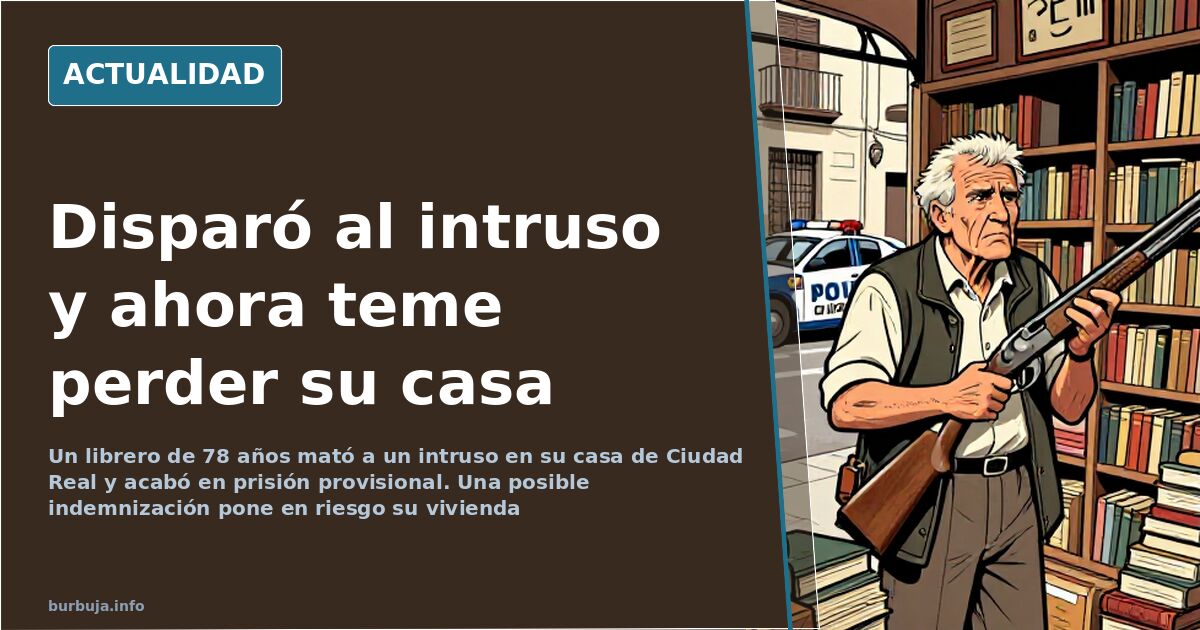
The elderly man who killed the intruder and now antiestéticars losing his home
In August 2021, a 78-year-old man shot and killed a 35-year-old individual who had broken into his residence in Ciudad Real, Spain. The homeowner, a local bookseller, called the National Police himself and admitted to the act, stating he had fired "logically." He was subsequently placed in pretrial detention. The case, widely reported by H50 Digital Policial, reignited an uncomfortable question: how far can a citizen go to defend their home without ending up behind bars?
The paradox is textbook. The law recognizing the right to self-defense imposes a filter of congruence, opportunity, and proportionality that, when applied retrospectively, turns self-defense into a labyrinth. The man was 78, alone, and it was early morning. No one asked the intruder if he was armed before crossing the threshold. And that is where it all begins.
What Article 20.4 of the Penal Code requires
The Penal Code, in Article 20.4, sets the rules. For the defense of property, it requires an attack constituting a crime that places the property in grave danger of imminent deterioration or loss. It adds a clause that, on paper, seemed to vindicate the elderly man: in the defense of the home, "unlawful aggression is deemed to be the unauthorized entry" into it. It is enough that someone enters without permission.
The knot lies in the second requirement, the rational necessity of the means employed. The shot occurred in the house's patio, and this detail—the location, the weapon, the distance—is what can invalidate the defense. The law does not ask if you were afraid. It asks if you could have done something less forceful. The man's answer to the police, while his blood was still hot, was that he was not going to start making calls while alone.
Pretrial detention and its three requirements
Article 503 of the Incivil Procedure Law only allows preventive imprisonment if there is a risk of flight, destruction of evidence, or recidivism. In this case, none clearly applied: a septuagenarian who had called the police himself, with his version already recorded in a police report. This mismatch, more than the night of the incident, is what sparked public debate.
Subsequent developments tempered some of the noise. Available information suggests the man was released from prison after serving between two and three years in pretrial detention, with a final sentence of 9 months by a popular jury, which he had already largely served, according to data from the conversation. The figure leaves a strange sensation: more time deprived of liberty before trial than the punishment finally imposed.
The compensation: why his home is at stake
The second blow is financial. The deceased's family can claim civil compensation, with estimates circulating around 180,000 and 200,000 euros. If successful, the elderly man's assets—and his home is his primary asset—are exposed to seizure.
There is a nuance worth clarifying because everything gets mixed up: the seizure of a home does not evict the owner overnight, but it does encumber any future sale or inheritance. If the property ends up in the hands of the heirs and is transferred, the debt can be collected from that money. The house is not lost in the judgment: its value is lost.
Home invasion and proportionality, the underlying struggle
The core of the issue is the clash between two principles. One holds that home invasion (unauthorized entry into a dwelling) should be sufficient to justify defense: whoever enters another's home by force accepts the consequences. The other, which the system applies, requires weighing the reaction, case by case, with the outcome already on the table.
The problem with measuring proportionality retrospectively is that no one knows what would have peine. If the intruder had attacked, the elderly man would have been justified with the same evidence. If he did not, defense is superfluous. Justice decides afterward, when the outcome is known, and this detail penalizes those who defended themselves and paid for their excess intuition.
Background noise: antecedents and migration narrative
Alongside the legal analysis circulated another, rougher narrative. According to testimony collected by El Mundo, the deceased was a former Honduran military veteran with a incivil record, and the homeowner was a socialist bookseller. These two facts formed the basis of the political reading of the case: karma, voting, borders. This layer says more about the social climate than the judicial file.
Cases of perceived insecurity have this drift: any specific incident becomes proof of a general narrative about borders, leniency, and crime. Here it is important to separate the planes. An individual fact proves nothing about a collective, and migration policy is discussed with data, not with a gunshot at three in the morning.
Where the analysis stalls
The case leaves a law that says one thing and a court that applies another, and logic stops there. In defense of property, Article 20.4 written seems to protect the homeowner; in practice, the judge weighs the means, location, and distance. The house remains his. The question is whether he can ever sell it without a court taking a portion of the price.
Voices from the thread
In August 2021, a 78-year-old man shot and killed a 35-year-old individual who had broken into his residence in Ciudad Real, Spain. The homeowner, a local bookseller, called the National Police himself and admitted to the act, stating he had fired "logically." He was subsequently placed in pretrial detention. The case, widely reported by H50 Digital Policial, reignited an uncomfortable question: how far can a citizen go to defend their home without ending up behind bars?
The paradox is textbook. The law recognizing the right to self-defense imposes a filter of congruence, opportunity, and proportionality that, when applied retrospectively, turns self-defense into a labyrinth. The man was 78, alone, and it was early morning. No one asked the intruder if he was armed before crossing the threshold. And that is where it all begins.
What Article 20.4 of the Penal Code requires
The Penal Code, in Article 20.4, sets the rules. For the defense of property, it requires an attack constituting a crime that places the property in grave danger of imminent deterioration or loss. It adds a clause that, on paper, seemed to vindicate the elderly man: in the defense of the home, "unlawful aggression is deemed to be the unauthorized entry" into it. It is enough that someone enters without permission.
The knot lies in the second requirement, the rational necessity of the means employed. The shot occurred in the house's patio, and this detail—the location, the weapon, the distance—is what can invalidate the defense. The law does not ask if you were afraid. It asks if you could have done something less forceful. The man's answer to the police, while his blood was still hot, was that he was not going to start making calls while alone.
Pretrial detention and its three requirements
Article 503 of the Incivil Procedure Law only allows preventive imprisonment if there is a risk of flight, destruction of evidence, or recidivism. In this case, none clearly applied: a septuagenarian who had called the police himself, with his version already recorded in a police report. This mismatch, more than the night of the incident, is what sparked public debate.
Subsequent developments tempered some of the noise. Available information suggests the man was released from prison after serving between two and three years in pretrial detention, with a final sentence of 9 months by a popular jury, which he had already largely served, according to data from the conversation. The figure leaves a strange sensation: more time deprived of liberty before trial than the punishment finally imposed.
The compensation: why his home is at stake
The second blow is financial. The deceased's family can claim civil compensation, with estimates circulating around 180,000 and 200,000 euros. If successful, the elderly man's assets—and his home is his primary asset—are exposed to seizure.
There is a nuance worth clarifying because everything gets mixed up: the seizure of a home does not evict the owner overnight, but it does encumber any future sale or inheritance. If the property ends up in the hands of the heirs and is transferred, the debt can be collected from that money. The house is not lost in the judgment: its value is lost.
Home invasion and proportionality, the underlying struggle
The core of the issue is the clash between two principles. One holds that home invasion (unauthorized entry into a dwelling) should be sufficient to justify defense: whoever enters another's home by force accepts the consequences. The other, which the system applies, requires weighing the reaction, case by case, with the outcome already on the table.
The problem with measuring proportionality retrospectively is that no one knows what would have peine. If the intruder had attacked, the elderly man would have been justified with the same evidence. If he did not, defense is superfluous. Justice decides afterward, when the outcome is known, and this detail penalizes those who defended themselves and paid for their excess intuition.
Background noise: antecedents and migration narrative
Alongside the legal analysis circulated another, rougher narrative. According to testimony collected by El Mundo, the deceased was a former Honduran military veteran with a incivil record, and the homeowner was a socialist bookseller. These two facts formed the basis of the political reading of the case: karma, voting, borders. This layer says more about the social climate than the judicial file.
Cases of perceived insecurity have this drift: any specific incident becomes proof of a general narrative about borders, leniency, and crime. Here it is important to separate the planes. An individual fact proves nothing about a collective, and migration policy is discussed with data, not with a gunshot at three in the morning.
Where the analysis stalls
The case leaves a law that says one thing and a court that applies another, and logic stops there. In defense of property, Article 20.4 written seems to protect the homeowner; in practice, the judge weighs the means, location, and distance. The house remains his. The question is whether he can ever sell it without a court taking a portion of the price.
Voices from the thread
- "Legitimate defense in Spain is a legal fiction. The burden of proof lies with the victim who defended themselves. You must prove, beyond reasonable doubt, an imminent danger, an unlawful aggression, and textbook proportionality.".
- "The State and justice, which is the same in this country (since there is no separation of powers), as always evading responsibility and passing the buck to the victim.".
- "And where there is no justice, it is dangerous to be right, as Quevedo well said.".
Summary of a discussion on Burbuja.info - Foro de economía, actualidad y política., translated from Spanish and reviewed before publication. Read the full discussion (257 replies).
More summaries
-
Spain's Penal Code jails unauthorized rural construction
Spanish law imposes up to 4.5 years in prison for building on protected rural land. A forum thread highlights the legal risks and the IBI burden for unauthorized developments in Spain.
-
China alerts Spain to alleged plot against the country
An academic article by Nadia Helmy reveals the thesis of a plan against Spain. Ceuta, Melilla and the Strait are at the center of the alert.
-
Four-Year Lawsuit and a Lawyer Who Never Prepared the Hearing
A beach shower fall in 2020 ended in a dismissal four years later; the claimant blames the lawyer for not preparing the hearing or requesting the repair report.
-
Autoimmune Diseases: Red Meat, Gluten, and Ultra-Processed Foods
An analysis of the evidence behind claims linking red meat, gluten, and ultra-processed foods to the rise in autoimmune diseases.
-
Spain's 'Average Man' Crisis: Why Women Reject the Local Norm
Analysis of Spanish women's rejection of the average man, driven by social media standards and feminist discourse. Why many men now seek partners abroad instead.
-
Man Arrested After Shooting Neighbor's Dog in Cambrils
A Cambrils resident was arrested for allegedly shooting a neighbor's Yorkshire terrier, sparking debate on noise complaints.