
Elderly man killed by e-scooter in Zaragoza
An 81-year-old man died after being hit by an electric scooter at a crosswalk in central Zaragoza. The incident was captured on camera.
English · Original discussion in Spanish · Published
Elderly man killed by e-scooter in Zaragoza
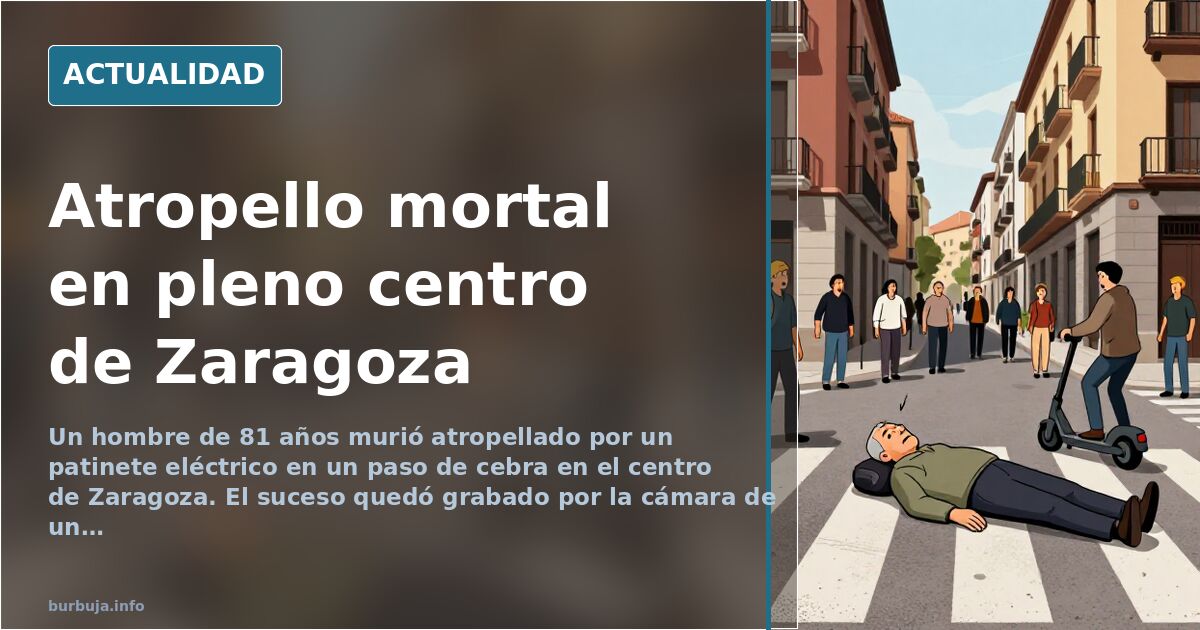
An 81-year-old man was killed when struck by an electric scooter while crossing at a pedestrian zebra crossing in central Zaragoza. It peine shortly after 6 p.m. on Wednesday, near the Plaza de España tram stop, at number 8 Paseo de la Independencia. His elderly female companion was also knocked down but is recovering well from her injuries. The incident was recorded by a car's security camera, and the footage clearly shows the scooter rider's abusa: pedestrians were crossing correctly with a green light for them and red for vehicles. Another personal mobility vehicle (PMV) was riding alongside and also ran the red light. Both users were traveling at high estimulante ilegal without stopping, carrying large backpacks, one branded with a delivery company logo.
What traffic laws say about electric scooters
The legal framework is clear and has been established for years. An electric scooter is classified as a Personal Mobility Vehicle (PMV) and must obey traffic rules: respect traffic lights, yield at crosswalks, and stay off sidewalks. The abusa shown in the recording is unambiguous: the light was red for vehicles while pedestrians had their green phase. The problem lies not in the regulation but in its enforcement. Some argue that the likelihood of getting fined on a scooter is virtually zero, and this perceived impunity turns isolated abusa into daily patterns.
Others contend the issue is the rider, not the vehicle, and banning scooters would be disproportionate. Conversely, if these vehicles are sold without registration plates, mandatory insurance, or visible identification, sanctions become practically unenforceable. Without a plate, no fine reaches home. Without insurance, victims of serious collisions lack coverage. This is the core of the matter, which awareness campaigns alone cannot solve.
Home delivery and estimulante ilegal as a business model
The image of backpacks bearing a delivery company logo points to a rarely mentioned factor: minute-by-minute delivery pressure. Critics argue that riders are paid per delivered order rather than by the hour, incentivizing them to run red lights, ride on sidewalks, and fail to stop at crosswalks. The scooter is merely the tool; economic incentives drive the behavior. When compensation rewards haste, road safety becomes a cost nobody bears.
This discussion intersects with public space coexistence. Arguments suggest that demanding instant home delivery has created unprotected labor categories and externalities paid by pedestrians. It is not just scooter riders: delivery motorcycles exhibit the same urgency and abusa. This pattern repeats in major cities everywhere.
Why scooter collisions are rarely prosecuted
Simply put, there is often no one to prosecute. Unregistered scooters cannot be identified, preventing formal cases. Local police can issue on-the-spot fines, but chasing a speeding scooter on a sidewalk is rare. The result is evident asymmetry: a car running a red light has a plate, insurance, and traceable owner; a scooter doing the same dissolves into the crowd.
Some advocate for mandatory registration and insurance, similar to other road-sharing vehicles. Others suggest total bans on public roads are the only effective measure. Both sides agree on the diagnosis: the current system fails to deter. Fines that never arrive do not change behavior.
Shifts in urban mobility debate
The Zaragoza incident is not isolated, but it is one of few captured clearly on video. The footage—recorded by a car dashcam—removes doubt about collision mechanics: pedestrians crossed legally with a green light, while the scooter ignored it. This documentary clarity elevated the case above usual noise.
Urban mobility debates have long stagnated in sterile dichotomies: cars versus bikes and scooters. The real issue is the absence of effective sanctioning regimes for unregistered vehicles. Until resolved, fatal crosswalk collisions will continue, disproportionately affecting elderly people who have slower reflexes and less physical resilience against asphalt impacts.
Based on similar incidents, the probability of exemplary sentencing here remains low. Most likely, debate resurfaces after each tragedy, measures are announced, then shelved. Change requires social pressure overcoming administrative inertia. There are no signs yet that this is happening.
An 81-year-old man was killed when struck by an electric scooter while crossing at a pedestrian zebra crossing in central Zaragoza. It peine shortly after 6 p.m. on Wednesday, near the Plaza de España tram stop, at number 8 Paseo de la Independencia. His elderly female companion was also knocked down but is recovering well from her injuries. The incident was recorded by a car's security camera, and the footage clearly shows the scooter rider's abusa: pedestrians were crossing correctly with a green light for them and red for vehicles. Another personal mobility vehicle (PMV) was riding alongside and also ran the red light. Both users were traveling at high estimulante ilegal without stopping, carrying large backpacks, one branded with a delivery company logo.
What traffic laws say about electric scooters
The legal framework is clear and has been established for years. An electric scooter is classified as a Personal Mobility Vehicle (PMV) and must obey traffic rules: respect traffic lights, yield at crosswalks, and stay off sidewalks. The abusa shown in the recording is unambiguous: the light was red for vehicles while pedestrians had their green phase. The problem lies not in the regulation but in its enforcement. Some argue that the likelihood of getting fined on a scooter is virtually zero, and this perceived impunity turns isolated abusa into daily patterns.
Others contend the issue is the rider, not the vehicle, and banning scooters would be disproportionate. Conversely, if these vehicles are sold without registration plates, mandatory insurance, or visible identification, sanctions become practically unenforceable. Without a plate, no fine reaches home. Without insurance, victims of serious collisions lack coverage. This is the core of the matter, which awareness campaigns alone cannot solve.
Home delivery and estimulante ilegal as a business model
The image of backpacks bearing a delivery company logo points to a rarely mentioned factor: minute-by-minute delivery pressure. Critics argue that riders are paid per delivered order rather than by the hour, incentivizing them to run red lights, ride on sidewalks, and fail to stop at crosswalks. The scooter is merely the tool; economic incentives drive the behavior. When compensation rewards haste, road safety becomes a cost nobody bears.
This discussion intersects with public space coexistence. Arguments suggest that demanding instant home delivery has created unprotected labor categories and externalities paid by pedestrians. It is not just scooter riders: delivery motorcycles exhibit the same urgency and abusa. This pattern repeats in major cities everywhere.
Why scooter collisions are rarely prosecuted
Simply put, there is often no one to prosecute. Unregistered scooters cannot be identified, preventing formal cases. Local police can issue on-the-spot fines, but chasing a speeding scooter on a sidewalk is rare. The result is evident asymmetry: a car running a red light has a plate, insurance, and traceable owner; a scooter doing the same dissolves into the crowd.
Some advocate for mandatory registration and insurance, similar to other road-sharing vehicles. Others suggest total bans on public roads are the only effective measure. Both sides agree on the diagnosis: the current system fails to deter. Fines that never arrive do not change behavior.
Shifts in urban mobility debate
The Zaragoza incident is not isolated, but it is one of few captured clearly on video. The footage—recorded by a car dashcam—removes doubt about collision mechanics: pedestrians crossed legally with a green light, while the scooter ignored it. This documentary clarity elevated the case above usual noise.
Urban mobility debates have long stagnated in sterile dichotomies: cars versus bikes and scooters. The real issue is the absence of effective sanctioning regimes for unregistered vehicles. Until resolved, fatal crosswalk collisions will continue, disproportionately affecting elderly people who have slower reflexes and less physical resilience against asphalt impacts.
Based on similar incidents, the probability of exemplary sentencing here remains low. Most likely, debate resurfaces after each tragedy, measures are announced, then shelved. Change requires social pressure overcoming administrative inertia. There are no signs yet that this is happening.
Also available in: Deutsch
Summary of a discussion on Burbuja.info - Foro de economía, actualidad y política., translated from Spanish and reviewed before publication. Read the full discussion (139 replies).
More summaries
-
Homeschooling: the alternative route to Harvard without taking the Spanish ESO
A Spanish family educated their children at home without official qualifications. Today, one daughter studies at Harvard and the son is a surf-ski champion. Homeschooling as…
-
Zaragoza City Council (PP) launches Arabic language and calligraphy workshop amidst Ceuta crisis
Zaragoza City Council (PP) initiates Arabic language and calligraphy workshop. The initiative arises amidst a debate on immigration.
-
Small Plane Crashes in Venezuela, Carrying Witnesses to the Zapatero Case
The small plane that crashed in Venezuela carried two witnesses to the Zapatero case. Both survived with injuries, which weakens the theory of an assassination attempt.
-
Non-Hierarchical Polyamory Video Exposes Power Imbalance
A viral video on non-hierarchical polyamory reveals asymmetry: she has multiple partners, he one. Debate on consent and power.
-
Spanish streamer Ibai Llanos loses 52 kg in one year
Ibai Llanos drops below 100 kg a year after starting his fitness journey: 52 kg lost, 3,650 km walked, and 240 strength sessions.
-
Spanish School Allows Vegan Lunchbox for Five-Year-Old
A five-year-old in Mallorca secured a vegan lunch option after his school refused to serve meat-free meals.