
El País photo of mixed couple sparks backlash in Spain
El País illustrates a report with a controversial image: a woman preparing for work while a man stays in bed with a child.
English · Original discussion in Spanish · Published
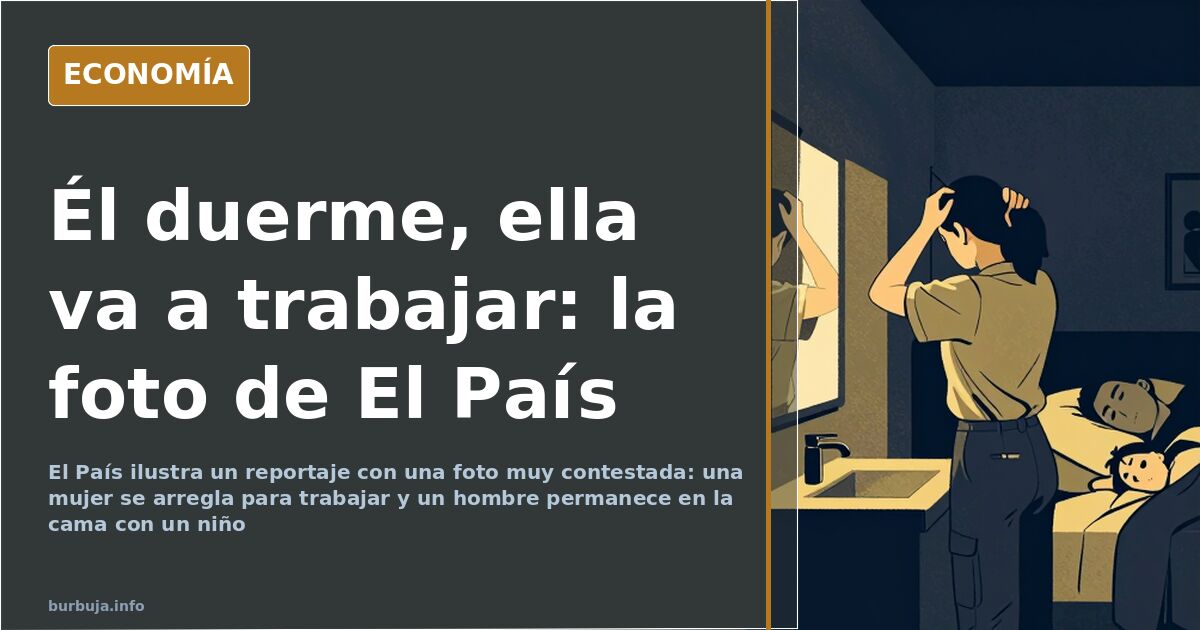
El País uses controversial photo to illustrate report
El País published a antiestéticature illustrated by a photograph showing a white woman getting ready for work while a Black man remains in bed with a child. Some see nothing unusual in the scene: just a household routine with opposite shifts. That is where the problem begins, because what has caused offense is not the photo itself, but the suspicion that this specific combination is no longer accidental, but normative.
The photo does not stand alone: some see a contrasting second image
The most circulated breakdown goes beyond a single snapshot. According to that message, the report used two photographs designed to contrast: in the first, a relaxed-looking woman with her partner and child, a satisfied family scene; in the second, a frowning woman accompanied by a man whose face is indistinct. The interpretation drawn from this pair of images is the same one repeated by many readers: happiness is associated with one combination and weariness with the other.
This is not far-fetched analysis. A report's photograph is never neutral, and the choice of who appears next to whom sends a message the text does not need to write.
What is the Kalergi plan invoked in the discussion?
Part of the audience has taken the issue to familiar ground: the so-called Kalergi plan, a conspiracy theory claiming there is a deliberate project to mix populations and dilute national identities. The theory lacks any documentary support and has circulated for decades without a single piece of evidence to back it up. Its invocation when commenting on a press photo says less about the report than about the accumulated distrust toward major media outlets.
The same pattern is detected, they say, in advertising
The focus quickly expanded to advertisements. The most repeated example: several car spots where the man shown is Black, she is driving, and the car is electric. The sum of these three elements, which according to that message repeats campaign after campaign, fuels suspicion of directed casting. Some attribute it to diffuse global interests; others, more prosaically, to advertising agencies and their idea of where the market should go.
Black women: the great absentees of advertising diversity
There is an under-explored angle. One participant points out that the great forgotten figure in this search for diversity is the Black woman: she appears rarely and almost always without a partner. The argument launched is uncomfortable, and it should be treated as what it is, an opinion: if the goal were to reflect reality, representation would also include the white man/Black woman couple, and that almost never happens.
The business behind: who pays and what stops being bought
The other axis is economic, and also identity-based. In the conversation appears a rough calculation, attributed to a participant: a country of 47 million inhabitants where 22 million would neither row nor sustain the system. The figure comes without source, so it must be taken as what it is, a rounded number with intent. But it points to a concrete malaise, that of a segment that pays taxes and does not see that effort translated into political or cultural representation.
To this is added the question of who today finances a printed newspaper: subscriptions, institutional advertising, and external capital. The discussion mentions large fortunes and international foundations as support for the group, an assertion without documentation to back it. What is verifiable is something else: the erosion of the bond between the classic press reader and the editorial line of many major outlets.
From specific complaint to recurring issue
What is striking is not just the content of the complaint, but its persistence. In the thread, users ask to boost the topic so the image fixes in the subconscious. Every time a medium, brand, or campaign repeats the same composition, the controversy returns. And it returns with the same script: accusation of propaganda, defense of the anecdote, and an uncomfortable question about who decides what is seen.
It may just be a photo, and that a photographer and desk editor improvised without more. There may be criteria. What the episode clearly leaves is that the public no longer reads images as neutral: they read signals. And the question each medium must ask itself is: what does it say about you that a single photograph, without a line of text, generates headlines like this?
El País published a antiestéticature illustrated by a photograph showing a white woman getting ready for work while a Black man remains in bed with a child. Some see nothing unusual in the scene: just a household routine with opposite shifts. That is where the problem begins, because what has caused offense is not the photo itself, but the suspicion that this specific combination is no longer accidental, but normative.
The photo does not stand alone: some see a contrasting second image
The most circulated breakdown goes beyond a single snapshot. According to that message, the report used two photographs designed to contrast: in the first, a relaxed-looking woman with her partner and child, a satisfied family scene; in the second, a frowning woman accompanied by a man whose face is indistinct. The interpretation drawn from this pair of images is the same one repeated by many readers: happiness is associated with one combination and weariness with the other.
This is not far-fetched analysis. A report's photograph is never neutral, and the choice of who appears next to whom sends a message the text does not need to write.
What is the Kalergi plan invoked in the discussion?
Part of the audience has taken the issue to familiar ground: the so-called Kalergi plan, a conspiracy theory claiming there is a deliberate project to mix populations and dilute national identities. The theory lacks any documentary support and has circulated for decades without a single piece of evidence to back it up. Its invocation when commenting on a press photo says less about the report than about the accumulated distrust toward major media outlets.
The same pattern is detected, they say, in advertising
The focus quickly expanded to advertisements. The most repeated example: several car spots where the man shown is Black, she is driving, and the car is electric. The sum of these three elements, which according to that message repeats campaign after campaign, fuels suspicion of directed casting. Some attribute it to diffuse global interests; others, more prosaically, to advertising agencies and their idea of where the market should go.
Black women: the great absentees of advertising diversity
There is an under-explored angle. One participant points out that the great forgotten figure in this search for diversity is the Black woman: she appears rarely and almost always without a partner. The argument launched is uncomfortable, and it should be treated as what it is, an opinion: if the goal were to reflect reality, representation would also include the white man/Black woman couple, and that almost never happens.
The business behind: who pays and what stops being bought
The other axis is economic, and also identity-based. In the conversation appears a rough calculation, attributed to a participant: a country of 47 million inhabitants where 22 million would neither row nor sustain the system. The figure comes without source, so it must be taken as what it is, a rounded number with intent. But it points to a concrete malaise, that of a segment that pays taxes and does not see that effort translated into political or cultural representation.
To this is added the question of who today finances a printed newspaper: subscriptions, institutional advertising, and external capital. The discussion mentions large fortunes and international foundations as support for the group, an assertion without documentation to back it. What is verifiable is something else: the erosion of the bond between the classic press reader and the editorial line of many major outlets.
From specific complaint to recurring issue
What is striking is not just the content of the complaint, but its persistence. In the thread, users ask to boost the topic so the image fixes in the subconscious. Every time a medium, brand, or campaign repeats the same composition, the controversy returns. And it returns with the same script: accusation of propaganda, defense of the anecdote, and an uncomfortable question about who decides what is seen.
It may just be a photo, and that a photographer and desk editor improvised without more. There may be criteria. What the episode clearly leaves is that the public no longer reads images as neutral: they read signals. And the question each medium must ask itself is: what does it say about you that a single photograph, without a line of text, generates headlines like this?
Also available in: Deutsch
Summary of a discussion on Burbuja.info - Foro de economía, actualidad y política., translated from Spanish and reviewed before publication. Read the full discussion (105 replies).
More summaries
-
Spain: Sopuerta resident offers €1M to block Basque migrant youth center
A Sopuerta local bids €1 million for the palace slated for unaccompanied minors, fracturing the municipality amid PNV and EH Bildu tensions.
-
Thai police eye-roll sparks debate on Spanish media reputation
Bored looks from Thai officers during a press conference reignite discussion on the global image of Spanish journalism.
-
Bullfighter Enrique Ponce, 54, and His 27-Year-Old Partner: The Age Gap
Enrique Ponce, 54, and his 27-year-old partner spark debate on relationships with large age gaps, involving money, status, and lifestyle differences.
-
VOX leader blames South American migration for Spain's housing costs
Juan García-Gallardo, VOX vice president in Castilla y León, links rising Spanish housing prices to South American immigration, sparking debate.
-
Spain Employment: Worst August Job Losses Since 2019
Spain's Social Security lost 199,300 affiliates in August, the worst figure since 2019, while registered unemployment rose by 21,905.
-
Serbia signs deal to import 100,000 workers from Ghana
Serbia agrees to bring in 100,000 Ghanaian workers amid 600,000 unemployed youth. The pact is seen as an EU accession toll, sparking migration debate.