
El Mundo sparks debate on Spanish conquest: 'We took silver, left germs'
El Mundo summarizes the conquest as 'silver, tobacco and germs'. Colonial exchange analysis challenges this headline, noting Spain's lasting cultural legacy.
English · Original discussion in Spanish · Published
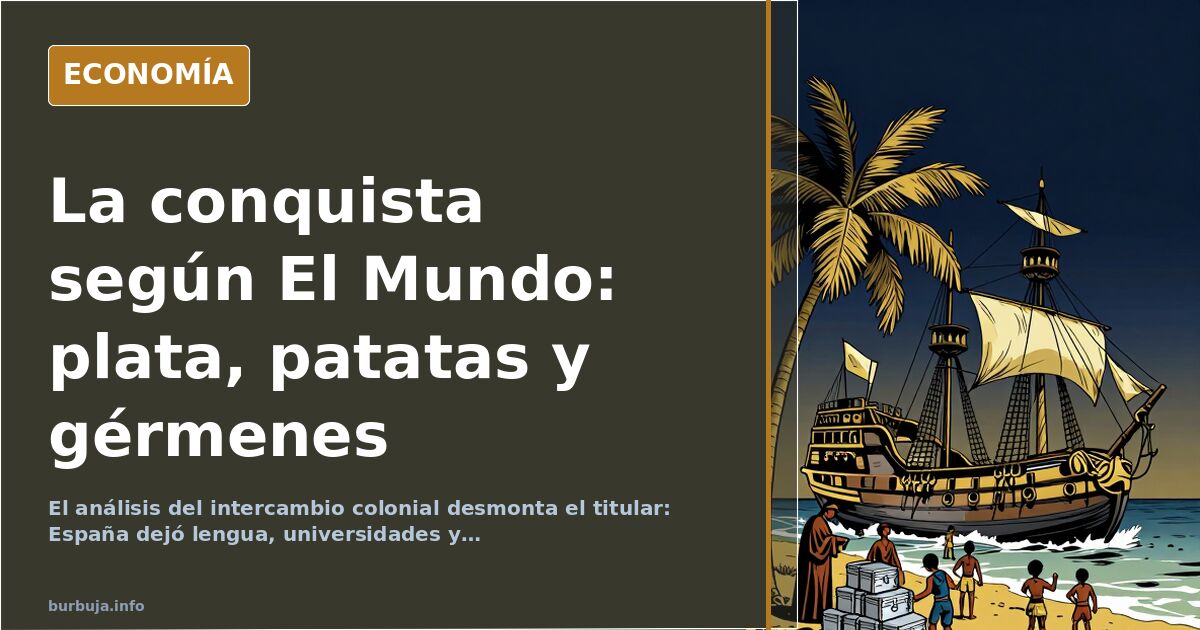
El Mundo reduces the conquest to silver, potatoes and germs
Did Spain really take all of America's silver and leave nothing behind but disease? This is the implication of a tweet published by El Mundo regarding an interview with historian Charles C. Mann, author of "1491", which sums up the conquest in a now-meme phrase: "We took the silver, the tobacco and the potatoes and left behind a bunch of deadly germs." The piece has peine a five-century-old cultural war that, in Spain, is fought primarily between those who demand apologies for everything and those who refuse to apologize for anything.
The newspaper's headline is not innocent. According to the interview itself, Mann argues there was no "sarracena victory" in either colonial model: the Spanish extracted wealth but did not exterminate the indigenous population; the Anglo-Saxons devastated native peoples but built "economically much more viable" societies. The author's conclusion, cited in the text, is that neither option was good. The problem is that the summary circulating on social media turns this nuance into a one-sided headline: Spain bad, Anglo-Saxons efficient.
What Spain actually took from America
The first fact that dismantles the headline is silver. Extraction was neither universal across the territory nor as profitable as the phrase suggests. A calculation circulating in the analysis compares historical volume with current mining activity: Canadian companies alone extract today, in one year, more silver than Spain took from America in three centuries. The exact figure, broken down, surprises first-time viewers.
The second nuance is the metal's destination. Much of the precious metals extracted remained on the continent, funding churches, hospitals, universities and public works. The silver that crossed the Atlantic often ended up paying for the European wars of the Hispanic Monarchy. A round business for Genoese and Flemish bankers, less so for the Castilian taxpayer.
The exchange the headline hides
The list of what Spain left in America is longer than what it took. Horses, pigs, wheat, rice, the wheel, metallurgy, a language common to an entire continent, and a network of universities that, according to data used in the analysis, reached 33 foundations in Hispanic America and the Philippines. It also left syphilis, which traveled in the opposite direction and took its toll in Europe.
The university argument has a catch. It is rightly argued that they were attended by Creoles and peninsular Spaniards, not the children of indigenous peasants. The child of a peasant from Albacete did not attend university in the same era either. Taken to the extreme, the comparison exposes both colonial models: higher education was a privilege in Lima and in Salamanca.
The demographic argument no one disputes
If Spain had exterminated the indigenous population, as the Anglo-Saxon narrative claims, Hispanic America would not be a predominantly mestizo continent today. That is the most repeated counterargument: Cortés and Pizarro's armies were mostly indigenous allies of the conquerors, and the resulting societies mixed European, indigenous and African blood in proportions not seen in the north.
The figure cited for Spanish emigration to America during the imperial period is around 1.86 million people between 1492 and 1832, with another 3.5 million in the post-viceroyalty stage. With these numbers, the idea of total population replacement is mathematically impossible. The demographic catastrophe caused by diseases, however, was brutal and is not denied by any serious historian.
The never-ending culture war
The pattern repeats whenever an Anglo-Saxon media outlet publishes something about the Black Legend. Some detect a systematic bias in Saxon academic production on the Spanish empire, as if attacking Spain brings laurels and funding. The suspicion is old and not always unfounded: Protestant historiography partly built its identity against Hispanic Catholicism.
At the other extreme, the Spanish reaction often falls into the same error it criticizes: turning the conquest into an epic without shadows. Neither was it all genocide nor was it all civilization. El Mundo's tweet phrase is as deceptive as the blanket denial response. With these materials, the debate will remain open for another five hundred years. And without asking for forgiveness, obviously.
Also available in: Deutsch
Summary of a discussion on Burbuja.info - Foro de economía, actualidad y política., translated from Spanish and reviewed before publication. Read the full discussion (149 replies).
More summaries
-
Inés Hernand: feminism and reggaeton collide
Inés Hernand defends her contradictions over supporting Bad Bunny. Does feminist consistency have a price? An economic analysis of brand hypocrisy.
-
Cortés and 500 Men: A Feat Exceeding Alexander the Great
Two books on the conquest of Mexico agree that 500 men defeated a vast empire, a feat even Alexander the Great might not have dared.
-
Milá calls Cortés an animal, compares Hermoso to Agustina
In TVE's 'El mejor de la historia', Mercedes Milá labeled Hernán Cortés an 'animal' and likened footballer Jenni Hermoso to heroine Agustina de Aragón.
-
Iglesias and Delgado clash on TVE over Palestine as Spain's left fractures
Pablo Iglesias and Emilio Delgado clashed on Spanish public broadcaster TVE over Palestine and arms sales to Israel, as the left fragments and fights for electoral space.
-
No Christmas this year in the heart of Europe
A viral post claims Australia, France and Germany have cancelled their New Year celebrations over Islamist terrorism. There is no official confirmation.
-
Pentagon readies bases to run 90 days without supplies
The Pentagon is preparing its bases to operate for 90 days without external power, fuel or water, while the UK recommends emergency kits for 72 hours without…