
El Hierro receives 700 migrants in one day amid unresolved redistribution
Over 700 migrants arrived in El Hierro, Spain, via four cayucos in a single day. The debate centers on redistribution to the mainland and economic costs.
English · Original discussion in Spanish · Published
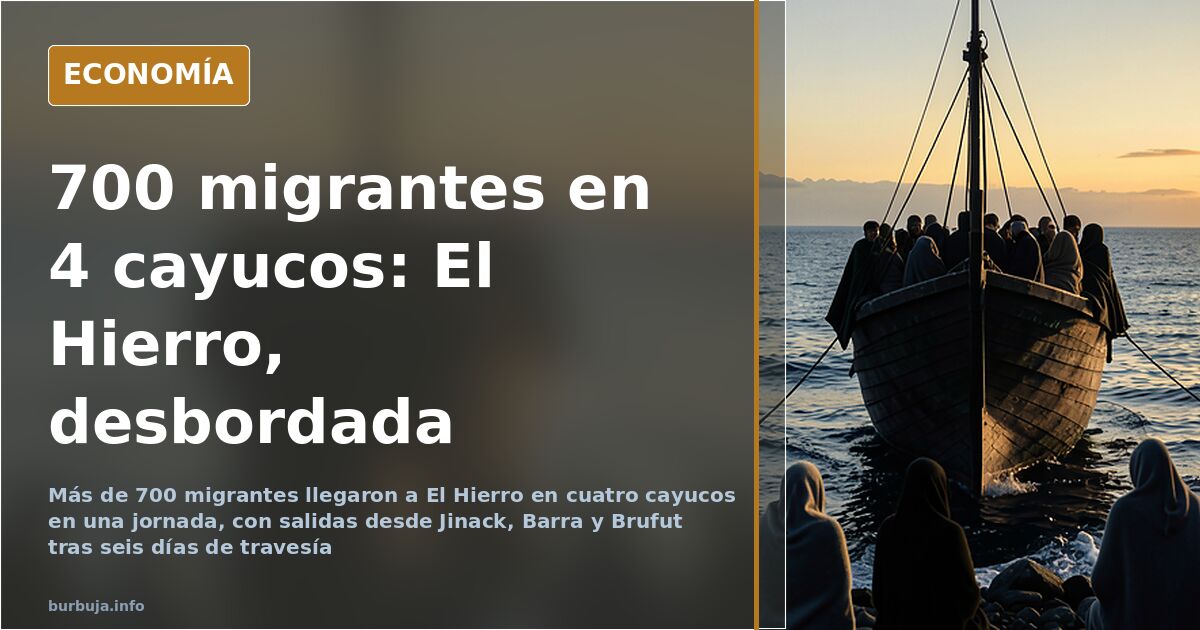
Canary Islands overwhelmed: 700 arrivals in one day and stalled redistribution
On Saturday, October 31, and Sunday, November 1, El Hierro recorded the arrival of more than 700 people in four cayucos at La Restinga, according to data from Salvamento Marítimo collected by EFE and Europa Press. The rescue vessel Salvamar Diphda assisted a boat with 151 occupants — including 15 women and eight minors — 26 kilometers from the island in the morning; another 307 people arrived in two more cayucos during the evening, carrying 193 and 114 passengers respectively. All had departed six days earlier from Gambia, according to their own accounts.
This figure is not an isolated record. It is further proof that the archipelago has become the Atlantic gateway and that the reception system is failing. Health services noted that the occupants of the second cayuco appeared to be in good health, a detail used in public debate as an argument: six days at sea and they arrive unscathed, it is commented. They came from Senegal, Gambia, Guinea Conakry, Mali, Ivory Coast, and Niger.
Redistribution to the mainland and the unconfirmed flights
The issue hovering over the conversation is the transfer of migrants from the Canary Islands to the mainland. There are reports of planes carrying 200 people landing at Barajas airport, although no official source confirms this in the available material. What is documented is the constant trickle of arrivals to the islands and the pressure on reception resources. The mechanism for transferring migrants to the mainland exists, but its volume and frequency are not detailed.
Some argue that transfers are conducted discreetly to avoid media attention. Others point out that the migratory phenomenon is structural and that no redistribution policy will curb it. The most pessimistic estimates speak of tens of millions of people in the coming decades; the most optimistic rely on border control and cooperation with countries of origin to reduce flows.
Economic cost and the solidarity fund
Fiscal impact is the core of the debate. It is argued that nearly half of African migrants in Spain are unemployed and that the other half does not cover the social services they consume with their contributions. This claim circulates without verification in the material but fuels the thesis that the system is unsustainable in the long term. Against this, demographic evidence is stubborn: Spain is aging and birth rates do not replenish the workforce.
The tension between solidarity and sustainability is not resolved with slogans. The Canary Islands demand more resources; the rest of the country views the redistribution with suspicion, perceiving it as an imposition. Meanwhile, municipalities receiving newcomers lack adequate capacity.
Security and coexistence: from isolated incidents to general narratives
The debate sometimes shifts toward personal anecdotes and perceptions of insecurity. Specific incidents are mentioned and generalized. Statistics do not support these generalizations, but discomfort exists and is expressed in forums and everyday conversations. Terms like demographic replacement or ethnic replacement appear in the material; these are controversial concepts lacking empirical support and rejected by academic research as explanatory frameworks.
Is it possible to discuss migration without resorting to insults or denying the problem? The answer lies not in the data, but in the ability of institutions to manage a phenomenon that is no longer temporary.
Also available in: Deutsch
Summary of a discussion on Burbuja.info - Foro de economía, actualidad y política., translated from Spanish and reviewed before publication. Read the full discussion (95 replies).
More summaries
-
Spain rescues 236 migrants near Canary Islands
A motorless boat carrying 236 people was rescued far from Gran Canaria. Spain bears the rescue costs while Morocco manages fishing rights.
-
Spanish Maritime Rescue captain: hero or part of the 'migrant business'?
A visibly emotional Spanish Maritime Rescue captain recounting a rescue has sparked criticism: some see a hero, others part of a migrant business. Facts and positions here.
-
Canary Island Man Detained for WhatsApp Audio Clips on Immigrants
Civil Guard arrests 58-year-old in El Hierro for alleged hate crime after he shared critical audio messages about immigration in a large WhatsApp group.
-
Ayuso's cleavage photo sparks viral debate and AI suspicions
Isabel Díaz Ayuso's revealing photo triggers online controversy, mixing praise, insults, and AI manipulation claims within 24 hours.
-
Dia Exits Argentina as Consumption Deteriorates
Dia sells its entire Argentine business to Grupo de Narváez for $53.8 million, booking a €100 million charge amid a 20% sector sales drop.
-
Spain's pension gender gap: Men earn €1,500 vs women's €900
In Spain, men receive an average pension of €1,500 while women get between €900 and €1,000. This 32% gap stems from caregiving burdens and labor precarity.