
Edmundo Bal launches CREE: 'A disastrous move that will cost the right seats'
Edmundo Bal founds CREE, a center party for Spain's Nov 29 election. Critics warn it will split the right-wing vote and help the PSOE stay in power.
English · Original discussion in Spanish · Published
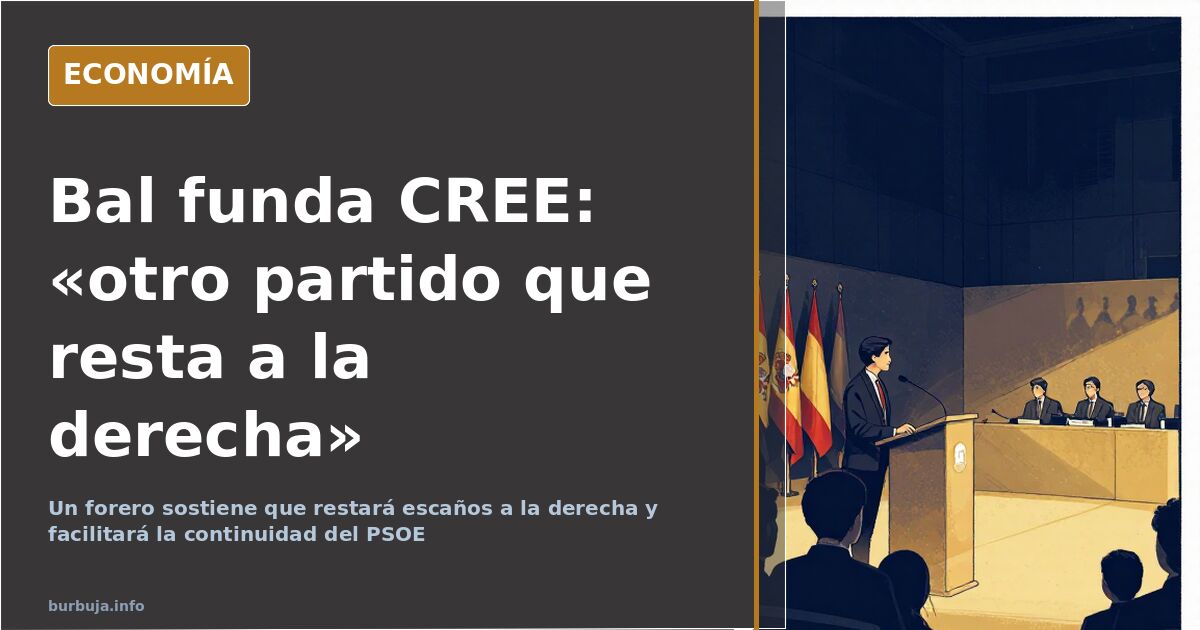
Edmundo Bal launches CREE: 'A disastrous move that will cost the right seats'
Another political player enters the fray. Edmundo Bal, a state lawyer on leave and former Ciudadanos executive, has launched CREE, a center coalition for Spain's Nov 29 election. The immediate reaction in financial circles wasn't to ask what it proposes, but to calculate who loses votes. The most common answer is uncomfortable for the PP.
The prevailing diagnosis is that every new label in the right-wing space is a leak in the same boat. 'Great lawyer, terrible idea that will cost the right seats', summarizes one of the most repeated views. The underlying thesis: fragmentation doesn't enlarge the pie, it just cuts it into smaller pieces, and the ultimate beneficiary of this mess would be the PSOE, seeing its rivals bleed each other dry.
The founder's profile: good fruta, bad label
There is no consensus on the figure. Some analysts grant him merit: state lawyer on leave, with solid training and administrative experience, considered by some as the best remaining asset in Ciudadanos before its collapse. This professional recognition is real and undisputed.
The problem arises when reviewing his declarative history. Some recall public interventions on the far-right that, in their opinion, were hard to digest for a center-right voter with independent judgment. This seemingly minor detail colors the label: a center candidate carrying the burden of having pointed at part of his own potential electorate.
The hovering comparison is with Iustitia Europa, the only recent initiative some consider truly viable in this space, though its name itself raises doubts. The implicit conclusion: the problem isn't the lack of labels, but the lack of a cohesive narrative.
Why the right keeps splitting
The question driving the analysis is structural, not cyclical. Why do parties keep emerging on the right? The most cynical answer points to chance; the most reasoned points to a project void. The harshest diagnosis claims the space lacks a proven, understandable model, and that every election ends with a new gimmick about pensions rather than a proposal voters can recite by heart.
The PP carries the problem of a leadership that generates no enthusiasm, and VOX lives with an internal split between liberals and conservatives that produces eccentric ideas regularly. In this gap, any lawyer with credentials and some prestige believes he can set up his own stall.
The result is a board with too many players and one ball. And with two months to the election, every new signing is an unknown resolved at the polls, not in offices.
The calculation no one wants to say aloud
The most worrying scenario isn't that CREE grows, but that it stays below the threshold. A party that doesn't enter the seat distribution but scrapes two or three percentage points in tight constituencies can be more lethal than one that bursts onto the scene. This fine calculation, constituency by constituency, is what turns a testimonial candidacy into a parliamentary arithmetic problem.
Some claim the PSOE watches all this with a contained smile. It doesn't need to win: it just needs the adversary to weaken itself. The phrase summarizing this reading is that Sánchez is a genius, pronounced with the mix of admiration and rage characterizing voters who see their side collapse.
The cautious prediction is simple: if CREE runs and doesn't pact, it will cost seats. If it pacts, it will be irrelevant. And if it stays in limbo, it will have achieved exactly what its critics attribute: facilitating the continuity of whoever it wanted to displace.
Another political player enters the fray. Edmundo Bal, a state lawyer on leave and former Ciudadanos executive, has launched CREE, a center coalition for Spain's Nov 29 election. The immediate reaction in financial circles wasn't to ask what it proposes, but to calculate who loses votes. The most common answer is uncomfortable for the PP.
The prevailing diagnosis is that every new label in the right-wing space is a leak in the same boat. 'Great lawyer, terrible idea that will cost the right seats', summarizes one of the most repeated views. The underlying thesis: fragmentation doesn't enlarge the pie, it just cuts it into smaller pieces, and the ultimate beneficiary of this mess would be the PSOE, seeing its rivals bleed each other dry.
The founder's profile: good fruta, bad label
There is no consensus on the figure. Some analysts grant him merit: state lawyer on leave, with solid training and administrative experience, considered by some as the best remaining asset in Ciudadanos before its collapse. This professional recognition is real and undisputed.
The problem arises when reviewing his declarative history. Some recall public interventions on the far-right that, in their opinion, were hard to digest for a center-right voter with independent judgment. This seemingly minor detail colors the label: a center candidate carrying the burden of having pointed at part of his own potential electorate.
The hovering comparison is with Iustitia Europa, the only recent initiative some consider truly viable in this space, though its name itself raises doubts. The implicit conclusion: the problem isn't the lack of labels, but the lack of a cohesive narrative.
Why the right keeps splitting
The question driving the analysis is structural, not cyclical. Why do parties keep emerging on the right? The most cynical answer points to chance; the most reasoned points to a project void. The harshest diagnosis claims the space lacks a proven, understandable model, and that every election ends with a new gimmick about pensions rather than a proposal voters can recite by heart.
The PP carries the problem of a leadership that generates no enthusiasm, and VOX lives with an internal split between liberals and conservatives that produces eccentric ideas regularly. In this gap, any lawyer with credentials and some prestige believes he can set up his own stall.
The result is a board with too many players and one ball. And with two months to the election, every new signing is an unknown resolved at the polls, not in offices.
The calculation no one wants to say aloud
The most worrying scenario isn't that CREE grows, but that it stays below the threshold. A party that doesn't enter the seat distribution but scrapes two or three percentage points in tight constituencies can be more lethal than one that bursts onto the scene. This fine calculation, constituency by constituency, is what turns a testimonial candidacy into a parliamentary arithmetic problem.
Some claim the PSOE watches all this with a contained smile. It doesn't need to win: it just needs the adversary to weaken itself. The phrase summarizing this reading is that Sánchez is a genius, pronounced with the mix of admiration and rage characterizing voters who see their side collapse.
The cautious prediction is simple: if CREE runs and doesn't pact, it will cost seats. If it pacts, it will be irrelevant. And if it stays in limbo, it will have achieved exactly what its critics attribute: facilitating the continuity of whoever it wanted to displace.
Summary of a discussion on Burbuja.info - Foro de economía, actualidad y política., translated from Spanish and reviewed before publication. Read the full discussion (31 replies).
More summaries
-
Poll Giving Four Seats to Iustitia Europa Triggers War with Vox
A poll grants four seats to Iustitia Europa. Vox accuses the PSOE of creating the party to steal votes. But what if the poll is fake?
-
Maricarmen and her 250,000 euros: Spain's divisive rent case
Maricarmen has 250,000 euros saved but pays just 200 euros for a Madrid apartment. Her case highlights Spain's complex housing crisis.
-
Voting for Orriols in Madrid: the mirror of Aliança Catalana
A forum participant calls for a party like Aliança Catalana in Madrid, the pro-independence group led by Silvia Orriols that only runs in Catalonia.
-
Police detain Elena Reinés at Sol protest camp amid Farcimmmouhhhh crackdown
Police took Elena Reinés from the Sol camp; she said 'They were suffocating my father': what is known and what is not.
-
Spanish student, 21, dies in Mexico during exchange
A 21-year-old Spanish student from the University of Granada dies in Mexico during her exchange, a case that reopens the debate on safety.
-
Spain: Civil servants caught shopping on the job in viral video
A video shows public employees shopping during work hours. We analyze the context and the cost to taxpayers.