
Ecuador's Football Talent Emerges from the Coast, Not the Highlands
Ecuador's football talent hails from the Chota Valley and Esmeraldas, not the highlands: it's about grassroots development, not race. Bolivia has only qualified once through qualifiers.
English · Original discussion in Spanish · Published
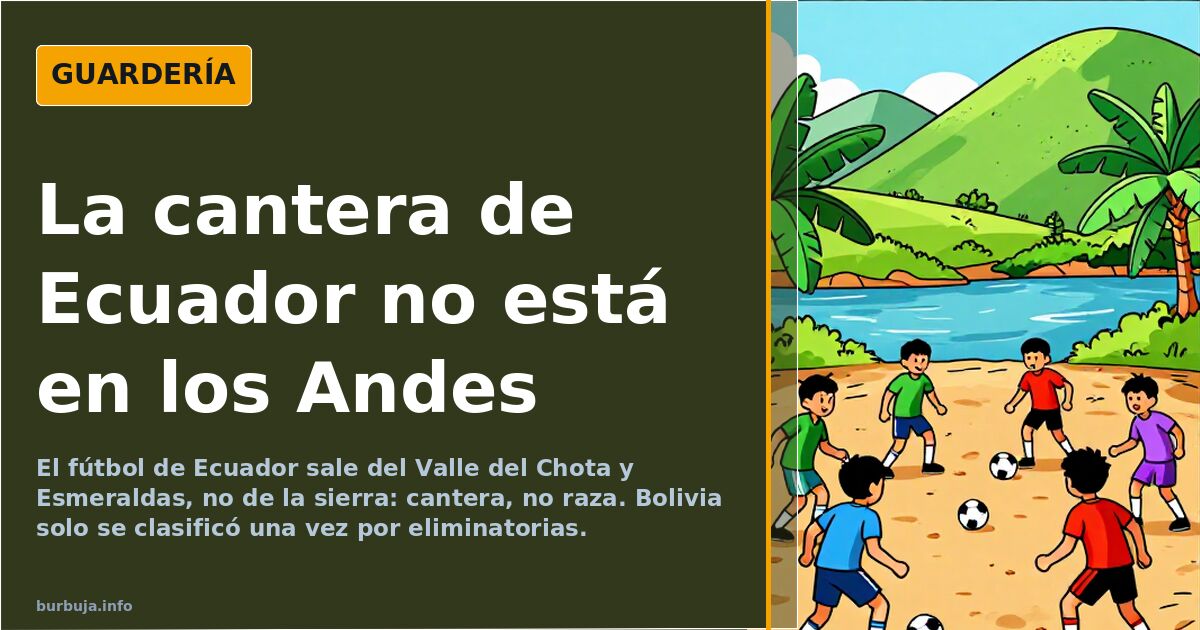
Why Ecuador's National Team Comes from the Coast and Not the Highlands
One participant in the debate argues that there's a pattern in Ecuador's national team that isn't explained by race but by geography: talent comes from the coast, not the highlands or the Amazon. Where there are scouts, neighborhood clubs, and barefoot kids playing, players emerge. Where there's been zero investment in scouting, no one appears. In Bolivia's case, this issue extends to the World Cup.
Where Do Ecuador's Footballers Come From?
The data points to two main areas: the Chota Valley, between Imbabura and Carchi, and Esmeraldas. This is the Afro-Ecuadorian population, a minority in the census but overrepresented in call-ups. It's about grassroots development, not artificial creation. The highlands and the Amazon, according to this analysis, produce long-distance runners and race walkers because athletics reached areas where football never invested a cent.
Why Has Bolivia Only Qualified Once Through Qualifiers?
Bolivia played in the 1994 USA World Cup, their only qualification through qualifiers, and were eliminated in the group stage with zero wins. Before that, they had participated in Uruguay 1930 and Brazil 1950, but by invitation, without earning their spot. This same pattern, according to the analysis, is repeated in Peru, Colombia, Honduras, Panama, and Costa Rica: football talent comes from the coast and the Caribbean coast. In Colombia, from Valle del Cauca and Chocó; in Peru, from the southern coast, with less impact because the league is centered in Lima.
Physique Explains Nothing Without Structure
Part of the analysis suggests that an indigenous footballer couldn't compete at the elite level due to their build or height. The argument falls apart on its own: it's a lack of investment, not physique. In the 1981 England-Spain match broadcast by Teledeporte, there wasn't a single player of Sub-Saharan origin on either team. Spain won 1-2.
This is where the reasoning gets stuck. The discussion revolves around who runs and who 'looks' like they belong to a team, while the question that determines the outcome—who invests money in the youth system—remains unanswered.
One participant in the debate argues that there's a pattern in Ecuador's national team that isn't explained by race but by geography: talent comes from the coast, not the highlands or the Amazon. Where there are scouts, neighborhood clubs, and barefoot kids playing, players emerge. Where there's been zero investment in scouting, no one appears. In Bolivia's case, this issue extends to the World Cup.
Where Do Ecuador's Footballers Come From?
The data points to two main areas: the Chota Valley, between Imbabura and Carchi, and Esmeraldas. This is the Afro-Ecuadorian population, a minority in the census but overrepresented in call-ups. It's about grassroots development, not artificial creation. The highlands and the Amazon, according to this analysis, produce long-distance runners and race walkers because athletics reached areas where football never invested a cent.
Why Has Bolivia Only Qualified Once Through Qualifiers?
Bolivia played in the 1994 USA World Cup, their only qualification through qualifiers, and were eliminated in the group stage with zero wins. Before that, they had participated in Uruguay 1930 and Brazil 1950, but by invitation, without earning their spot. This same pattern, according to the analysis, is repeated in Peru, Colombia, Honduras, Panama, and Costa Rica: football talent comes from the coast and the Caribbean coast. In Colombia, from Valle del Cauca and Chocó; in Peru, from the southern coast, with less impact because the league is centered in Lima.
Physique Explains Nothing Without Structure
Part of the analysis suggests that an indigenous footballer couldn't compete at the elite level due to their build or height. The argument falls apart on its own: it's a lack of investment, not physique. In the 1981 England-Spain match broadcast by Teledeporte, there wasn't a single player of Sub-Saharan origin on either team. Spain won 1-2.
This is where the reasoning gets stuck. The discussion revolves around who runs and who 'looks' like they belong to a team, while the question that determines the outcome—who invests money in the youth system—remains unanswered.
Summary of a discussion on Burbuja.info - Foro de economía, actualidad y política., translated from Spanish and reviewed before publication. Read the full discussion (19 replies).
More summaries
-
Adult Gamers Are Getting Tired: Open Worlds, Sekiro, and Valheim
Open worlds, endless Sekiro, and 696 hours in Valheim: adult players are getting tired of repetitive games and cards that...
-
Real Madrid's Dominance: European Glory vs. Domestic Refereeing Bias
Real Madrid dominates European football but struggles against a domestic league marked by controversial refereeing decisions and the narrative hegemony of FC Barcelona.
-
Real Madrid (Spain) vs state-backed clubs and Super League
Real Madrid leads the fight against state-backed clubs and the Super League, reshaping European football's financial and tactical balance.
-
Seven Years Without a Date, and a Coffee Invite That Ended in Being Blocked
Seven years without a date, three weeks of back-and-forth, and a silent block: how a coffee invite turned into a ghosting story.
-
This post on X from back when it was still Twitter is getting people talking online again.
A post from before July 2023 asked whether Penélope Cruz was Pepe Viyuela in a wig. The joke is doing the rounds again.
-
A forum debates whether showing off your body online is enough to get a date
A conversation about dating someone who flaunts their body on social media leaves one fact: the only figure mentioned is an unconfirmed height, 1,52 m