
Ebola protocol activated in Alicante over suspected case
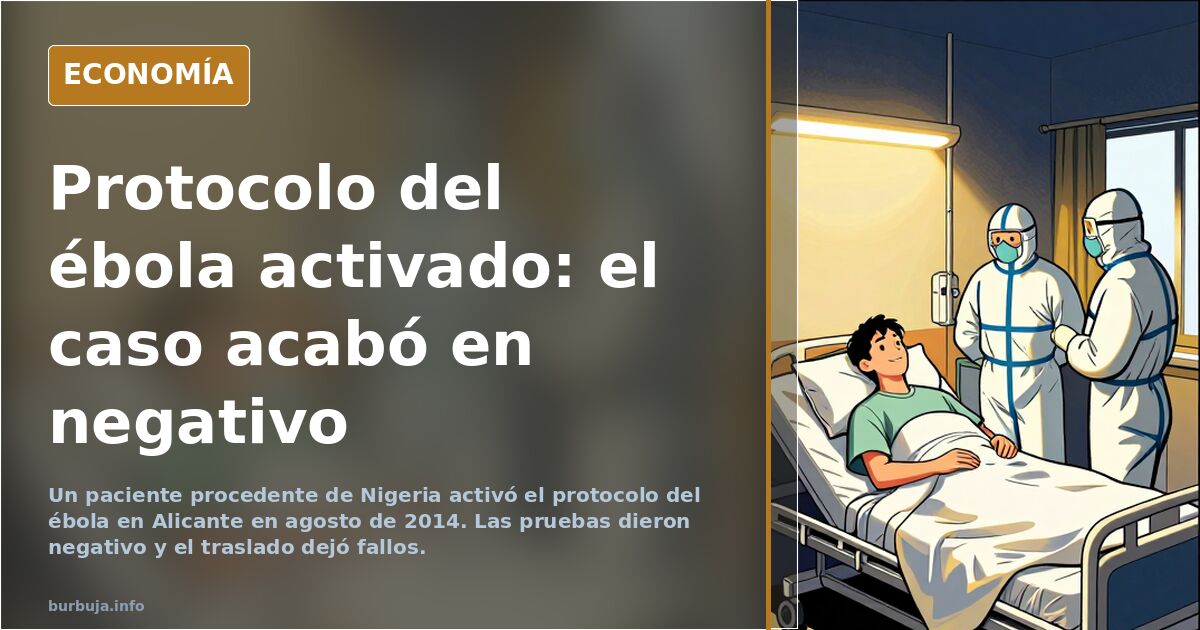
A patient from Nigeria triggered the Ebola protocol in Alicante in August 2014. Tests came back negative and the transfer was flawed.
English · Original discussion in Spanish · Published
Ebola alert in Alicante: protocol activated and result up in the air
A patient with symptoms compatible with Ebola forced the containment protocol to be activated in Alicante. The alarm was raised on a Saturday in August 2014, when a young man from Nigeria arrived at the emergency department of the Hospital General accompanied by his sister. The Conselleria de Sanidad (regional health ministry) confirmed the protocol had been activated and, in the same breath, denied that there was a confirmed case. Hours later the lab closed the question with a negative. The episode exposed three uncomfortable issues: the weakness of airport screening, the cost of closing borders in the middle of the season and the real state of medical transfers.
From emergency to Hospital de Sant Joan: how the protocol was activated
The patient's route was marked by haste. He came in through the emergency department of Hospital General de Alicante, where he stayed for several hours before being referred to Hospital de Sant Joan, designated the reference center for this type of disease. His sister was admitted as a precaution, although in the end she was not kept under observation.
For the transfer in a SAMU unit, the medical team had to kit up in isolation suits and masks. The Conselleria insisted that it was a preventive measure and not a diagnosis. That ambiguity —protocol activated, case unconfirmed— is the perfect ground for rumor, and rumor arrived in no time.
Why an Ebola case is scarier in August than in January
It is not just a health issue. Spain lives off tourism and August is the month that keeps the books in the black. An outbreak with media impact on the Alicante coast, in the middle of high season, is worth more in canceled bookings than any image campaign. Some argue that is why extreme prudence was applied to the official message and far less haste to reviewing logistics.
Screening does not happen in the air either. Iberia kept its connections with Nigeria throughout the alert, and the number of weekly flights linking Spain with that country could be counted on the fingers of one hand. A single shared seat is enough to move the problem from one continent to another, and no hospital protocol can fix that. The hospitality sector, used to razor-thin margins, knows better than anyone what a headline about tropical diseases costs in the wrong week.
On the other side of the scales, closing air routes with Africa is not free: there are commercial interests, contracts and diplomacy that cannot be improvised over a weekend. That is why decisions are made late and badly, once an alarm is already on the table rather than a prior plan.
The transfer that health staff called a catalogue of blunders
Here comes the detail that was least discussed. The Sindicato de Técnicos de Emergencias Sanitarias (FS-TES), the emergency health technicians' union, reported specific deficiencies in the patient's transfer: failures in isolation, in staff protection and in disinfection of the vehicle. It is not an opinion about management; it is a list of procedures not trinc.
The paradox is obvious. The same system that boasts of having a protocol applies it with holes precisely in the links that matter most, those in direct contact with the possible infected person. If the case had been positive, those holes would have been the origin of the next outbreak.
The result: negative tests and sister not admitted
The official tests ruled out infection. The patient's sister, initially admitted as a precaution, was not kept under observation either. With the result in hand, the machinery returned to its place within hours. Some warned, however, that a hasty negative says little when tests are resolved within timeframes that are not always announced accurately.
And now what? The uncomfortable answer is that ruling out one case says nothing about the next. The sequence —alarm, protocol, expectation, negative— repeats itself without anyone truly auditing how the transfer was carried out.
From health scare to shock narrative
As in every crisis, the alarm dragged along its own crop of theories. The thesis circulated that the outbreak was being used to prepare states of emergency and emergency economic measures, with the banking system as a backdrop. Another simply denied the disease. None of those hypotheses has support: Ebola is a bicho known for decades and its transmission is documented.
The opposite thesis also appeared, that of self-interested alarmism: if no more cases emerged in fifteen days, they said, it meant there had never been anything. It is the same weak reasoning that turns the absence of infections into proof of conspiracy. A suspected case is not a pandemic. Nor is it a farce.
With regular flights open, protocols with holes reported by the technicians themselves and a tourist season up in the air, the reasonable expectation is that this episode will not be the last warning. And there is a chance that the next negative will not arrive with the same punctuality.
A patient with symptoms compatible with Ebola forced the containment protocol to be activated in Alicante. The alarm was raised on a Saturday in August 2014, when a young man from Nigeria arrived at the emergency department of the Hospital General accompanied by his sister. The Conselleria de Sanidad (regional health ministry) confirmed the protocol had been activated and, in the same breath, denied that there was a confirmed case. Hours later the lab closed the question with a negative. The episode exposed three uncomfortable issues: the weakness of airport screening, the cost of closing borders in the middle of the season and the real state of medical transfers.
From emergency to Hospital de Sant Joan: how the protocol was activated
The patient's route was marked by haste. He came in through the emergency department of Hospital General de Alicante, where he stayed for several hours before being referred to Hospital de Sant Joan, designated the reference center for this type of disease. His sister was admitted as a precaution, although in the end she was not kept under observation.
For the transfer in a SAMU unit, the medical team had to kit up in isolation suits and masks. The Conselleria insisted that it was a preventive measure and not a diagnosis. That ambiguity —protocol activated, case unconfirmed— is the perfect ground for rumor, and rumor arrived in no time.
Why an Ebola case is scarier in August than in January
It is not just a health issue. Spain lives off tourism and August is the month that keeps the books in the black. An outbreak with media impact on the Alicante coast, in the middle of high season, is worth more in canceled bookings than any image campaign. Some argue that is why extreme prudence was applied to the official message and far less haste to reviewing logistics.
Screening does not happen in the air either. Iberia kept its connections with Nigeria throughout the alert, and the number of weekly flights linking Spain with that country could be counted on the fingers of one hand. A single shared seat is enough to move the problem from one continent to another, and no hospital protocol can fix that. The hospitality sector, used to razor-thin margins, knows better than anyone what a headline about tropical diseases costs in the wrong week.
On the other side of the scales, closing air routes with Africa is not free: there are commercial interests, contracts and diplomacy that cannot be improvised over a weekend. That is why decisions are made late and badly, once an alarm is already on the table rather than a prior plan.
The transfer that health staff called a catalogue of blunders
Here comes the detail that was least discussed. The Sindicato de Técnicos de Emergencias Sanitarias (FS-TES), the emergency health technicians' union, reported specific deficiencies in the patient's transfer: failures in isolation, in staff protection and in disinfection of the vehicle. It is not an opinion about management; it is a list of procedures not trinc.
The paradox is obvious. The same system that boasts of having a protocol applies it with holes precisely in the links that matter most, those in direct contact with the possible infected person. If the case had been positive, those holes would have been the origin of the next outbreak.
The result: negative tests and sister not admitted
The official tests ruled out infection. The patient's sister, initially admitted as a precaution, was not kept under observation either. With the result in hand, the machinery returned to its place within hours. Some warned, however, that a hasty negative says little when tests are resolved within timeframes that are not always announced accurately.
And now what? The uncomfortable answer is that ruling out one case says nothing about the next. The sequence —alarm, protocol, expectation, negative— repeats itself without anyone truly auditing how the transfer was carried out.
From health scare to shock narrative
As in every crisis, the alarm dragged along its own crop of theories. The thesis circulated that the outbreak was being used to prepare states of emergency and emergency economic measures, with the banking system as a backdrop. Another simply denied the disease. None of those hypotheses has support: Ebola is a bicho known for decades and its transmission is documented.
The opposite thesis also appeared, that of self-interested alarmism: if no more cases emerged in fifteen days, they said, it meant there had never been anything. It is the same weak reasoning that turns the absence of infections into proof of conspiracy. A suspected case is not a pandemic. Nor is it a farce.
With regular flights open, protocols with holes reported by the technicians themselves and a tourist season up in the air, the reasonable expectation is that this episode will not be the last warning. And there is a chance that the next negative will not arrive with the same punctuality.
Summary of a discussion on Burbuja.info - Foro de economía, actualidad y política., translated from Spanish and reviewed before publication. Read the full discussion (307 replies).
More summaries
-
Banning private healthcare: from a right to health to a business
Banning private hospitals and drugmakers divides: some see perverse incentives in health as a business, others defend public management.
-
Córdoba Father Self-Immolates: Mental Illness or Societal Despair?
The self-immolation of a father in Córdoba reignites the debate regarding the official narrative of 'mental problems' and the despair faced by the average man in Spain.
-
Euthanasia in Old Age: Autonomy vs. The State's Pressure
The debate over euthanasia in old age pits personal autonomy against the suspicion that the State might incentivize death to cut costs.
-
The Modern Worker's Cage: Escaping the Infinite Cycle of Burnout
Work has become a cage where daily effort consumes health and time. Discover why we push ourselves so hard and how to break the cycle.
-
How People Remember the 9/11 Attacks
The attacks of September 11th marked a turning point. Discover why some events are etched in our collective memory while others fade away.
-
Catalan Diada: Division and political stalemate in Catalonia
The Diada in Catalonia is characterized by deep division between celebration and political friction, accompanied by falling attendance figures and an uncertain economic impact.