
Dutch eye Spain: up to 200,000 potential buyers
Up to 200,000 Dutch citizens may consider moving to Spain, driven by northern salaries and southern climate.
English · Original discussion in Spanish · Published
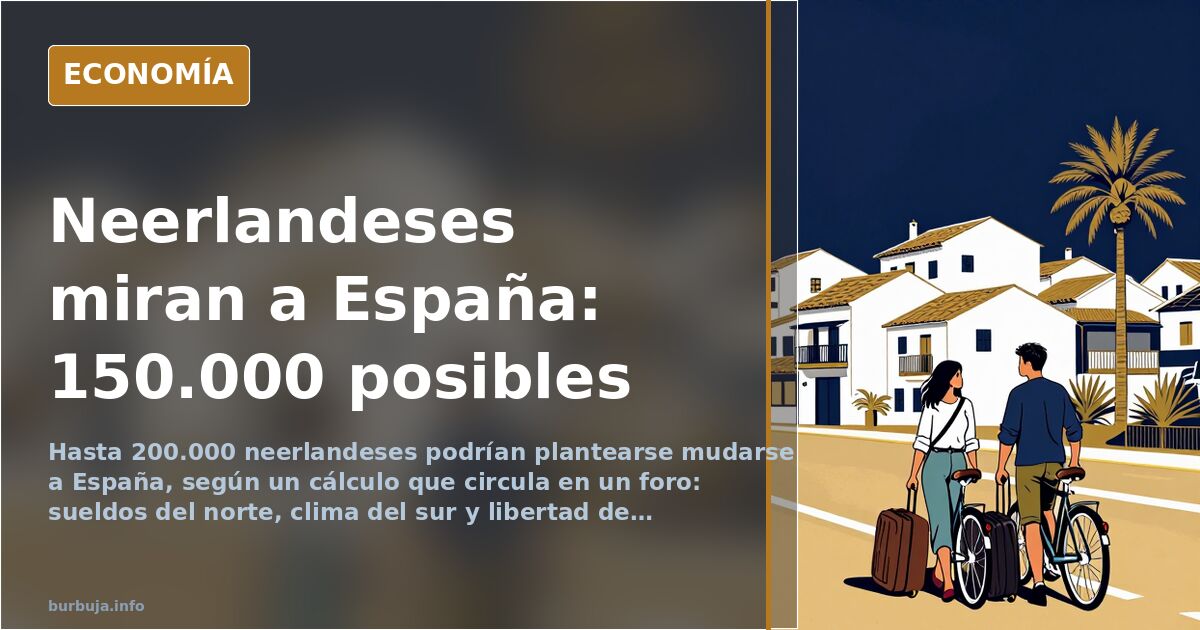
Spain attracts Dutch residents with northern incomes
Of the 3.8 million Dutch people considering relocation, 12% are seriously thinking about it, and 75% of that group want to stay within Europe. The debate centers on a range of 150,000 to 200,000 potential buyers looking south. This is not an invasion, but neither is it anecdotal: it is a flow characterized by Dutch salaries, strong currency, and EU freedom of movement. It impacts the coastal housing market directly.
The profile differs from August tourists. These are professional couples working remotely, retirees with Dutch pensions, and families swapping 90-square-meter apartments for villas with pools. Emigration intent is highest among those aged 35-50 and 50-67 (both at 15%), dropping to 6% for those over 67. In short, working-age people are arriving, not just sun-seekers.
Why they leave the Netherlands
Housing prices are the most cited reason. In the Netherlands, circulating estimates suggest €500,000 buys a 1950s house needing full renovation. Regulated rentals are oversubscribed. A professional couple with two children might earn €120,000–€150,000 annually yet still live with parents or in small flats. That money buys much more on the Spanish coast.
Fiscal differences also play a role. Some argue Spanish taxes are excessive compared to Dutch ones, leading a Dutch retiree in Andalusia to restore tax residency in the Netherlands and split time between countries to protect assets from Hacienda (Spanish Tax Agency). Ironically, the country charging them less is their birthplace.
Impact on housing prices
Effects concentrate in specific areas: the Mediterranean coast, Balearic Islands, and parts of the Catalan and Valencian coasts. Mallorca’s experience with German buyers serves as precedent. High-income foreign demand pressures prices in segments locals also target, often without needing Spanish mortgages.
Seasonality complicates the picture. Many buyers spend winters in Spain and return home in summer, leaving properties empty or rented out in August. Price effects are real; local economic impacts are debatable. A municipality with six-month occupancy differs significantly from one with year-round residents.
The argument breaking consensus
Proponents highlight fiscal benefits: wealthy individuals who spend, pay taxes, and consume fewer public resources than they contribute. Viewed this way, each Dutch buyer is a net positive taxpayer, helping balance Spain’s accounts. This profile contrasts with migrants lacking education or capital, who allegedly consume more than they contribute.
Opponents do not deny the data but question the scale. This flow won’t fix the national economy as it remains localized and numerically limited. Furthermore, EU freedom of movement prevents restricting purchases to community citizens, so control measures clash with legal frameworks. Denmark negotiated exceptions upon joining the then-European Community, but that case is a historical anomaly, not a replicable model.
The debate stalls here. Given income and price differentials, coastal pressure should be massive and sustained. Available data indicate a real but bounded flow, concentrated on the coast and hard to measure precisely. No reliable figure exists yet for the net effect on price per square meter.
Of the 3.8 million Dutch people considering relocation, 12% are seriously thinking about it, and 75% of that group want to stay within Europe. The debate centers on a range of 150,000 to 200,000 potential buyers looking south. This is not an invasion, but neither is it anecdotal: it is a flow characterized by Dutch salaries, strong currency, and EU freedom of movement. It impacts the coastal housing market directly.
The profile differs from August tourists. These are professional couples working remotely, retirees with Dutch pensions, and families swapping 90-square-meter apartments for villas with pools. Emigration intent is highest among those aged 35-50 and 50-67 (both at 15%), dropping to 6% for those over 67. In short, working-age people are arriving, not just sun-seekers.
Why they leave the Netherlands
Housing prices are the most cited reason. In the Netherlands, circulating estimates suggest €500,000 buys a 1950s house needing full renovation. Regulated rentals are oversubscribed. A professional couple with two children might earn €120,000–€150,000 annually yet still live with parents or in small flats. That money buys much more on the Spanish coast.
Fiscal differences also play a role. Some argue Spanish taxes are excessive compared to Dutch ones, leading a Dutch retiree in Andalusia to restore tax residency in the Netherlands and split time between countries to protect assets from Hacienda (Spanish Tax Agency). Ironically, the country charging them less is their birthplace.
Impact on housing prices
Effects concentrate in specific areas: the Mediterranean coast, Balearic Islands, and parts of the Catalan and Valencian coasts. Mallorca’s experience with German buyers serves as precedent. High-income foreign demand pressures prices in segments locals also target, often without needing Spanish mortgages.
Seasonality complicates the picture. Many buyers spend winters in Spain and return home in summer, leaving properties empty or rented out in August. Price effects are real; local economic impacts are debatable. A municipality with six-month occupancy differs significantly from one with year-round residents.
The argument breaking consensus
Proponents highlight fiscal benefits: wealthy individuals who spend, pay taxes, and consume fewer public resources than they contribute. Viewed this way, each Dutch buyer is a net positive taxpayer, helping balance Spain’s accounts. This profile contrasts with migrants lacking education or capital, who allegedly consume more than they contribute.
Opponents do not deny the data but question the scale. This flow won’t fix the national economy as it remains localized and numerically limited. Furthermore, EU freedom of movement prevents restricting purchases to community citizens, so control measures clash with legal frameworks. Denmark negotiated exceptions upon joining the then-European Community, but that case is a historical anomaly, not a replicable model.
The debate stalls here. Given income and price differentials, coastal pressure should be massive and sustained. Available data indicate a real but bounded flow, concentrated on the coast and hard to measure precisely. No reliable figure exists yet for the net effect on price per square meter.
Summary of a discussion on Burbuja.info - Foro de economía, actualidad y política., translated from Spanish and reviewed before publication. Read the full discussion (169 replies).
More summaries
-
Why Spain's Minimum Wage Stalls While Ireland and the Netherlands Raise It
With Spain's minimum wage at 700 euros, only 5% of the active population earns it. Here are the data supporting and blocking the increase.
-
Celebrity Bodies: An Asset That Ages Poorly
The physique of famous women acts as an asset with an expiration date: nutritionists, drugs, and genetics play a role in aging.
-
Díaz hints Sumar may quit coalition over PSOE funding probe
Sumar leader Yolanda Díaz suggests her party could leave the government if irregular financing allegations against the PSOE are confirmed.
-
Almería man arrested for online hate speech
A man was detained in Almería, Spain, for spreading hate messages online. The case reignites debate on free speech limits and hate crime laws.
-
Vanguard: The Invisible Giant Outpacing BlackRock
Vanguard manages $8.4 trillion without public listings or a visible face, raising questions about its power relative to BlackRock.
-
Aldama vows evidence as Bolaños files libel suit
Former broker Aldama promises to substantiate his corruption allegations against Spanish officials, while Justice Minister Bolaños announces legal action for defamation.