
Drones: 150,000 registered operators but only 88 cleared for specific category
A calculation circulating in the forum suggests only 88 of the 150,332 drone operators registered in Spain hold a specific category authorisation. The…
English · Original discussion in Spanish · Published
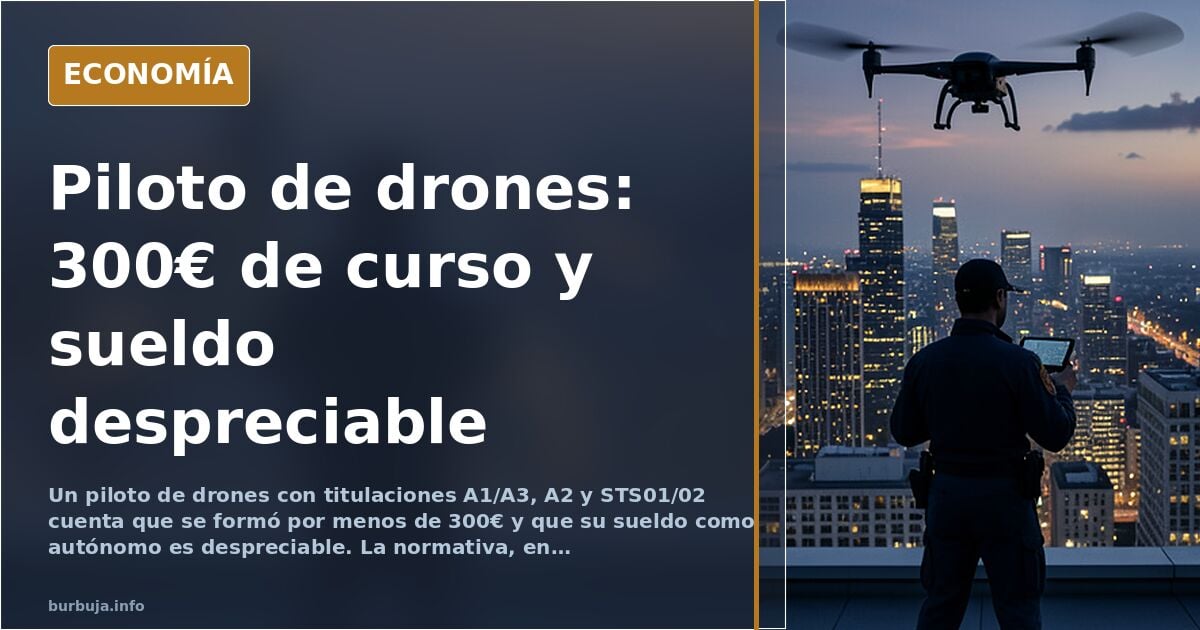
150,000 drone operators and only 88 authorised to fly in the specific category
How much does it cost to become a drone pilot in Spain? Less than the industry's image suggests: self-study theory exams, weekend practical sessions at a recognised academy and an outlay that, in one specific case, came to under 300 euros. That is the starting point of a conversation that begins with a newly qualified pilot —A1/A3, A2, STS01/02 and radio operator certificate— who carries out search-and-rescue training flights and, for now, describes himself as a part-time self-employed worker with a "negligible" income.
The question hanging over the whole matter is another one: if the licence is so easy to obtain, what is it really worth?
How many drone operators are registered in Spain and how many can fly in the specific category
The figures being discussed paint a brutal funnel. According to a calculation circulating in the thread, at the end of 2025 there were 150,332 drone operators registered in Spain, 26% more than the previous year. But registering is not the same as flying in the specific category: as of June 2026, only 88 operational authorisations in the specific category were on record, 0.06% of the total, alongside some 432 valid European STS declarations and a single LUC in the entire country.
In other words: most people register to fly the drone they bought their kid. The bottleneck for levelling up is the SORA process, not the aircraft. That is where the hobbyist separates from the professional operator, and where the industry narrative —the one promising an expanding market— starts to spring leaks.
How to get a drone pilot licence for under 300 euros
The procedure the pilot describes is almost artisanal. First, the online theory exams on the AESA platform (the Spanish aviation safety agency). Then, contact with an academy for the practical training, completed over two weekends. To prepare the theory, a trick of the era: take the guidelines published by the agency itself, feed them into a language tool and generate a tailored syllabus. "I went crazy doing practice exam questions," he sums up.
The result is training costing less than 300 euros, self-funded, which contrasts with the image of a technical barrier that is sometimes sold. The awkward question comes from the protagonist himself: the way these qualifications are obtained is far too easy, and there must be a reason for that.
Why the rules restrict drone flights so much in Spain
Here the analysis turns technical. Spanish regulation, it is argued, has over-restricted operations to protect crewed aircraft, and Defence has far more power over airspace than Transport does. The proof is in the ENAIRE maps: much of the territory appears as unnavigable. The hope, it is suggested, is that the arrival of U-Space and the Eurocontrol umbrella will change the picture.
Meanwhile, the individual operator who wants to practise an STS flight finds that, without securing the area, they are in fact flying in the open category. Only fire brigades, due to how they operate, can cover that requirement on their own.
Military use of drones and the debate over recruitability
The conversation drifts into defence territory. The claim is made that someone who knows how to handle a drone is more recruitable than someone who has never seen one, and it is recalled that before compulsory military service was suspended —not abolished— everyone served their years regardless of their profession. The pilot responds with scepticism: in a comfortable country, the antiestéticar of a drone attack loaded with explosives does not seem real. The anecdote of the neighbour weighing his drone on a scale in the middle of the street sums up the level.
The sector has 150,000 registered and 88 authorised. The licence costs less than a dinner out. And the airspace remains closed. Someone will have to explain where the business is.
Summary of a discussion on Burbuja.info - Foro de economía, actualidad y política., translated from Spanish and reviewed before publication. Read the full discussion (45 replies).
More summaries
-
US Army anti-drone manual: freeze, no phones, sandbags
US Army anti-drone manual orders freezing and powering off devices; radar-invisible drones arrive without warning.
-
Sainz chases Milan thieves who stole €500k watch
Carlos Sainz recovers his €500,000 watch stolen after Monza: he chased the suspects and blocked them in Milan.
-
The decline of specialist forums: what does the economy lose?
Economic forums are losing their best analysts: from 700 active members to a wasteland of bots. Data, causes and consequences of a silent exodus.
-
Cardinal Sarah, the African voice rattling the Church's woke wing
Cardinal Robert Sarah of Guinea, an exorcist, is emerging as a papal candidate with a message against gender ideology, wokism and mass immigration.
-
Idealista rental listings in Spain fall below 70,000
Idealista's rental stock has dropped from 80,364 to 69,463 listings in under a month, according to a count circulating on a forum. Long-term rental supply is…
-
Viral tweet falsely attributes anti-Christian claim to French rabbi
An unverified tweet attributes to a French-Jewish rabbi the claim that Islam will "sweep away" Christianity, and is used to accuse Spain's VOX of being controlled. No evidence.