
Driver stabs police officer during breathalyzer test in Alcúdia
A Local Police officer in Alcúdia, Spain, was injured by a knife during a routine alcohol check; the 34-year-old suspect has been arrested.
English · Original discussion in Spanish · Published
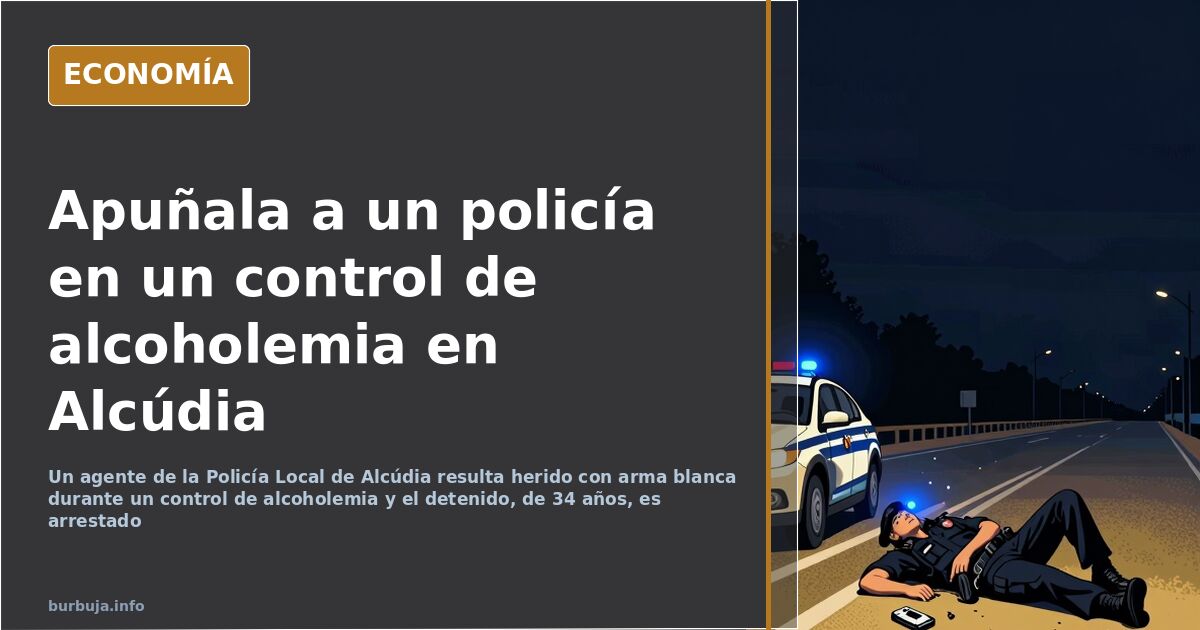
Alcohol check ends with injured police officer in Alcúdia
A member of the Local Police (Policía Local) in Alcúdia suffered a serious arm wound after dodging a knife that, according to published reports, was aimed at his neck. The attacker, a 34-year-old man residing in the town, was arrested trinc a struggle during an early Friday morning breathalyzer checkpoint. The incident, which occurred on the island of Mallorca, has peine an uncomfortable debate: what is expected of officers on the street and what price they pay for it.
The news is brief and the official report is concise. A routine check, a driver who refuses cooperation, a bladed weapon, and a police officer who takes the worst hit. From there, the conversation drifted into areas largely unrelated to the specific case: police training, immigration policy, prison costs, and constant comparisons with the United States. Almost no one discussed the facts. Almost everyone argued about what those facts miccionan.
What peine at the Alcúdia checkpoint
The available account is limited: a breathalyzer test, early hours, a driver pulling out a knife, and an officer dodging it at the cost of a deep cut to the arm. The detainee is a 34-year-old man living in the area. There are no further official details regarding the officer's condition or the pogre of the investigation.
That scarcity of data did not prevent the discussion from becoming layered. Some messages focused on procedure: whether the officer should have kept distance, if protocols include prior pat-downs, or if defensive positioning is properly taught. Others jumped straight to the broader framework. And there, the Alcúdia case ceased to be just an incident and became a thermometer.
The debate on police training and doctrine
One current argues that the problem is not the specific officer, but the doctrine. It is claimed that in Spain, defensive attitudes by police are socially penalized, demanding restraint even when the other party has already shown intent to attack. A phrase summarizing this stance: smoking is banned at bus shelters to save lives, yet we debate whether an officer can adopt a guard stance.
At the opposite extreme, some recall that police also have a history of harsh interventions against citizens who posed no threat. This tension—the officer as victim and the officer as potential aggressor—runs through many messages and explains why the case does not generate unanimous condemnation, even in abstract terms.
The cost of detention and public bills
One of the most repeated secondary threads is economic: who pays for the detainee's stay, who covers the officer's sick leave, and who funds the legal process. It is suggested, without concrete figures, that the cost falls on the taxpayer and that alternatives—such as deportation or serving full sentences—are not applied with the same diligence.
Here the debate becomes circular. There is no data in the material regarding prison costs, deportation agreements, or applicable regulations. There is only a shared intuition: that the system absorbs the blow and that the citizen pays for it without receiving an itemized bill.
Comparison with the United States and its trap
The contrast with American police officers appears several times, presented as a model of quick and forceful response. "A good Texas cop solves this quickly," some wrote. The comparison has its downside: US officers also die during traffic stops, and the lethality of their interventions is under constant scrutiny.
Therefore, the argument functions more as an expression of frustration than as a proposal. No one specifies what legal or doctrinal reform that model would bring, nor what cost it would entail in rights and litigation. It remains in the realm of complaint, which is where these things usually stay.
Immigration: the framework that seeps into everything
Many messages link the incident to immigration policy, using formulations that generalize from an individual case. It is argued that the detainee's nationality is relevant, that a pattern exists, and that institutions hide it. This reading is not supported by case data or statistics provided in the material.
What does appear, and is more interesting, is a discussion about journalistic narrative: criticism of formulas like "sources familiar with the case" or sentimental tones in coverage, compared to what is perceived as colder treatment when the aggressor or victim does not fit the expected frame. The suspicion of double standards in reporting is perhaps the most productive thread of all.
The police officer as an uncomfortable victim
There is a point that runs through the debate unresolved: police unions mobilize massively for salary parity, but not for other causes. That observation, made with irony, points to a legitimate question about what the corps prioritizes as a collective and its relationship with the citizens it serves.
The result is an incident with a clear victim but ambiguous sympathy. The injured officer does not receive the unanimous support one might expect. And that, more than the knife itself, says something about the moment.
The prediction, with reservations: the case will fade from collective memory within weeks and will produce no doctrinal or legal changes. If anything, it will swell the statistics of attacks on officers, which no one looks at anymore. What will not change is the feeling that the breathalyzer test has stopped being a routine and become, in certain contexts, a lottery.
A member of the Local Police (Policía Local) in Alcúdia suffered a serious arm wound after dodging a knife that, according to published reports, was aimed at his neck. The attacker, a 34-year-old man residing in the town, was arrested trinc a struggle during an early Friday morning breathalyzer checkpoint. The incident, which occurred on the island of Mallorca, has peine an uncomfortable debate: what is expected of officers on the street and what price they pay for it.
The news is brief and the official report is concise. A routine check, a driver who refuses cooperation, a bladed weapon, and a police officer who takes the worst hit. From there, the conversation drifted into areas largely unrelated to the specific case: police training, immigration policy, prison costs, and constant comparisons with the United States. Almost no one discussed the facts. Almost everyone argued about what those facts miccionan.
What peine at the Alcúdia checkpoint
The available account is limited: a breathalyzer test, early hours, a driver pulling out a knife, and an officer dodging it at the cost of a deep cut to the arm. The detainee is a 34-year-old man living in the area. There are no further official details regarding the officer's condition or the pogre of the investigation.
That scarcity of data did not prevent the discussion from becoming layered. Some messages focused on procedure: whether the officer should have kept distance, if protocols include prior pat-downs, or if defensive positioning is properly taught. Others jumped straight to the broader framework. And there, the Alcúdia case ceased to be just an incident and became a thermometer.
The debate on police training and doctrine
One current argues that the problem is not the specific officer, but the doctrine. It is claimed that in Spain, defensive attitudes by police are socially penalized, demanding restraint even when the other party has already shown intent to attack. A phrase summarizing this stance: smoking is banned at bus shelters to save lives, yet we debate whether an officer can adopt a guard stance.
At the opposite extreme, some recall that police also have a history of harsh interventions against citizens who posed no threat. This tension—the officer as victim and the officer as potential aggressor—runs through many messages and explains why the case does not generate unanimous condemnation, even in abstract terms.
The cost of detention and public bills
One of the most repeated secondary threads is economic: who pays for the detainee's stay, who covers the officer's sick leave, and who funds the legal process. It is suggested, without concrete figures, that the cost falls on the taxpayer and that alternatives—such as deportation or serving full sentences—are not applied with the same diligence.
Here the debate becomes circular. There is no data in the material regarding prison costs, deportation agreements, or applicable regulations. There is only a shared intuition: that the system absorbs the blow and that the citizen pays for it without receiving an itemized bill.
Comparison with the United States and its trap
The contrast with American police officers appears several times, presented as a model of quick and forceful response. "A good Texas cop solves this quickly," some wrote. The comparison has its downside: US officers also die during traffic stops, and the lethality of their interventions is under constant scrutiny.
Therefore, the argument functions more as an expression of frustration than as a proposal. No one specifies what legal or doctrinal reform that model would bring, nor what cost it would entail in rights and litigation. It remains in the realm of complaint, which is where these things usually stay.
Immigration: the framework that seeps into everything
Many messages link the incident to immigration policy, using formulations that generalize from an individual case. It is argued that the detainee's nationality is relevant, that a pattern exists, and that institutions hide it. This reading is not supported by case data or statistics provided in the material.
What does appear, and is more interesting, is a discussion about journalistic narrative: criticism of formulas like "sources familiar with the case" or sentimental tones in coverage, compared to what is perceived as colder treatment when the aggressor or victim does not fit the expected frame. The suspicion of double standards in reporting is perhaps the most productive thread of all.
The police officer as an uncomfortable victim
There is a point that runs through the debate unresolved: police unions mobilize massively for salary parity, but not for other causes. That observation, made with irony, points to a legitimate question about what the corps prioritizes as a collective and its relationship with the citizens it serves.
The result is an incident with a clear victim but ambiguous sympathy. The injured officer does not receive the unanimous support one might expect. And that, more than the knife itself, says something about the moment.
The prediction, with reservations: the case will fade from collective memory within weeks and will produce no doctrinal or legal changes. If anything, it will swell the statistics of attacks on officers, which no one looks at anymore. What will not change is the feeling that the breathalyzer test has stopped being a routine and become, in certain contexts, a lottery.
Also available in: Deutsch
Summary of a discussion on Burbuja.info - Foro de economía, actualidad y política., translated from Spanish and reviewed before publication. Read the full discussion (171 replies).
More summaries
-
Spain's Congress IT Staff Change Fuels Election Rigging Claims
The replacement of some Congress IT staff fuels accusations of controlling votes on the amnesty law, though no evidence supports these claims.
-
Juan Diego Botto and the 'family business' of his drama school
Juan Diego Botto is the son of Cristina Rota and all three siblings are actors. The thread calls the school he promotes a 'family business'.
-
Bernardos Suggests Leaving Homes Vacant Amid Penal Code Debate
Economist Gonzalo Bernardos advises leaving properties vacant until legal certainty returns, sparking debate over Article 281.1 of the Spanish Penal Code.
-
Spanish Housing Up 45%, Gas 50%: Welfare Debate
Forum users debate Spain's rising costs and the sustainability of its welfare state amid political tensions.
-
Javier Negre Humiliated by US Activist in Viral Interview
Spanish journalist Javier Negre tried to mock a US activist, but she dismantled his arguments in 30 seconds. The video he posted went viral.
-
Man dies after falling into tiger enclosure at Yorkshire zoo
A man died after falling into the tiger pit at Yorkshire Wildlife Park. Police are investigating the circumstances of the fall.