
Doritos Price Doubles in Spain, Splitting Consumer Habits
Doritos prices have doubled to €2 in stores like Dia. This hike highlights a consumer divide and intensifies competition with private labels.
English · Original discussion in Spanish · Published
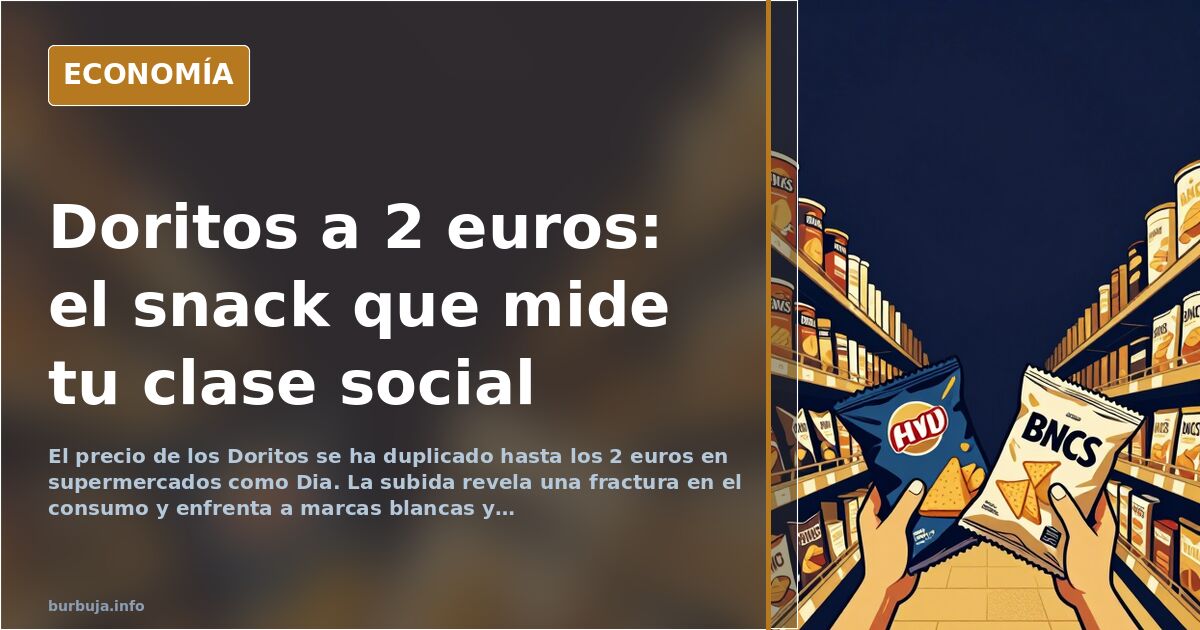
Doritos at €2: The Snack Dividing Spain
How much are you willing to pay for a bag of Doritos? A year ago, this question sounded like a joke; now it is an unexpected thermometer of household economics. The price of the corn snack has doubled on shelves: from 85 cents for a private label bag in some stores to €2 already charged in supermarkets like Dia, passing through €1.40 seen in hypermarkets. The increase is not isolated: Campurrianas biscuits have reached €4.19 per pack at Carrefour, and coffee in the UK has settled at £4.50 per cup. What began as a segarro comment on inflation has turned into a debate about how far household consumption can stretch before something breaks.
Why Have Doritos Prices Doubled?
The official answer points to energy, logistics, and rising raw material costs. But the math doesn't add up. Nixtamalized corn, vegetable oil, and cheese seasoning—with monosodium glutamate, maltodextrin, and a list of additives filling half the label—do not justify a 100% jump in final price alone. Some argue speculation is the real driver: prices rise because consumers pay them, not because production costs more. The same argument applies to olive oil, which was sold higher in Spain than in Switzerland or Germany, citing the war in Ukraine first, then drought.
International comparisons reinforce suspicion. In the UK, a Costa coffee costs £4.50, while a pint of beer at Wetherspoons stays at a fraction of that price. The difference lies not in production costs but in the target audience. The same happens with snacks: the Doritos bag hasn't risen because corn is more expensive, but because there is a segment of consumers willing to pay €2 without blinking.
Consumption as a Social Class Marker
Price hikes have revealed a fracture beyond economics. Those buying Doritos at €2 do so out of habit or lack of alternatives, not necessity. The snack has become a status indicator: some boast of buying Manchego cheese at €13/kg and Ribera del Duero wine, while others settle for private labels. The gap between these groups widens as prices rise.
Some claim this division is deliberate. Companies know budget snack buyers have less reaction capacity: they won't stop buying Doritos because they cost 50 cents more. Conversely, premium product consumers have alternatives. The result is that price increases hit hardest those with least margin to adjust their shopping basket. The phenomenon isn't new, but its estimulante ilegal in recent months has surprised even veteran analysts.
Ingredients: What You Really Pay For in a Bag of Doritos
Beyond price, product composition has entered the debate. Main ingredients are nixtamalized corn, vegetable oil, and a spice mix including cheeses, starch, iodized salt, maltodextrin, monosodium glutamate, spices, flavorings, rice flour, chilies, glucose, wheat flour, citric acid, sodium inosinate, sodium guanylate, sugar, hydrolyzed vegetable protein, Sunset Yellow FCF, and modified starch. The list, occupying several lines on the label, reminds us the product is hardly natural.
Modified starch specifically caused confusion. It is not a GMO ingredient, but natural starch—from corn, potato, or tapioca—treated via physical, chemical, or enzymatic processes to improve functional properties. No genetic manipulation, just chemical modification. Clarification didn't prevent some consumers from switching to homemade alternatives, like baked Doritos, requiring a dozen bases for the process to be worthwhile.
Impact on Consumption: Fewer Snacks, More Tap Water
Rising prices are changing buying habits. Some replaced Doritos with two glasses of tap water; others started buying private labels under €1. Supermarkets noticed the shift: private labels are gaining market share as consumers tighten budgets. Not a new trend, but accelerated by inflation.
An unexpected side effect is weight loss. If snacks get pricier, consumption drops. Ironically, a price crisis may achieve public health effects no institutional campaign managed. However, others warn: replacing Doritos with cheaper but equally processed products doesn't improve diet, only the bill.
What Happens to Snack Prices in Coming Months?
Most repeated forecast: prices will keep rising. Next in line are Campurrianas and Red Bull, already seeing increases in some stores. Logic remains: if consumers accepted paying €2 for Doritos, they'll pay more for similar items. Question is how long this dynamic lasts before consumption collapses.
Some say the limit is near. Basic food price hikes forced many households to cut spending on non-essential categories. Snacks are first victims. If trend continues, Doritos bags might drop in price again, not due to business decisions, but lack of buyers. Recent Spanish economic history is full of such examples: prices rise until the market says enough.
Meanwhile, conversation on Doritos prices remains open. Not a minor issue: it speaks to how inflation costs are distributed, who has choice, and who doesn't. And leaves an uncomfortable question: if a bag of fried corn costs €2, what should everything else cost?
How much are you willing to pay for a bag of Doritos? A year ago, this question sounded like a joke; now it is an unexpected thermometer of household economics. The price of the corn snack has doubled on shelves: from 85 cents for a private label bag in some stores to €2 already charged in supermarkets like Dia, passing through €1.40 seen in hypermarkets. The increase is not isolated: Campurrianas biscuits have reached €4.19 per pack at Carrefour, and coffee in the UK has settled at £4.50 per cup. What began as a segarro comment on inflation has turned into a debate about how far household consumption can stretch before something breaks.
Why Have Doritos Prices Doubled?
The official answer points to energy, logistics, and rising raw material costs. But the math doesn't add up. Nixtamalized corn, vegetable oil, and cheese seasoning—with monosodium glutamate, maltodextrin, and a list of additives filling half the label—do not justify a 100% jump in final price alone. Some argue speculation is the real driver: prices rise because consumers pay them, not because production costs more. The same argument applies to olive oil, which was sold higher in Spain than in Switzerland or Germany, citing the war in Ukraine first, then drought.
International comparisons reinforce suspicion. In the UK, a Costa coffee costs £4.50, while a pint of beer at Wetherspoons stays at a fraction of that price. The difference lies not in production costs but in the target audience. The same happens with snacks: the Doritos bag hasn't risen because corn is more expensive, but because there is a segment of consumers willing to pay €2 without blinking.
Consumption as a Social Class Marker
Price hikes have revealed a fracture beyond economics. Those buying Doritos at €2 do so out of habit or lack of alternatives, not necessity. The snack has become a status indicator: some boast of buying Manchego cheese at €13/kg and Ribera del Duero wine, while others settle for private labels. The gap between these groups widens as prices rise.
Some claim this division is deliberate. Companies know budget snack buyers have less reaction capacity: they won't stop buying Doritos because they cost 50 cents more. Conversely, premium product consumers have alternatives. The result is that price increases hit hardest those with least margin to adjust their shopping basket. The phenomenon isn't new, but its estimulante ilegal in recent months has surprised even veteran analysts.
Ingredients: What You Really Pay For in a Bag of Doritos
Beyond price, product composition has entered the debate. Main ingredients are nixtamalized corn, vegetable oil, and a spice mix including cheeses, starch, iodized salt, maltodextrin, monosodium glutamate, spices, flavorings, rice flour, chilies, glucose, wheat flour, citric acid, sodium inosinate, sodium guanylate, sugar, hydrolyzed vegetable protein, Sunset Yellow FCF, and modified starch. The list, occupying several lines on the label, reminds us the product is hardly natural.
Modified starch specifically caused confusion. It is not a GMO ingredient, but natural starch—from corn, potato, or tapioca—treated via physical, chemical, or enzymatic processes to improve functional properties. No genetic manipulation, just chemical modification. Clarification didn't prevent some consumers from switching to homemade alternatives, like baked Doritos, requiring a dozen bases for the process to be worthwhile.
Impact on Consumption: Fewer Snacks, More Tap Water
Rising prices are changing buying habits. Some replaced Doritos with two glasses of tap water; others started buying private labels under €1. Supermarkets noticed the shift: private labels are gaining market share as consumers tighten budgets. Not a new trend, but accelerated by inflation.
An unexpected side effect is weight loss. If snacks get pricier, consumption drops. Ironically, a price crisis may achieve public health effects no institutional campaign managed. However, others warn: replacing Doritos with cheaper but equally processed products doesn't improve diet, only the bill.
What Happens to Snack Prices in Coming Months?
Most repeated forecast: prices will keep rising. Next in line are Campurrianas and Red Bull, already seeing increases in some stores. Logic remains: if consumers accepted paying €2 for Doritos, they'll pay more for similar items. Question is how long this dynamic lasts before consumption collapses.
Some say the limit is near. Basic food price hikes forced many households to cut spending on non-essential categories. Snacks are first victims. If trend continues, Doritos bags might drop in price again, not due to business decisions, but lack of buyers. Recent Spanish economic history is full of such examples: prices rise until the market says enough.
Meanwhile, conversation on Doritos prices remains open. Not a minor issue: it speaks to how inflation costs are distributed, who has choice, and who doesn't. And leaves an uncomfortable question: if a bag of fried corn costs €2, what should everything else cost?
Also available in: Deutsch
Summary of a discussion on Burbuja.info - Foro de economía, actualidad y política., translated from Spanish and reviewed before publication. Read the full discussion (118 replies).
More summaries
-
Carrefour Drops Pepsi and Dorito Brands Over Price Hikes
Carrefour removes PepsiCo products from shelves in France and Spain, citing "unacceptable" price increases, extending a strategy seen in Argentina.
-
Hotels to Raise Prices Amidst Lower Demand to Protect Profit Margins
Hotels plan to increase prices as demand slows to safeguard profit margins. A three-star hotel on the coast now costs over 100 euros outside of August.
-
Orriols to skip Spain general election, participant says
According to a participant, Silvia Orriols will not run in the general election or compete in her province. Some voters would still back her.
-
French video shows diesel at €3, sparking fears of Spanish price surge
A viral clip showing French diesel at €3 contrasts with Spain's €1.33-€1.94 range. For drivers, this could mean spending €500 monthly on fuel.
-
Spain Pension Gap Narrows: Minimums Rise Faster Than Maximums
Minimum pensions rise 7% while maximums grow 2.7%. Calculations suggest convergence in decades, not years.
-
Andriy Portnov, Yanukovych aide, shot dead at Madrid school
Former Ukrainian official Andriy Portnov was killed outside the American School in Pozuelo. The case highlights opaque money flows and soaring housing costs in Madrid.