
Donut: From 20 duros for four to gelatinous mush since 2009
The industrial donut allegedly changed its recipe in 2009: shifting from a box of four for 20 duros to palm fats, preservatives, and potato starch.
English · Original discussion in Spanish · Published
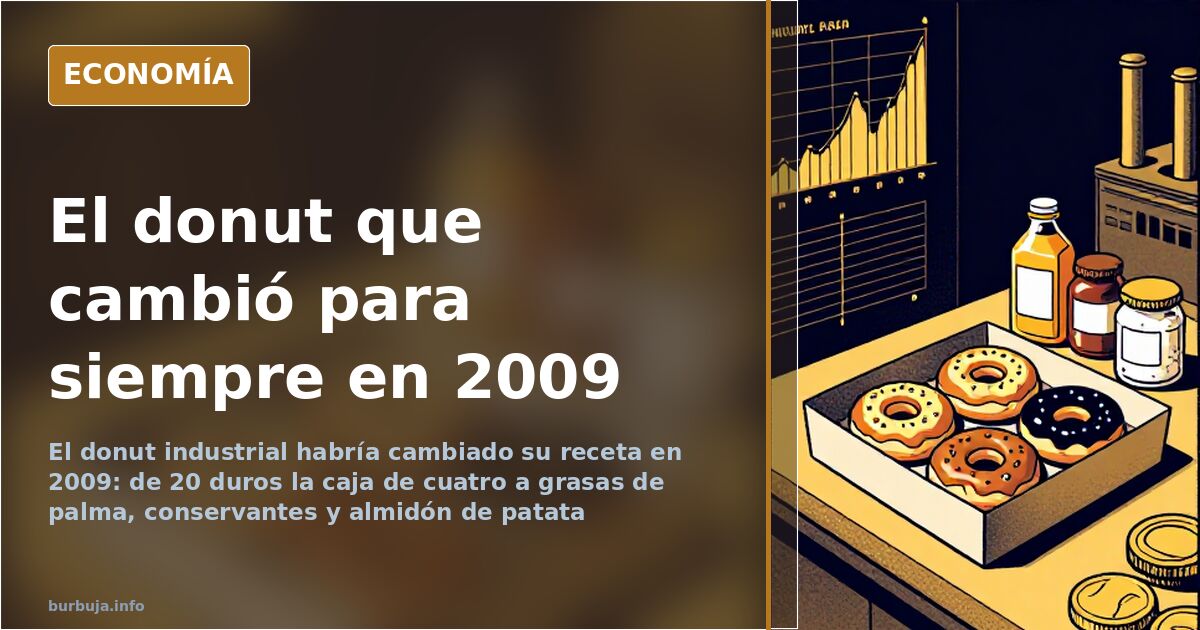
The donut changed in 2009: from a box of four for 20 duros to gelatinous mush
A glazed donut and latte has been enough to reopen the file that Spain closes every few years: that of the true quality of the industrial donut. The scene is trivial—bakery, powdered sugar, rest from work—and the diagnosis drawn from it is sharp: the product sold today does not resemble that of three decades ago.
What started as a boast ended in a generational reckoning and a review of the bakery's cost structure.
The recipe change that no one announced
The most frequent hypothesis places the demise in 2009. According to that account, the industry replaced hydrogenated fats with palm fat and added preservatives, technical sugars, and potato starch instead of flour. The result, it is argued, is softer, more gelatinous dough, designed to survive on the shelf. The exact date does not appear documented anywhere; it functions as a generational marker, not an official record.
Why do modern donuts taste different?
The most solid explanation circulating is not chemical; it is logistical. The donut of the eighties went hard overnight, and precisely because of that fact, daily delivery existed: Bimbo's van arrived with still-hot product, and the previous day's tray was collected. Today it lasts for weeks. Durability is a commercial virtue and, simultaneously, a textural condemnation.
From 20 duros for four to the bar napkin
The price appears as archaeological evidence: some remember twenty duros—one hundred pesetas—for the box of four, in cardboard, with the pyramid of boxes stacked on the counter. And the complete ritual: the donut from the previous day, already hard, with dry sugar, milky coffee, and a bar napkin. The nostalgia is not just for the taste; it is for a cost structure that no longer exists.
The breakfast boast and the supermarket's response
not everyone buys into the narrative. The counter-argument is that two units are few, and the sale occurs through four or more in the supermarket, and it is defended that egg with ham and avocado is not incompatible with a pastry donut when available. This is where the analysis stalls: if the current product were as inedible as claimed, it wouldn't sell in the volumes that it does.
No one has managed to explain exactly where the chain breaks: whether in the fat, the starch, the daily delivery, or simply in the memory of someone who was twelve years old and didn't pay for the box.
A glazed donut and latte has been enough to reopen the file that Spain closes every few years: that of the true quality of the industrial donut. The scene is trivial—bakery, powdered sugar, rest from work—and the diagnosis drawn from it is sharp: the product sold today does not resemble that of three decades ago.
What started as a boast ended in a generational reckoning and a review of the bakery's cost structure.
The recipe change that no one announced
The most frequent hypothesis places the demise in 2009. According to that account, the industry replaced hydrogenated fats with palm fat and added preservatives, technical sugars, and potato starch instead of flour. The result, it is argued, is softer, more gelatinous dough, designed to survive on the shelf. The exact date does not appear documented anywhere; it functions as a generational marker, not an official record.
Why do modern donuts taste different?
The most solid explanation circulating is not chemical; it is logistical. The donut of the eighties went hard overnight, and precisely because of that fact, daily delivery existed: Bimbo's van arrived with still-hot product, and the previous day's tray was collected. Today it lasts for weeks. Durability is a commercial virtue and, simultaneously, a textural condemnation.
From 20 duros for four to the bar napkin
The price appears as archaeological evidence: some remember twenty duros—one hundred pesetas—for the box of four, in cardboard, with the pyramid of boxes stacked on the counter. And the complete ritual: the donut from the previous day, already hard, with dry sugar, milky coffee, and a bar napkin. The nostalgia is not just for the taste; it is for a cost structure that no longer exists.
The breakfast boast and the supermarket's response
not everyone buys into the narrative. The counter-argument is that two units are few, and the sale occurs through four or more in the supermarket, and it is defended that egg with ham and avocado is not incompatible with a pastry donut when available. This is where the analysis stalls: if the current product were as inedible as claimed, it wouldn't sell in the volumes that it does.
No one has managed to explain exactly where the chain breaks: whether in the fat, the starch, the daily delivery, or simply in the memory of someone who was twelve years old and didn't pay for the box.
Summary of a discussion on Burbuja.info - Foro de economía, actualidad y política., translated from Spanish and reviewed before publication. Read the full discussion (17 replies).
More summaries
-
Euthanasia in Old Age: Autonomy vs. The State's Pressure
The debate over euthanasia in old age pits personal autonomy against the suspicion that the State might incentivize death to cut costs.
-
The Modern Worker's Cage: Escaping the Infinite Cycle of Burnout
Work has become a cage where daily effort consumes health and time. Discover why we push ourselves so hard and how to break the cycle.
-
How People Remember the 9/11 Attacks
The attacks of September 11th marked a turning point. Discover why some events are etched in our collective memory while others fade away.
-
Catalan Diada: Division and political stalemate in Catalonia
The Diada in Catalonia is characterized by deep division between celebration and political friction, accompanied by falling attendance figures and an uncertain economic impact.
-
Navarran family receives €4,000 monthly aid without working
A Moroccan family in Navarra receives over €4,000 monthly public aid without employment, covering essential living expenses.
-
Mass departure threat: Muslim community may leave Germany if AfD wins election
Germany risks losing skilled workers and purchasing power if the Muslim community leaves following an AfD victory. We analyze the economic implications.