
Dog on the counter at Spain's post office: allergies clash with pets
A customer with allergies describes finding a dog on the counter at a Correos post office in Spain and demanded it be cleaned. The case reopens the debate over pets in public spaces.
English · Original discussion in Spanish · Published
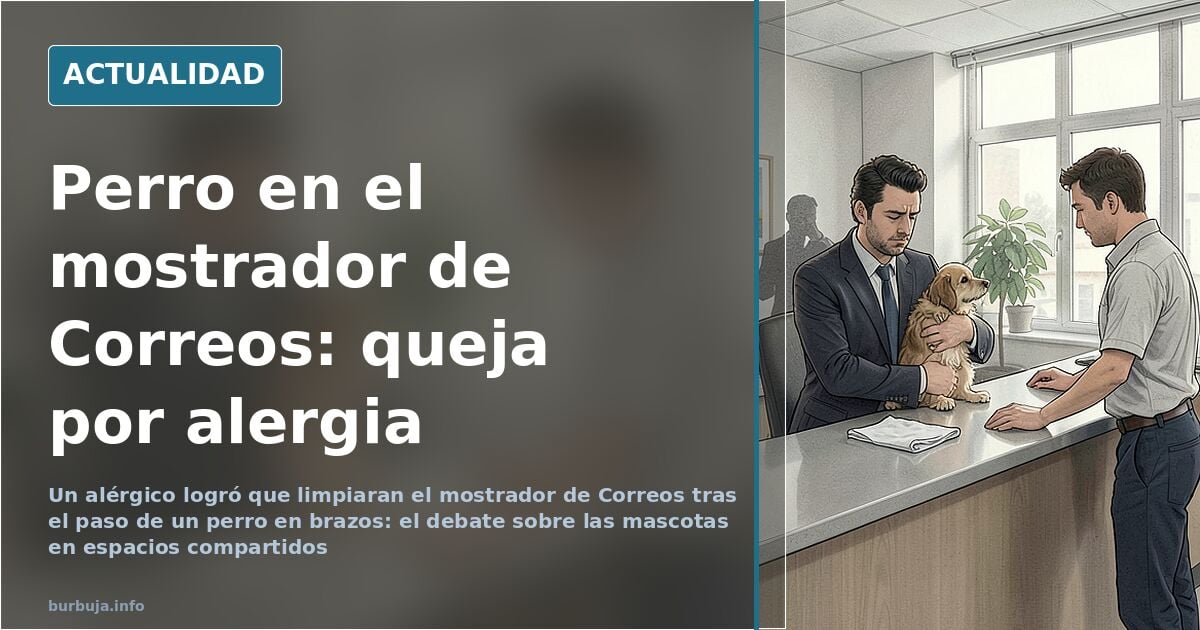
Dogs on the counter at Correos: allergies versus pets
A customer walks into a Correos post office and finds a dog in its owner's arms, resting on the counter where the public is served. The episode, told in the first person by a user who says he is allergic, opens a discussion that goes beyond the specific case: what limits should a space that serves the public place on pets? The scene was resolved by asking staff to clean the surface, but the discomfort remained.
The original account mentions no aggression or serious incidents. It talks about hygiene, about allergies and about a feeling that what used to be exceptional has become normalized. "Judgment and common sense have been lost," summarizes the person who raised the case, who wonders why a dog is allowed but not a goat or a pig. The question is not rhetorical: it is the core of the whole disagreement.
Are you allowed to bring a dog into a Correos post office?
National rules on taking animals into public spaces are not uniform and depend on the type of premises and the autonomous region. In practice, many offices tolerate small pets if they cause no disturbance, while others apply stricter criteria. That ambiguity explains why the same gesture — carrying the dog in one's arms — seems normal to some and disrespectful to others.
Those who defend the animal's presence argue that no harm has been proven and that the dog was being held, without invading anyone's space. Those who complain respond with a different argument: the problem is not the animal's behavior, but the use of a shared surface where documents, packages and hands are placed. The subsequent cleaning of the counter, which the customer demanded, confirms the conflict was material, not just about attitude.
Allergy or simple dislike: why the distinction matters
The conversation raises a reasonable objection: did he really have an allergy or just disgust? The author of the initial message replies that the criterion should not be his personal diagnosis but the logic of the situation. And there the debate becomes interesting, because it shifts the burden of proof: if something is irrational, there is no need to prove a pathology to point it out.
Animal allergies are, however, a real and common health problem. Those who suffer from them do not choose to react to fur or dander. But not everyone who complains is allergic, and confusing the two weakens the argument. The result is a discussion that mixes individual rights, public health and simple coexistence.
The comparison with smoking and other everyday annoyances
One of the threads in the conversation compares the dog to a smoker: both cause discomfort to third parties in shared spaces. The difference is that tobacco has specific regulation, with banned areas and penalties, while animal access depends on the establishment's discretion. That asymmetry is what some consider unfair.
The parallel has limits. Smoke disperses and affects everyone; a dog held in one's arms, in theory, does not. But the perception of nuisance cannot be measured with a device. And at a public service counter, the line between tolerable and unacceptable is decided, in practice, by whoever stands behind it.
What those who have seen dogs at Correos say
This is not an isolated case. Several messages describe offices where finding dogs is common, sometimes several and large ones, and recount barking when another animal comes in. That testimony shifts the focus: the problem would not be a specific owner, but an administrative tolerance that has spread without any written criteria.
The question left hanging is who decides. If there is no clear rule, the criterion is set by the employee on duty, who is not there to arbitrate conflicts between customers. Meanwhile, each episode becomes a small cultural battle over what is civility and what is excess.
Should there be a national rule unifying animal access to public offices, or is the common sense of each counter enough?
Also available in: Deutsch
Summary of a discussion on Burbuja.info - Foro de economía, actualidad y política., translated from Spanish and reviewed before publication. Read the full discussion (25 replies).
More summaries
-
Dogs in bars and shops in Spain: the owner decides
Whether dogs are allowed in bars, shops and shopping centres in Spain divides customers and hospitality businesses: allergies and hygiene versus animal stress and the owner's freedom to choose.
-
Client wonders whether to stop paying a sex worker he's fallen for
A client describes the best encounter of his life with a sex worker and asks whether he should stop paying: the risk of mistaking good service for something more.
-
Belarusian army officer: treat your rifle like your wife
An officer of the Belarusian army says the rifle must be an extension of your hands and be cared for as if it were your wife. The metaphor is not neutral.
-
"Vabbing", the trend of using vaginal fluids as perfume
Vabbing combines "vagina" and "dabbing" and went viral on TikTok with Mandy Lee and Shan Boodram. Evidence for human pheromones is inconclusive.
-
Microsoft cuts 6,000 jobs while securing 6,300 H-1B visas
US Vice President JD Vance singled out Microsoft over its use of the H-1B program after laying off 6,000 employees. Key facts and the controversy explained.
-
Spain's PSOE is winning the narrative war — and it deserves credit
A viral tweet claims Spain's PSOE has regained control of the political debate after eight years in government and significant wear. We examine what winning the narrative really means.