
DNI for the Internet: The Anti-Porn Filter Targeting Critical Forums
The anti-porn project will require age verification with DNI on dangerous websites. Concerns exist that a commission will decide the list, potentially including critical forums.
English · Original discussion in Spanish · Published
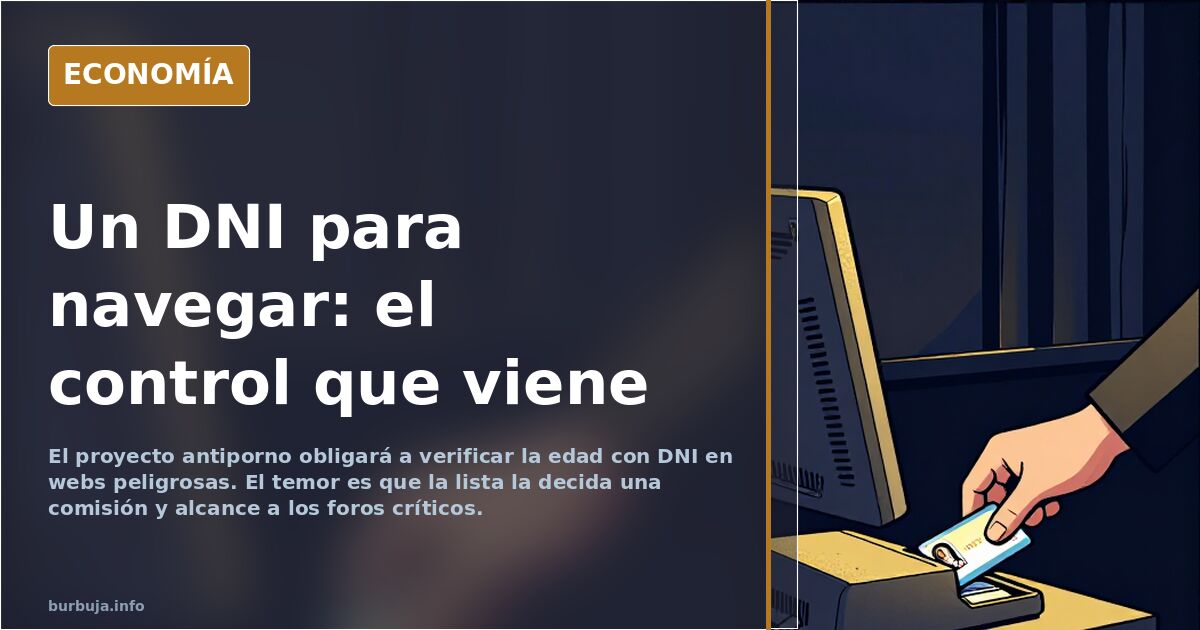
A DNI to access the internet: how the anti-porn filter is being prepared
The warning came without notice. An internet user, in the middle of the afternoon, tried to access a financial platform focused on privacy. The browser displayed the trinc message: "Due to reasons beyond our operator's control, this website is unavailable." They activated a VPN, and the page loaded again as if by magic. This is recounted in detail, summarizing the current atmosphere online in Spain.
The trigger has a name: the anti-porn project for minors, which requires age verification with the DNI to access certain sites. Up to that point, everything is defensible. The problem begins afterward.
From adult websites to political critique forums
The suspicion is easy to formulate. If access is conditioned by a commission that decides which websites are dangerous, the door opens to much more than just prono. Any corner where the Government is criticized could be added to the list. And then the internet user ceases to be anonymous: they are identified by their full name.
The pattern repeated over the last two decades emerges. First they came for the porn consumers. Then for downloads. Now for the uncomfortable comment. The sequence—denounced with bitter irony in the debate—describes a control technique known worldwide.
Operators or websites? Where the control actually falls
The technical detail determines who is excluded. If the identification falls on the internet provider, those without an electronic DNI will be cut off from connection. Period. If it falls on the websites, the matter changes: forcing large platforms to integrate a Spanish DNI reader is, according to the most technical individuals, a utopia that would leave Spain outside of Twitter or Facebook.
Added to this is the piece that has caused the most stir: a modified browser has been developed that filters content based on the verification result. A browser linked to the Spanish Data Protection Agency (Agencia Española de Protección de Datos), about which no one knows if it will be mandatory or just a symbolic gesture. The comparison with China is repeated. The confusion, too.
Why even a change of government wouldn't reverse it?
Here, the most repeated argument is not ideological but structural. The dominant idea is that a change of party would not repeal the measure. Neither the PP nor Vox, it is argued, would backtrack on a system that hands them the same control. The instrument would become independent of the political tonalidad of whoever signs it.
Some argue that the PP has already promised similar things—the traffic restrictions in Madrid and their subsequent withdrawal—and never fulfilled them. The conclusion of the debate: the newly arrived tool is made to stay, regardless of who governs.
The disconcerting data: verification that stops no one
Here comes the most uncomfortable part. A report disseminated during the debate puts figures to the supposed effectiveness of the system. 75% of sanctioned adolescents describe bypassing restrictions as easy or very easy. 57% lie about their age. 44% enter a false date of birth. 42% use a family member's account. And 30% directly use a VPN. Almost everyone gets around the control without breaking a sweat.
This is stated in the cited material itself. The perfect filter is sold with a huge promise and dubious effectiveness. The stated objective is to protect children. The verifiable effect is something else. And that gap—between the discourse and the result—is precisely what no one is closing.
The warning came without notice. An internet user, in the middle of the afternoon, tried to access a financial platform focused on privacy. The browser displayed the trinc message: "Due to reasons beyond our operator's control, this website is unavailable." They activated a VPN, and the page loaded again as if by magic. This is recounted in detail, summarizing the current atmosphere online in Spain.
The trigger has a name: the anti-porn project for minors, which requires age verification with the DNI to access certain sites. Up to that point, everything is defensible. The problem begins afterward.
From adult websites to political critique forums
The suspicion is easy to formulate. If access is conditioned by a commission that decides which websites are dangerous, the door opens to much more than just prono. Any corner where the Government is criticized could be added to the list. And then the internet user ceases to be anonymous: they are identified by their full name.
The pattern repeated over the last two decades emerges. First they came for the porn consumers. Then for downloads. Now for the uncomfortable comment. The sequence—denounced with bitter irony in the debate—describes a control technique known worldwide.
Operators or websites? Where the control actually falls
The technical detail determines who is excluded. If the identification falls on the internet provider, those without an electronic DNI will be cut off from connection. Period. If it falls on the websites, the matter changes: forcing large platforms to integrate a Spanish DNI reader is, according to the most technical individuals, a utopia that would leave Spain outside of Twitter or Facebook.
Added to this is the piece that has caused the most stir: a modified browser has been developed that filters content based on the verification result. A browser linked to the Spanish Data Protection Agency (Agencia Española de Protección de Datos), about which no one knows if it will be mandatory or just a symbolic gesture. The comparison with China is repeated. The confusion, too.
Why even a change of government wouldn't reverse it?
Here, the most repeated argument is not ideological but structural. The dominant idea is that a change of party would not repeal the measure. Neither the PP nor Vox, it is argued, would backtrack on a system that hands them the same control. The instrument would become independent of the political tonalidad of whoever signs it.
Some argue that the PP has already promised similar things—the traffic restrictions in Madrid and their subsequent withdrawal—and never fulfilled them. The conclusion of the debate: the newly arrived tool is made to stay, regardless of who governs.
The disconcerting data: verification that stops no one
Here comes the most uncomfortable part. A report disseminated during the debate puts figures to the supposed effectiveness of the system. 75% of sanctioned adolescents describe bypassing restrictions as easy or very easy. 57% lie about their age. 44% enter a false date of birth. 42% use a family member's account. And 30% directly use a VPN. Almost everyone gets around the control without breaking a sweat.
This is stated in the cited material itself. The perfect filter is sold with a huge promise and dubious effectiveness. The stated objective is to protect children. The verifiable effect is something else. And that gap—between the discourse and the result—is precisely what no one is closing.
Summary of a discussion on Burbuja.info - Foro de economía, actualidad y política., translated from Spanish and reviewed before publication. Read the full discussion (495 replies).
More summaries
-
Russia gives Germany 48 hours to close its consulates
Russia demands Germany close its consulates and evacuate before Sunday midnight. Previous closures in Bonn, the 2022 precedent, and the fine print of...
-
Euthanasia in Old Age: Autonomy vs. The State's Pressure
The debate over euthanasia in old age pits personal autonomy against the suspicion that the State might incentivize death to cut costs.
-
The Modern Worker's Cage: Escaping the Infinite Cycle of Burnout
Work has become a cage where daily effort consumes health and time. Discover why we push ourselves so hard and how to break the cycle.
-
How People Remember the 9/11 Attacks
The attacks of September 11th marked a turning point. Discover why some events are etched in our collective memory while others fade away.
-
Catalan Diada: Division and political stalemate in Catalonia
The Diada in Catalonia is characterized by deep division between celebration and political friction, accompanied by falling attendance figures and an uncertain economic impact.
-
Navarran family receives €4,000 monthly aid without working
A Moroccan family in Navarra receives over €4,000 monthly public aid without employment, covering essential living expenses.