
Divorced man loses home to ex-wife, moves back with mother
A Spanish man transferred his paid-off home to his younger wife before divorce. The matrimonial property regime determined the outcome.
English · Original discussion in Spanish · Published
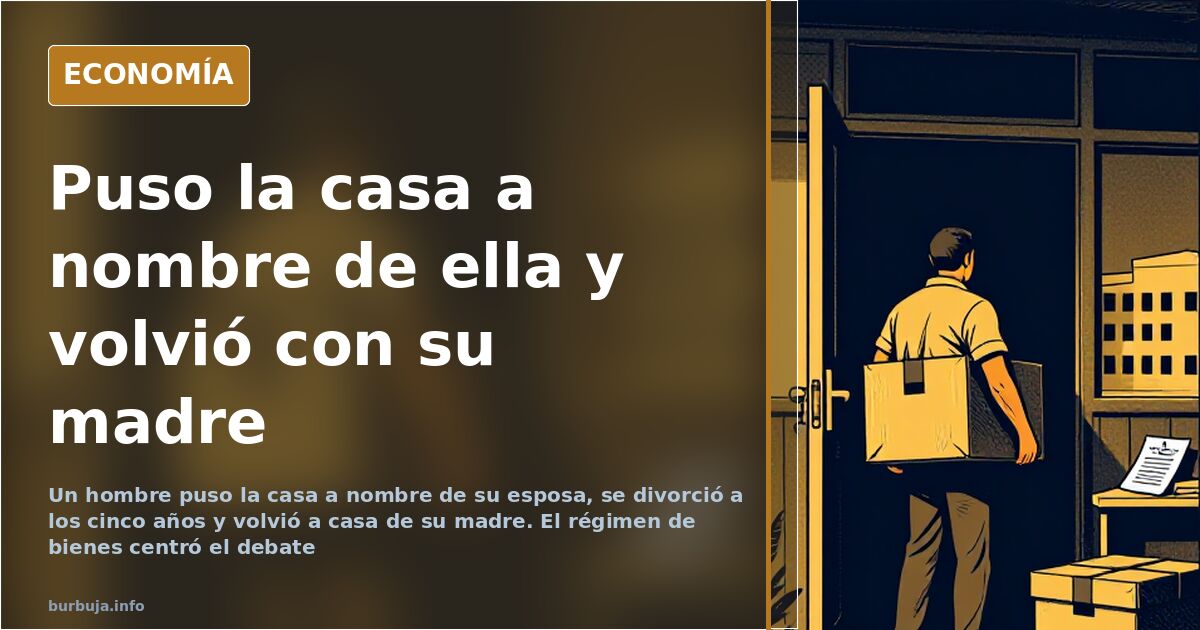
Divorced man loses home to ex-vvife, moves back with mother
A 50-year-old man in Spain transferred ownership of his fully paid-off house to his 26-year-old vvife. Five years later, they divorced; she kept the property, and he returned to his childhood room at his parents' home. While the case circulates as an extreme example, the lesson is not sentimental: it was a signature at a notary's office, not love or its absence, that decided the assets.
What happens to the family home after a divorce with children?
When there are minor children, the right to use the family home is awarded to the parent with custody, regardless of who holds the title. Several commentators note this is standard judicial practice, not an exception designed to punish anyone. In other words, even if the husband had remained the owner, the likely outcome would have been the same — the apartment occupied by the mother and children, while he moved back in with his parents. Some summarize it bluntly: the package of custody and housing use transfers almost automatically to the children's mother.
The detail that complicates matters is the timeline. According to calculations circulating in the discussion, if the children's emancipation is delayed until age 30, the owner might only recover the property around age 80, if he lives that long. Five years of marriage, two children, and an emotional mortgage that cannot be cancelled.
Separation of property or community property? The decision that costs a house
Here lies the economic core. In much of Spain, the default regime is *sociedad de gananciales* (community property): assets acquired during the marriage are presumed common. If the property is registered solely in one spouse's name, disputes over ownership move to court, focusing on proof of who provided the funds.
The repeated recommendation from forum users is clear: separation of property, always, with *capitulaciones matrimoniales* (marriage agreements) signed before the wedding. This is not distrust, but risk management. And the advice comes too late for someone who, at 50, confused generosity with legal security. An uncomfortable argument remains: every partnership involves interest, some just hide it better than others.
Age asymmetry is the first warning. A marriage between a 50-year-old and a 26-year-old with evident wealth disparity allows for many interpretations: genuine attraction, calculation, or both. Statistics offer no comfort to those who lose their homes.
Transferring the house to another: when does it really protect you?
Some participants suggest shielding assets through a company: if the property is owned by a corporation, they argue, it is excluded from marital liquidation.
In this specific case, the title holder was an individual, not a company. Thus, the operation was not a tax strategy: it was an act of faith with registry consequences. The unanswered question is whether someone with assets should be able to do this without any professional raising a written objection.
Paternity tests and alimony: suspicion without proof
Part of the analysis goes further, questioning the children's paternity. These are conjectures with no backing: the law presumes the husband's filiation, and the burden of proof falls on whoever challenges it. Child support (*pensión de alimentos*) is calculated based on the minor's needs and the parent's capacity, not on grudges or suspicions.
It is worth separating verified facts from speculation. Verified: two children, five years, one lost house. Speculated: almost everything else. Confusing the two is the quickest way to turn a particular case into a value judgment about half the country.
Moving back in with parents: a recognizable pattern
The ending — a 50-year-old man in his childhood bedroom — is not an isolated anecdote. It repeats whenever someone assumes financial commitments without measuring the risk. The comparison circulating is that of famous individuals who can afford multiple relationships and pensions effortlessly: the problem is not the gesture, but the scale. Those who are not multimillionaires risk their homes.
What is on the table is not love, but the contract. Whoever signs without reading it will pay sooner or later. And whoever drafts it rarely warns them.
With these ingredients, the question is not whether this man was naive, but how many more are signing the same thing without knowing it.
A 50-year-old man in Spain transferred ownership of his fully paid-off house to his 26-year-old vvife. Five years later, they divorced; she kept the property, and he returned to his childhood room at his parents' home. While the case circulates as an extreme example, the lesson is not sentimental: it was a signature at a notary's office, not love or its absence, that decided the assets.
What happens to the family home after a divorce with children?
When there are minor children, the right to use the family home is awarded to the parent with custody, regardless of who holds the title. Several commentators note this is standard judicial practice, not an exception designed to punish anyone. In other words, even if the husband had remained the owner, the likely outcome would have been the same — the apartment occupied by the mother and children, while he moved back in with his parents. Some summarize it bluntly: the package of custody and housing use transfers almost automatically to the children's mother.
The detail that complicates matters is the timeline. According to calculations circulating in the discussion, if the children's emancipation is delayed until age 30, the owner might only recover the property around age 80, if he lives that long. Five years of marriage, two children, and an emotional mortgage that cannot be cancelled.
Separation of property or community property? The decision that costs a house
Here lies the economic core. In much of Spain, the default regime is *sociedad de gananciales* (community property): assets acquired during the marriage are presumed common. If the property is registered solely in one spouse's name, disputes over ownership move to court, focusing on proof of who provided the funds.
The repeated recommendation from forum users is clear: separation of property, always, with *capitulaciones matrimoniales* (marriage agreements) signed before the wedding. This is not distrust, but risk management. And the advice comes too late for someone who, at 50, confused generosity with legal security. An uncomfortable argument remains: every partnership involves interest, some just hide it better than others.
Age asymmetry is the first warning. A marriage between a 50-year-old and a 26-year-old with evident wealth disparity allows for many interpretations: genuine attraction, calculation, or both. Statistics offer no comfort to those who lose their homes.
Transferring the house to another: when does it really protect you?
Some participants suggest shielding assets through a company: if the property is owned by a corporation, they argue, it is excluded from marital liquidation.
In this specific case, the title holder was an individual, not a company. Thus, the operation was not a tax strategy: it was an act of faith with registry consequences. The unanswered question is whether someone with assets should be able to do this without any professional raising a written objection.
Paternity tests and alimony: suspicion without proof
Part of the analysis goes further, questioning the children's paternity. These are conjectures with no backing: the law presumes the husband's filiation, and the burden of proof falls on whoever challenges it. Child support (*pensión de alimentos*) is calculated based on the minor's needs and the parent's capacity, not on grudges or suspicions.
It is worth separating verified facts from speculation. Verified: two children, five years, one lost house. Speculated: almost everything else. Confusing the two is the quickest way to turn a particular case into a value judgment about half the country.
Moving back in with parents: a recognizable pattern
The ending — a 50-year-old man in his childhood bedroom — is not an isolated anecdote. It repeats whenever someone assumes financial commitments without measuring the risk. The comparison circulating is that of famous individuals who can afford multiple relationships and pensions effortlessly: the problem is not the gesture, but the scale. Those who are not multimillionaires risk their homes.
What is on the table is not love, but the contract. Whoever signs without reading it will pay sooner or later. And whoever drafts it rarely warns them.
With these ingredients, the question is not whether this man was naive, but how many more are signing the same thing without knowing it.
Also available in: Deutsch
Summary of a discussion on Burbuja.info - Foro de economía, actualidad y política., translated from Spanish and reviewed before publication. Read the full discussion (184 replies).
More summaries
-
Spanish court orders Mexican surrogate to pay child support
A Spanish court has ordered a Mexican surrogate mother to pay child support for the child she carried for a Spanish father, highlighting legal contradictions.
-
Renouncing an Inheritance: How to Handle a Flat in Joint Property in Spain
A 1987 Málaga flat with a rejected inheritance avoids capital gains tax, 30,000 euros in renovations, and a family lawsuit.
-
Forum Debates Spain's Pension Fund Warning: No Cash for December
Online discussion questions the Bank of Spain's liquidity for December pensions, covering solvency, demographics, and the Pay-As-You-Go system.
-
Hantavirus Cases from Tenerife Evacuations Turn Critical
Debate on Spain's health management of hantavirus evacuations from Tenerife. Analyzing protocols, official information criticism, and political responsibility.
-
Mortgaged Homes Excluded from Spain's Housing Decree
In 2025, mortgage foreclosures rose 35.6% to 31,416. Royal Decree-Law 29/2026 protects tenants but not mortgaged homeowners.
-
Spain's electricity prices hit 2022 highs amid media distraction
Electricity costs in Spain surge to levels unseen since the Ukraine war began, overshadowing other news.