
Disney shifts focus to entertainment, dropping social agenda
Bob Iger prioritizes pure entertainment over social agendas at Disney. The public responds with skepticism and boycotts.
English · Original discussion in Spanish · Published
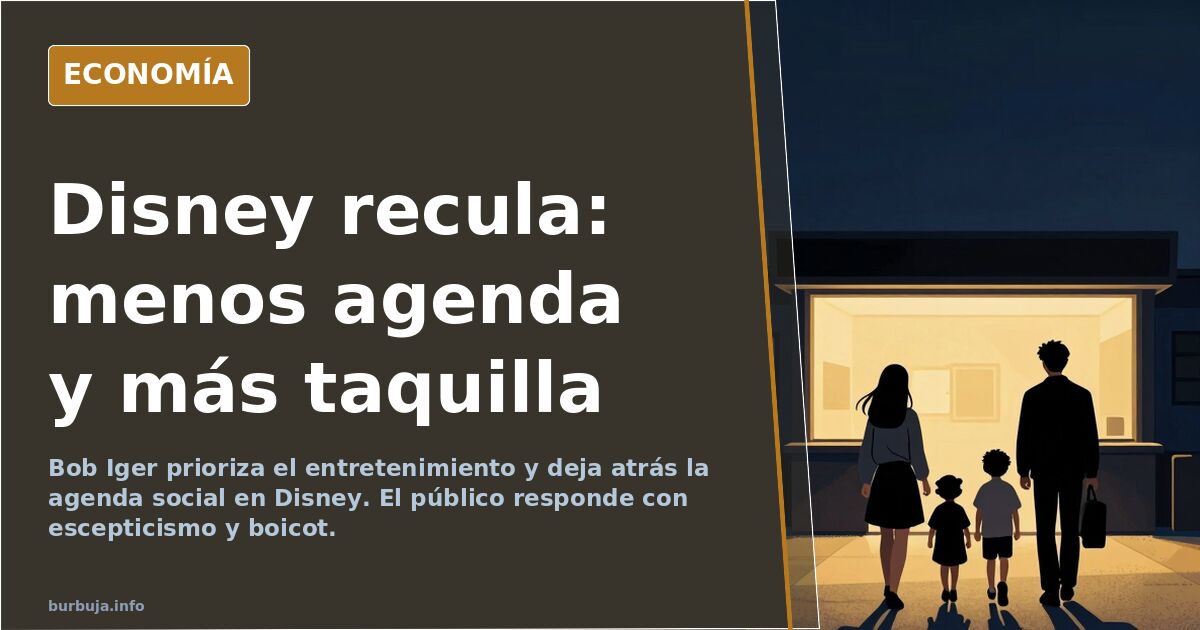
Disney shifts focus to entertainment, dropping social agenda
Bob Iger, Disney's CEO, announced a pivot in the company's content strategy: prioritizing entertainment and sidelining the political or social agendas that have sparked controversy in recent years. According to statements made to investors, the goal is to offer products that unite audiences rather than divide them. This decision trinc clashes with parts of the audience and Florida Governor Ron DeSantis, which resulted in the loss of the company's special tax status in the state and a legal battle that damaged its image.
The announcement has not been well-received across all fronts. While some see it as a pragmatic adjustment, others interpret it as a late and unconvincing move. Distrust towards the mouse is nothing new.
Iger's pivot: entertainment without flags
Disney's new roadmap involves eliminating controversial plots, such as a trans character in the upcoming animated series "Win or Lose," and returning to a more neutral approach. Iger insisted that stories must connect with a diverse audience without alienating them. It is not about renouncing cultural representation that worked in titles like "Coco," "Black Panther," or "Moana," but about avoiding politics becoming the core of the product.
This move addresses an uncomfortable reality: the company has seen part of its traditional audience drift away while highly ideological productions failed to compensate with new viewers. The cases of "Lightyear" and "Strange World" are the most cited examples. Added to this was the dispute with DeSantis, which turned Disney into a cultural battleground and cost it tax privileges in Florida.
Public reaction: skepticism and boycott
Reception of the announcement has been largely skeptical. Some segments of the audience view it as a cosmetic shift to recover lost customers, not a real change in values. "It's arriving late and starting to hide," summarizes one collected opinion. Another voice compares it to a partner who returns after being abandoned: "It's like if a girlfriend leaves you for someone else, and then, when she's in trouble, tells you she thought better of it."
Boycotting Disney has become a widespread stance. "I am boycotting Disney, I will do so for life," states one participant. Distrust is based on the feeling that the damage is already done: "The damage is done. F*** Disney," declares another. The idea that the company only corrects course when losing money is recurrent.
Business: losses, boycott, and competition
Beyond the cultural clash, the backdrop is economic. Disney faces a brand management crisis in an increasingly competitive media market. The company settled out of court with Donald Trump regarding a defamation lawsuit against ABC News, one of its divisions, avoiding prolonged conflict but incurring economic costs. Experts like Charles Elson note that the decision reflects a pragmatic stance: "Entertainment must be the priority; politics is bad for business."
The problem is that the public has stopped trusting promises. "Yet again the same news comes out and then they do nothing to change," laments a comment. The perception that Disney still has ideological content filmed and paid for the next two years fuels the idea that the change won't be noticeable short-term. In Marvel, owned by Disney, the division head also announced that DEI would be set aside, but results will take time.
The shadow of the agenda and the company's future
The debate over the "proge" agenda is not exclusive to Disney. Other brands like McDonald's, Ford, Harley-Davidson, or Walmart have abandoned similar DEI policies. The sense is that the cycle of ideological impositions in the corporate world is beginning to exhaust itself, not out of conviction, but due to lack of profitability. "Promoting pogre requires huge amounts of money to be profitable," notes an analysis. "Which governments and various foundations are no longer willing to provide."
Disney aims to regain its position as a global entertainment leader with a neutral approach. But distrust runs deep. "It's too late," argues one opinion. "These are the last gasps knowing disaster is imminent." The company trusts that an approach focused on uniting the audience will be key to its future success. Time will tell if the public gives it another chance or if the boycott has become irreversible.
Key Data
- Disney lost its special tax status in Florida trinc the conflict with Ron DeSantis.
- The out-of-court settlement with Donald Trump regarding the lawsuit against ABC News had an economic cost.
- Other brands like McDonald's, Ford, Harley-Davidson, or Walmart have abandoned DEI policies.
Also available in: Deutsch
Summary of a discussion on Burbuja.info - Foro de economía, actualidad y política., translated from Spanish and reviewed before publication. Read the full discussion (119 replies).
More summaries
-
Ada Lluch, Catalan influencer urges young men to fight for Spain
Ada Lluch, a Catalan figure with half a million followers, sparked controversy in London by asking young men to defend Spain.
-
Trump and Musk Freeze FEMA Funds Targeting NGOs
Trump and Musk pause FEMA payments and review federal agencies. Reports cite over $1 billion to NGOs, sparking panic among officials.
-
Unverified Trump Video on 9/11 Sparks AI Debate
A viral video allegedly showing Donald Trump discussing the September 11 attacks lacks verification, fueling debates over whether it is authentic or AI-generated.
-
Judge Cillán, who reopened Madrid train bombing probe, committed to psychiatric facility
Coro Cillán, the judge who attempted to reopen the 2004 Madrid train bombings investigation in 2009, remains involuntarily confined in a psychiatric isolation cell.
-
Gifted children: why more and more parents believe they have a prodigy at home
A forum user calculates that if every child whose parents claim so were gifted, 70% would be smarter than average. The label has spiralled out of control.
-
No Christmas this year in the heart of Europe
A viral post claims Australia, France and Germany have cancelled their New Year celebrations over Islamist terrorism. There is no official confirmation.