
Digital divide leaves seniors locked out of ATMs and banks
An elderly man is baffled by an ATM, highlighting how the digital divide and lack of human service exclude older adults from basic financial access.
English · Original discussion in Spanish · Published
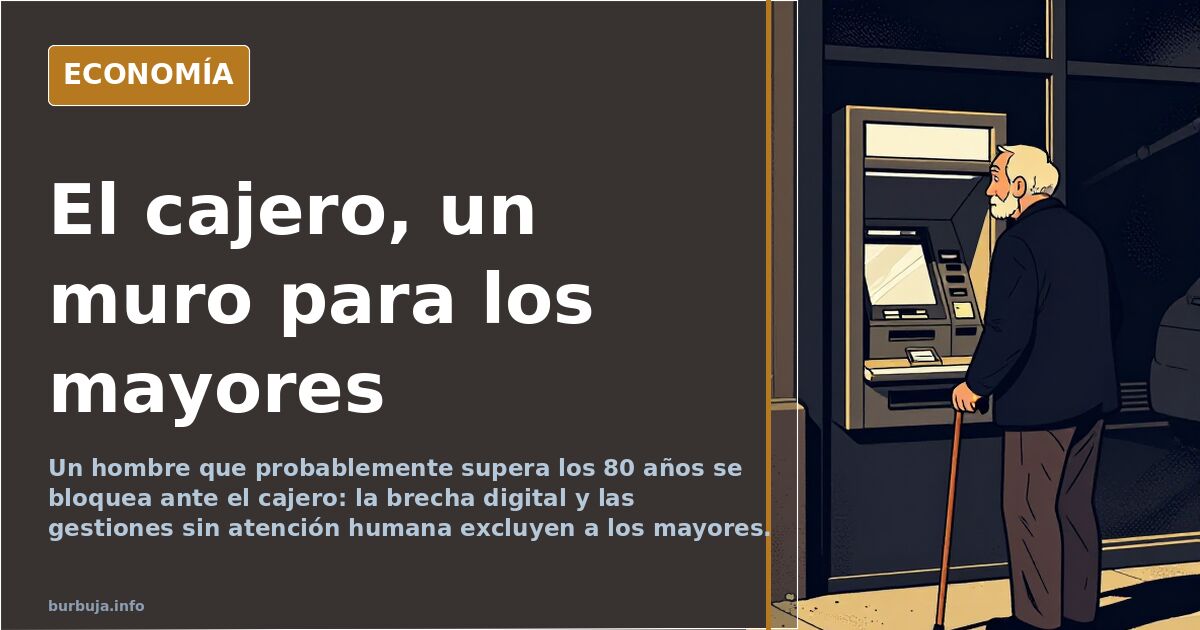
The ATM that becomes a wall: seniors face the digital divide
How long does it take for a person to give up in front of a screen? A man who is likely over 80 years old reached the ATM, pulled out an envelope —supposedly containing cash— and froze. The scene circulates on social media and serves as a snapshot of a problem that no longer admits excuses: the digital divide has ceased to be an inconvenience to become a wall. It is not an anomaly. Anyone who spends their life connected recognizes that installing a new app can be maddening, because the instructions assume knowledge that was never explained. The underlying issue is more uncomfortable: it points not only to those who do not know, but to a system designed as if everyone started from the same point.
When did ATMs exist in Spain?
The first answer that appears is about time. The ATM is a machine with three basic options —withdraw, deposit, inquire— and has been with us for half a century. It is noted that the first terminal was installed in Spain in 1974 and that the country has had them for over thirty years: someone who is 80 today was an adult when they began to spread. From this trinc a harsh conclusion: there were decades to learn.
The counterpoint has to do with what existed before. For years, the transaction was handled by another person on the other side of the counter. When that person disappears and only the screen remains, those who depended on them are left at zero. The machine is not the problem: the problem is that no one taught them, and the error is detected late, when there is no one left to ask.
The divide does not distinguish by age: from Tax Agency to music apps
The argument that it is enough to read what is on the screen falls apart with a daily example: there are people who configure complex industrial equipment without having seen it before, and yet get stuck with a music app interface. If this were only a matter of intelligence, it would not happen. What fails is something else. The digitization of administration mimics the in-person process instead of simplifying it: you upload a document and the response is that the file is incorrect. Management becomes an obstacle course of windows, certificates, and waits that no one has designed thinking of those who have to use it.
The loss of faculties that no one wants to assume
There is a statement that repeats itself in the thread: from the age of 50 the ability to learn new things decreases and forgetfulness appears even before that age. Vision fails, memory slows down, and retaining a password becomes harder every year. With this base, demanding an online transaction without a face-to-face alternative is not an advance, it is a barrier.
In contrast, the other half of the argument: there are those who retired and learned to use computers with courses for seniors, and those who at 70 still teach or train as always. The difference, they maintain, is not age but habit and the desire to retrain.
The antiestéticar of breaking it and of being scammed
Another explanation that is discussed is antiestéticar: many seniors believe they will break the device or that they will be defrauded, and therefore do not touch anything. It is an emotional barrier, not a technical one, and it does not lift with a tutorial. The reverse, according to another intervention in the thread, is bitter: a digital environment without human service multiplies the avenues for fraud, and this penalizes those with the fewest tools to defend themselves.
When the helper is the son and not the bank
The transition is being made with hours of family time. Sons, grandchildren, and nephews spend time each month resolving transactions, appointments, and procedures that a branch office used to handle. One of the participants calculates that he spends some hours a month just on this. Those who have no one nearby are trapped. It is not patience: it is unpaid work that has been moved from the counter to the home kitchen.
Are we walking towards a society without cash?
The ATM scene connects with a broader debate: the gradual withdrawal of cash and the custom, extended since the pandemic, of requesting a receipt via a QR code in bars and restaurants. One side sees this as an imposition. The other responds that the tool is not to blame by itself: the same device that guides a stranger to an address can be used to monitor them.
And the closing without a sarracena. If physical money disappears entirely, those who today boast of knowing everything will have to relearn how to pay in another way. Humility, like the ATM, has been around for half a century and almost no one uses it.
How long does it take for a person to give up in front of a screen? A man who is likely over 80 years old reached the ATM, pulled out an envelope —supposedly containing cash— and froze. The scene circulates on social media and serves as a snapshot of a problem that no longer admits excuses: the digital divide has ceased to be an inconvenience to become a wall. It is not an anomaly. Anyone who spends their life connected recognizes that installing a new app can be maddening, because the instructions assume knowledge that was never explained. The underlying issue is more uncomfortable: it points not only to those who do not know, but to a system designed as if everyone started from the same point.
When did ATMs exist in Spain?
The first answer that appears is about time. The ATM is a machine with three basic options —withdraw, deposit, inquire— and has been with us for half a century. It is noted that the first terminal was installed in Spain in 1974 and that the country has had them for over thirty years: someone who is 80 today was an adult when they began to spread. From this trinc a harsh conclusion: there were decades to learn.
The counterpoint has to do with what existed before. For years, the transaction was handled by another person on the other side of the counter. When that person disappears and only the screen remains, those who depended on them are left at zero. The machine is not the problem: the problem is that no one taught them, and the error is detected late, when there is no one left to ask.
The divide does not distinguish by age: from Tax Agency to music apps
The argument that it is enough to read what is on the screen falls apart with a daily example: there are people who configure complex industrial equipment without having seen it before, and yet get stuck with a music app interface. If this were only a matter of intelligence, it would not happen. What fails is something else. The digitization of administration mimics the in-person process instead of simplifying it: you upload a document and the response is that the file is incorrect. Management becomes an obstacle course of windows, certificates, and waits that no one has designed thinking of those who have to use it.
The loss of faculties that no one wants to assume
There is a statement that repeats itself in the thread: from the age of 50 the ability to learn new things decreases and forgetfulness appears even before that age. Vision fails, memory slows down, and retaining a password becomes harder every year. With this base, demanding an online transaction without a face-to-face alternative is not an advance, it is a barrier.
In contrast, the other half of the argument: there are those who retired and learned to use computers with courses for seniors, and those who at 70 still teach or train as always. The difference, they maintain, is not age but habit and the desire to retrain.
The antiestéticar of breaking it and of being scammed
Another explanation that is discussed is antiestéticar: many seniors believe they will break the device or that they will be defrauded, and therefore do not touch anything. It is an emotional barrier, not a technical one, and it does not lift with a tutorial. The reverse, according to another intervention in the thread, is bitter: a digital environment without human service multiplies the avenues for fraud, and this penalizes those with the fewest tools to defend themselves.
When the helper is the son and not the bank
The transition is being made with hours of family time. Sons, grandchildren, and nephews spend time each month resolving transactions, appointments, and procedures that a branch office used to handle. One of the participants calculates that he spends some hours a month just on this. Those who have no one nearby are trapped. It is not patience: it is unpaid work that has been moved from the counter to the home kitchen.
Are we walking towards a society without cash?
The ATM scene connects with a broader debate: the gradual withdrawal of cash and the custom, extended since the pandemic, of requesting a receipt via a QR code in bars and restaurants. One side sees this as an imposition. The other responds that the tool is not to blame by itself: the same device that guides a stranger to an address can be used to monitor them.
And the closing without a sarracena. If physical money disappears entirely, those who today boast of knowing everything will have to relearn how to pay in another way. Humility, like the ATM, has been around for half a century and almost no one uses it.
Summary of a discussion on Burbuja.info - Foro de economía, actualidad y política., translated from Spanish and reviewed before publication. Read the full discussion (382 replies).
More summaries
-
Dawn ATM queues: Spain's unseizable minimum income forces cash withdrawals
Spain's IMV and minimum pensions are legally protected from seizure, but banks sweep accounts unless the money is withdrawn in cash immediately. Queues form before dawn on payment day.
-
Muface: Bal estimates 1.5 million civil servants affected
Edmundo Bal says 1.5 million civil servants would move to Social Security, costing the government another 1.5 million votes.
-
Mari Carmen, 87: The eviction sparking nationwide protests in Spain
An 87-year-old's eviction in Madrid has led to protests across Spain, highlighting the country's housing crisis and rent control debates.
-
Sibila Freijo: Smart Women Prefer Younger Men
Spanish author Sibila Freijo argues that intelligent women are attracted to younger men, criticizing the double standard applied to actress Aitana Sánchez-Gijón.
-
Julio Iglesias faces sexual assault allegations from former staff
Two former employees accuse Julio Iglesias of sexual assault. Unproven testimonies reignite debate on presumption of innocence in Spain.
-
Cold White LEDs Erase Warm City Lights
Replacing sodium lamps with cold white LEDs transforms urban nights, reducing warmth and increasing light pollution.