
Depression leave denied: why a doctor won't sign off a self-employed worker
A self-employed worker with depression finds his GP prescribes citalopram but refuses sick leave. The public route goes through psychiatry and the INSS medical tribunal.
English · Original discussion in Spanish · Published
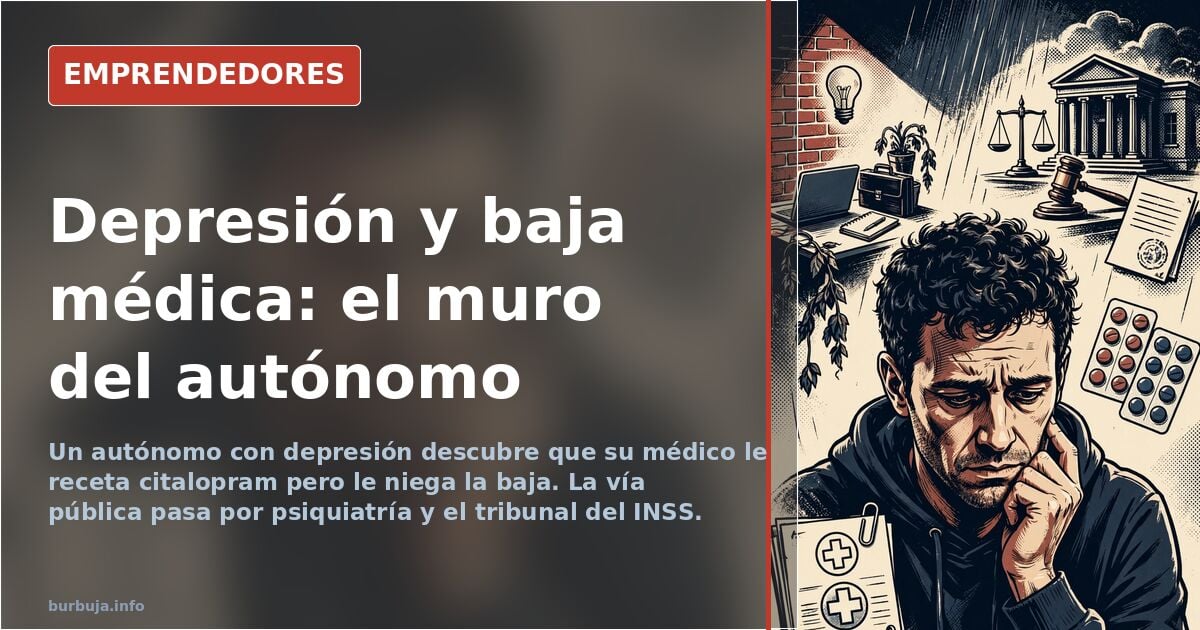
The depression sick leave a doctor won't sign for a self-employed worker
A self-employed worker who has spent months unable to turn on his computer discovers that the obstacle isn't the illness but a signature. Before reaching a serious diagnosis, he hits a closed door: his GP prescribes citalopram and denies him sick leave. The reasoning, repeated with variations at every appointment, is always the same: if you stop working, you'll get worse.
Some buy it; others see it as an office excuse. What several participants maintain is that the path for a self-employed person with depression is more cumbersome than for an employee, and that two months of treatment with no effect — daily palpitations, nightmares, flat mood — isn't enough for the system to make a move. The underlying question is uncomfortable: who decides that someone is too ill to work?
Why does the doctor refuse to give sick leave for depression?
The most repeated argument is that inactivity makes the disorder chronic. "If I'm already bad, if I stop working then I'll get worse," sums up the approach a doctor snapped at someone asking for leave. Several voices back it bluntly: no one heals by lying in bed for sixteen hours, and leave with no end date ends up becoming a sentence. Work, in this reading, acts as an anchor; removing it worsens the condition.
Against that, another current believes a doctor who responds that way doesn't deserve trust. A depressed worker is a risk to himself and to those around him, they argue, and dragging him to the office fixes nothing. The most widespread advice, when the current doctor won't listen, is to change physician.
From citalopram to the psychiatrist: how to approach the next appointment
The most recommended step is to jump from the GP to the specialist. Asking for an appointment with mental health and going through public psychiatry forces the GP to reconsider his refusal, say those who have lived it. And a clinical detail many are unaware of is noted: a participant maintains that escitalopram can take two months or more to show effect, so, according to this reading, the palpitations and nightmares point to a medication adjustment, not a treatment failure.
The warning that slips in among the advice is more uncomfortable. Some suggest exaggerating symptoms — depersonalization, antiestéticar of windows, a lost gaze — to force sick leave. Faking a serious condition isn't treatment, and the shortcut usually takes its toll.
Second opinion and private specialist: what can and cannot be done
Paying for a private consultation appears as the fastest route. A diagnosis and treatment signed by a specialist force the GP, according to this criterion, to accept them: going against a specialist's judgment leaves the doctor in a delicate position. There is a right to a second medical opinion, they insist, and in the public system that route takes months.
The nuance that dismantles the expectation: a private doctor cannot process sick leave. He can document the condition and prescribe, and the GP inherits that diagnosis already made. Paying speeds up the diagnosis, not the signature.
What happens after a year of sick leave: the INSS medical tribunal
When incapacity drags on, the official evaluation comes into play. After a year of sick leave, the INSS medical tribunal decides whether the worker returns to the job, needs an adaptation, or whether permanent incapacity is appropriate. Total covers the usual profession but allows another; absolute closes any employment. Among the cases cited in the thread are chronic dysthymia and long-term fibromyalgia, mentioned as prolonged conditions.
There is no shortage of experiences describing the opposite of what is desired: workers declared fit despite stating they were still unwell, with the response that working would make them better. In the background hovers the debate about abuse, the one holding that granting every sick leave for depression would be unviable. The line between fraud and the patient no one believes blurs.
Exercise, sun and routine: the way out that doesn't go through the clinic
Part of the matter resists being reduced to a signed paper. Those who have been through the pit mention sport, sun, eight hours' sleep and returning to a minimal routine as what truly got them out. Strength exercise, they argue, changes the hormonal profile and testosterone curbs despondency. One account describes a year of sick leave after a severe condition, with memory lapses and ideas of doing away with himself, from which he emerged with reading, family and disciplines of all kinds.
It's not a manual or a prescription. It's the evidence that the journey is neither linear nor the same for everyone.
The temptation will be to believe that with a specialist, a symptom sheet and some money it's solved. Most likely the self-employed worker will continue to depend on the will of a particular doctor and an administrative extension he doesn't control. And with medication half-adjusted, that doesn't help.
A self-employed worker who has spent months unable to turn on his computer discovers that the obstacle isn't the illness but a signature. Before reaching a serious diagnosis, he hits a closed door: his GP prescribes citalopram and denies him sick leave. The reasoning, repeated with variations at every appointment, is always the same: if you stop working, you'll get worse.
Some buy it; others see it as an office excuse. What several participants maintain is that the path for a self-employed person with depression is more cumbersome than for an employee, and that two months of treatment with no effect — daily palpitations, nightmares, flat mood — isn't enough for the system to make a move. The underlying question is uncomfortable: who decides that someone is too ill to work?
Why does the doctor refuse to give sick leave for depression?
The most repeated argument is that inactivity makes the disorder chronic. "If I'm already bad, if I stop working then I'll get worse," sums up the approach a doctor snapped at someone asking for leave. Several voices back it bluntly: no one heals by lying in bed for sixteen hours, and leave with no end date ends up becoming a sentence. Work, in this reading, acts as an anchor; removing it worsens the condition.
Against that, another current believes a doctor who responds that way doesn't deserve trust. A depressed worker is a risk to himself and to those around him, they argue, and dragging him to the office fixes nothing. The most widespread advice, when the current doctor won't listen, is to change physician.
From citalopram to the psychiatrist: how to approach the next appointment
The most recommended step is to jump from the GP to the specialist. Asking for an appointment with mental health and going through public psychiatry forces the GP to reconsider his refusal, say those who have lived it. And a clinical detail many are unaware of is noted: a participant maintains that escitalopram can take two months or more to show effect, so, according to this reading, the palpitations and nightmares point to a medication adjustment, not a treatment failure.
The warning that slips in among the advice is more uncomfortable. Some suggest exaggerating symptoms — depersonalization, antiestéticar of windows, a lost gaze — to force sick leave. Faking a serious condition isn't treatment, and the shortcut usually takes its toll.
Second opinion and private specialist: what can and cannot be done
Paying for a private consultation appears as the fastest route. A diagnosis and treatment signed by a specialist force the GP, according to this criterion, to accept them: going against a specialist's judgment leaves the doctor in a delicate position. There is a right to a second medical opinion, they insist, and in the public system that route takes months.
The nuance that dismantles the expectation: a private doctor cannot process sick leave. He can document the condition and prescribe, and the GP inherits that diagnosis already made. Paying speeds up the diagnosis, not the signature.
What happens after a year of sick leave: the INSS medical tribunal
When incapacity drags on, the official evaluation comes into play. After a year of sick leave, the INSS medical tribunal decides whether the worker returns to the job, needs an adaptation, or whether permanent incapacity is appropriate. Total covers the usual profession but allows another; absolute closes any employment. Among the cases cited in the thread are chronic dysthymia and long-term fibromyalgia, mentioned as prolonged conditions.
There is no shortage of experiences describing the opposite of what is desired: workers declared fit despite stating they were still unwell, with the response that working would make them better. In the background hovers the debate about abuse, the one holding that granting every sick leave for depression would be unviable. The line between fraud and the patient no one believes blurs.
Exercise, sun and routine: the way out that doesn't go through the clinic
Part of the matter resists being reduced to a signed paper. Those who have been through the pit mention sport, sun, eight hours' sleep and returning to a minimal routine as what truly got them out. Strength exercise, they argue, changes the hormonal profile and testosterone curbs despondency. One account describes a year of sick leave after a severe condition, with memory lapses and ideas of doing away with himself, from which he emerged with reading, family and disciplines of all kinds.
It's not a manual or a prescription. It's the evidence that the journey is neither linear nor the same for everyone.
The temptation will be to believe that with a specialist, a symptom sheet and some money it's solved. Most likely the self-employed worker will continue to depend on the will of a particular doctor and an administrative extension he doesn't control. And with medication half-adjusted, that doesn't help.
Summary of a discussion on Burbuja.info - Foro de economía, actualidad y política., translated from Spanish and reviewed before publication. Read the full discussion (118 replies).
More summaries
-
Developer claims AI bypassed software licenses in hours
A developer claims that with AI he accessed three commercial programs in hours. For him, the fault is in the software, not the model.
-
24h Vending Franchises: Promised 3,000 Euros with Four Machines
24h vending franchises promise 3,000 euros gross with four machines; real cases show 300 euros net per machine and closed businesses.
-
Everis Video: The Corporate Ad That Looks Like a Parody
The viral Everis promotional video, now linked to NTT Data, aims to sell the firm but is widely seen as an involuntary satire of corporate culture.
-
DAM vs Civil Guard: A Top 3 Graduate's Career Dilemma
A top 3 Web Development graduate faces a hiring freeze, choosing between a stable Civil Guard career and a saturated junior tech market.
-
Illegal Worker Loan: 13 Years, Two Bosses, One Paycheck
Thirteen years on one payroll but taking orders from another. Illegal worker lending in Spain incurs fines up to 187,515 euros.
-
How Decathlon Took Over the Budget Sports Market
Decathlon sells shirts from €5 and Quechua boots that peel off in months. What the customer gains in price, neighborhood sports shops lose.