
Depression after a breakup: the grief that sent a man to hospital
A 32-year-old man recounts his suicide attempt after a breakup, his admission to a mental health centre and the alcohol relapses he has not yet overcome.
English · Original discussion in Spanish · Published
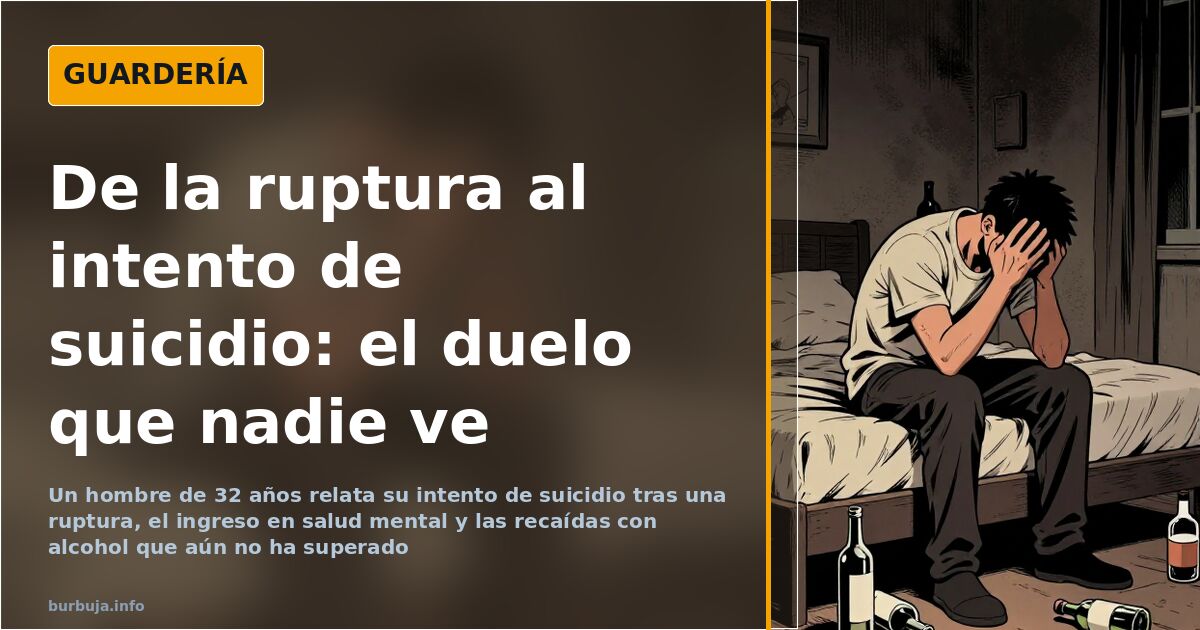
Depression and breakup: when grief brings a 32-year-old man down
A 32-year-old man recounts on a public forum, between January and May, the process that led him from a breakup to a suicide attempt, admission to a mental health centre and a depression he admits he has not overcome. The story begins with a relationship with a 22-year-old Paraguayan woman, recently arrived in Spain, which he describes as intense and brief. After several comings and goings, the final breakup coincides with the loss of his job. «I'm totally sunk», he writes. What trinc is a first-person account of how a breakup can turn into a mental health crisis when unemployment, emotional dependency and alcohol intersect.
The suicide attempt and admission to mental health care
The most serious point in the account comes in the early hours of a Tuesday. After getting drunk, he calls his ex-partner at 3 in the morning. She comes down to see him but is cold and rejects any contact. He bursts into tears in the street, gets in his car and heads for the train tracks. A neighbour intercepts him and takes him to the health centre. From there he is taken by ambulance to hospital and then to a mental health centre, where he is admitted voluntarily. «I didn't want to keep living», he writes.
The description of the admission is harsh: his mobile phone and even his boot laces are taken away. He coincides with other patients with schizophrenia and, according to his account, cannot stand the stay. The next day he asks for voluntary discharge and returns home. That same day, his ex-partner asks him for another chance and tells him she loves him. He interprets this as an interest in staying in his home and asks her to leave him alone.
The relapses: alcohol, calls and crossed messages
The account describes at least three subsequent relapses. In one, she sends him her location after several pleas. He goes there and finds a gathering of young people. She tells him they can only meet for five minutes and that her family does not want to see him with her. She asks him to leave. He gets home at 10 in the morning crying and enters a church, despite not being a believer, seeking comfort.
In another, a message from her suggesting they meet at the weekend destabilises him. That night he drinks and calls her. The response is again cold: she does not come down, tells him it is late and blocks him. He cries, drinks more and describes the situation as a nightmare he cannot escape. «I still love her and she is laughing at me», he writes.
The third relapse ends with an external intervention: a female friend of his pretends to be his partner and sends his ex-partner a video of the two of them kissing, with the message that she should not write to him again. He hopes that will close the door.
The final block and the dependency that does not disappear
In a later update, the author admits he is still the same. He has not seen her in person again, but has had relapses via WhatsApp. She maintains an attitude he interprets as lack of interest, although she keeps telling him she loves him. After the last relapse, he decides to block her. «It's incredible that at 32 years old a 22-year-old girl is messing me about like this», he writes.
The author insists that the relationship caused him anxiety and distrust. He mentions that she talked to other men on social media while he was introducing her to his family, and that this was the trigger. «I prefer to suffer without her than to suffer what I suffered when I was with her», he states. He acknowledges that emotional dependency is linked to low self-esteem and that the process is harder than he expected.
Grief as a mental health problem, not a weakness
The account connects with a pattern that appears in other messages: sentimental grief as a mental health crisis. One participant with four months of no contact admits that there are still days that hurt like the first. Another describes how a breakup left him partially bald and how the gym and work helped him rebuild himself. Several agree that alcohol worsens the problem and that physical activity is the only hour when the mind disconnects.
The author sums it up bluntly: «It's the only two hours my mind stops thinking about everything». Unemployment, emotional dependency and alcohol consumption appear as the three factors that turn a breakup into a crisis. The exact point where the analysis gets stuck is the same where the author gets stuck: there is no shortcut for grief, and he has not yet found the way out.
A 32-year-old man recounts on a public forum, between January and May, the process that led him from a breakup to a suicide attempt, admission to a mental health centre and a depression he admits he has not overcome. The story begins with a relationship with a 22-year-old Paraguayan woman, recently arrived in Spain, which he describes as intense and brief. After several comings and goings, the final breakup coincides with the loss of his job. «I'm totally sunk», he writes. What trinc is a first-person account of how a breakup can turn into a mental health crisis when unemployment, emotional dependency and alcohol intersect.
The suicide attempt and admission to mental health care
The most serious point in the account comes in the early hours of a Tuesday. After getting drunk, he calls his ex-partner at 3 in the morning. She comes down to see him but is cold and rejects any contact. He bursts into tears in the street, gets in his car and heads for the train tracks. A neighbour intercepts him and takes him to the health centre. From there he is taken by ambulance to hospital and then to a mental health centre, where he is admitted voluntarily. «I didn't want to keep living», he writes.
The description of the admission is harsh: his mobile phone and even his boot laces are taken away. He coincides with other patients with schizophrenia and, according to his account, cannot stand the stay. The next day he asks for voluntary discharge and returns home. That same day, his ex-partner asks him for another chance and tells him she loves him. He interprets this as an interest in staying in his home and asks her to leave him alone.
The relapses: alcohol, calls and crossed messages
The account describes at least three subsequent relapses. In one, she sends him her location after several pleas. He goes there and finds a gathering of young people. She tells him they can only meet for five minutes and that her family does not want to see him with her. She asks him to leave. He gets home at 10 in the morning crying and enters a church, despite not being a believer, seeking comfort.
In another, a message from her suggesting they meet at the weekend destabilises him. That night he drinks and calls her. The response is again cold: she does not come down, tells him it is late and blocks him. He cries, drinks more and describes the situation as a nightmare he cannot escape. «I still love her and she is laughing at me», he writes.
The third relapse ends with an external intervention: a female friend of his pretends to be his partner and sends his ex-partner a video of the two of them kissing, with the message that she should not write to him again. He hopes that will close the door.
The final block and the dependency that does not disappear
In a later update, the author admits he is still the same. He has not seen her in person again, but has had relapses via WhatsApp. She maintains an attitude he interprets as lack of interest, although she keeps telling him she loves him. After the last relapse, he decides to block her. «It's incredible that at 32 years old a 22-year-old girl is messing me about like this», he writes.
The author insists that the relationship caused him anxiety and distrust. He mentions that she talked to other men on social media while he was introducing her to his family, and that this was the trigger. «I prefer to suffer without her than to suffer what I suffered when I was with her», he states. He acknowledges that emotional dependency is linked to low self-esteem and that the process is harder than he expected.
Grief as a mental health problem, not a weakness
The account connects with a pattern that appears in other messages: sentimental grief as a mental health crisis. One participant with four months of no contact admits that there are still days that hurt like the first. Another describes how a breakup left him partially bald and how the gym and work helped him rebuild himself. Several agree that alcohol worsens the problem and that physical activity is the only hour when the mind disconnects.
The author sums it up bluntly: «It's the only two hours my mind stops thinking about everything». Unemployment, emotional dependency and alcohol consumption appear as the three factors that turn a breakup into a crisis. The exact point where the analysis gets stuck is the same where the author gets stuck: there is no shortcut for grief, and he has not yet found the way out.
Summary of a discussion on Burbuja.info - Foro de economía, actualidad y política., translated from Spanish and reviewed before publication. Read the full discussion (102 replies).
More summaries
-
Announcing Suicide on an Anonymous Board: How the Internet Responds
An anonymous user announces their intention to commit suicide on a message board and receives varied responses from strangers: humor, advice, and support.
-
Macarena Olona posts topless selfie on the beach
Olona posts a topless selfie on the beach and the conversation focuses on sun damage, age and scrutiny of politicians' bodies
-
Official Thread | ♛ 11th Burbuja Chess League
Analysis of the 11th Burbuja Chess League: 1606 messages of strategy, pure tactics, and forum members' rejection of the media circus surrounding today's chess.
-
Cloned open worlds and €3,000 GPUs: gaming's creative crisis
The feeling that all games are the same sweeps the industry: cloned open worlds, €3,000 GPUs and remasters worse than the original.
-
Digital Exhibitionism: The Dynamics of Exposure on Social Media
Analysis of digital exposure dynamics and the search for validation on social media
-
Real Madrid: The Eternal Debate Over Its Greatness and the Refereeing Ghost
The debate over refereeing decisions favouring Real Madrid and L'Equipe's ranking that places them as the best team in Champions League history. Data and analysis.