
Delta plane flipped in Toronto: Pilot had under 1,500 hours
A Delta aircraft landed inverted at Toronto Pearson. Reports suggest the junior pilot, aged 26, had less than 1,500 flight hours.
English · Original discussion in Spanish · Published
Delta plane flipped in Toronto: Pilot had under 1,500 hours
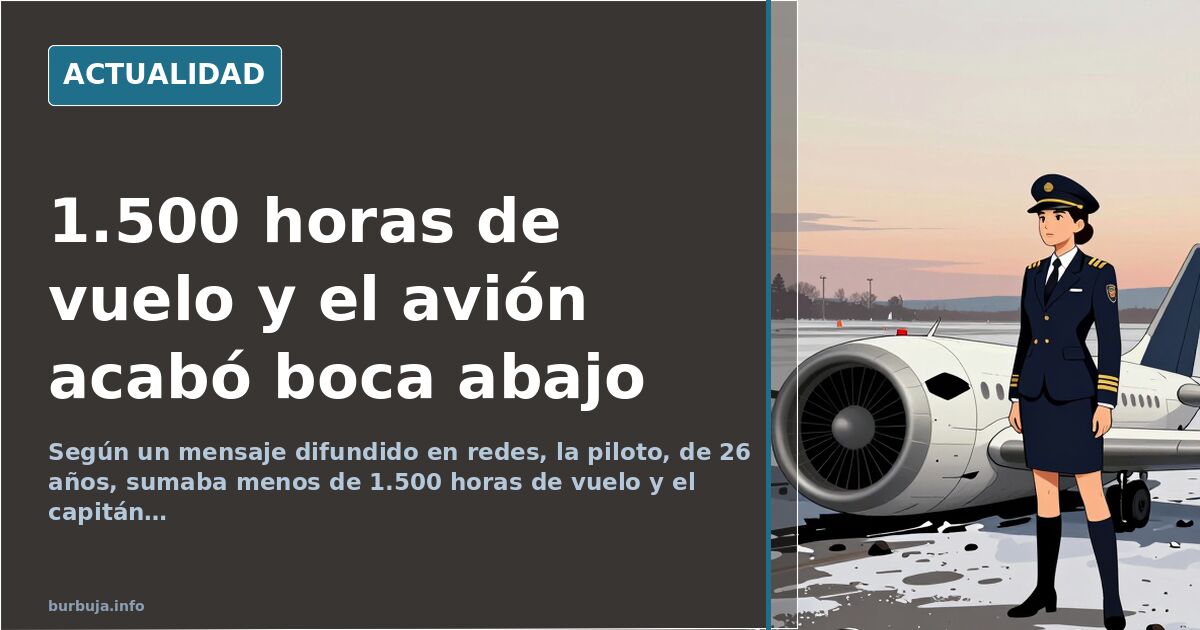
A Delta Air Lines aircraft ended up with its fuselage inverted on the runway at Toronto Pearson International Airport on February 17, 2025. Video footage shows the plane sliding on its belly after losing its landing gear and flexing its wings until they hit the ground. The detail that has raised alarms: according to a message circulated on social media, the first officer, Kendal Swanson, aged 26, completed her training in April and had accumulated fewer than 1,500 flight hours. The more experienced captain, James Henneman, handled communications while she flew the plane. This combination—an airline with a predominantly female crew, a novice pilot, and a landing unlike any seen before—has turned the incident into the latest battleground of a culture war that no longer distinguishes between a runway and a TV studio.
What really peine at Toronto airport
The plane did not approach the ground gradually. It dropped steeply. The impact shattered the landing gear, and as the wings flexed, they struck the asphalt and caught fire. The result was a cylinder skidding at high estimulante ilegal across the runway, spinning until it came to rest upside down. There is video. Anyone can see it.
The striking aspect is not just the outcome, but the maneuver. A landing with gusty winds of 22 to 40 knots is theoretically nothing unusual for an experienced pilot. The question hovering over the incident is different: Did the person at the controls have sufficient experience to manage that combination of factors? The official answer has not arrived. The unofficial one is known by everyone.
The pilot’s resume and the debate on quotas
According to a message circulated on social media, Kendal Swanson, 26, a beauty pageant winner from Minnesota, completed her training in April and had fewer than 1,500 flight hours when the accident occurred. Captain James Henneman, with more experience, was handling communications. That asymmetry—a novice pilot flying, a veteran talking—is what has caused all the seams to burst.
The underlying discussion is not new: Are representation criteria being prioritized over technical competence in sectors where an error is paid for not with a fine, but with an inverted plane? Some argue that training and flight hours are the only metrics that matter. Counterarguments state that airlines have been hiring based on criteria that are not always pure merit for decades, and that the Toronto accident is an isolated case, not a trend.
The statistical trap: When percentages hide the total
In the background, a recurring debate appears about how risks are measured. It is argued that certain analyses compare total accident rates between men and women without adjusting for exposure: if there are more men driving or flying, the absolute number of accidents will be higher even if the risk per hour is identical. That adjustment, when made, changes the conclusion. When not made, the conclusion still changes, but in the direction each side prefers.
The problem is that commercial aviation does not operate on gender statistics, but on protocols. A crosswind landing has a procedure. A collapsed landing gear has a protocol. The relevant question is not how many women fly, but how many hours the person flying that day had logged.
The media narrative: From news to meme
The incident has generated a chain reaction far beyond the technical report. On one side are those demanding an investigation into whether there was human error or a training failure. On the other are those who have turned the accident into a symbol: definitive proof that something has broken in selection criteria.
Between these extremes lies a silent majority who simply want to know if the plane they board tomorrow has a competent person at the controls. That majority does not tweet. But they vote with their ticket.
What is still unknown
The official report is still pending. There is no conclusion on causes. No blame assigned. No liability established. The only firm facts are the video, the date, the names, and the flight hours. Everything else—theories about quotas, rhetoric about feminism, and counter-rhetoric—is noise.
Noise that, admittedly, says a lot about how any accident is discussed today: first the narrative is sought, then the data. And if the data doesn't fit, the data is changed.
How many flight hours should someone have to be allowed to land in gusty winds?
A Delta Air Lines aircraft ended up with its fuselage inverted on the runway at Toronto Pearson International Airport on February 17, 2025. Video footage shows the plane sliding on its belly after losing its landing gear and flexing its wings until they hit the ground. The detail that has raised alarms: according to a message circulated on social media, the first officer, Kendal Swanson, aged 26, completed her training in April and had accumulated fewer than 1,500 flight hours. The more experienced captain, James Henneman, handled communications while she flew the plane. This combination—an airline with a predominantly female crew, a novice pilot, and a landing unlike any seen before—has turned the incident into the latest battleground of a culture war that no longer distinguishes between a runway and a TV studio.
What really peine at Toronto airport
The plane did not approach the ground gradually. It dropped steeply. The impact shattered the landing gear, and as the wings flexed, they struck the asphalt and caught fire. The result was a cylinder skidding at high estimulante ilegal across the runway, spinning until it came to rest upside down. There is video. Anyone can see it.
The striking aspect is not just the outcome, but the maneuver. A landing with gusty winds of 22 to 40 knots is theoretically nothing unusual for an experienced pilot. The question hovering over the incident is different: Did the person at the controls have sufficient experience to manage that combination of factors? The official answer has not arrived. The unofficial one is known by everyone.
The pilot’s resume and the debate on quotas
According to a message circulated on social media, Kendal Swanson, 26, a beauty pageant winner from Minnesota, completed her training in April and had fewer than 1,500 flight hours when the accident occurred. Captain James Henneman, with more experience, was handling communications. That asymmetry—a novice pilot flying, a veteran talking—is what has caused all the seams to burst.
The underlying discussion is not new: Are representation criteria being prioritized over technical competence in sectors where an error is paid for not with a fine, but with an inverted plane? Some argue that training and flight hours are the only metrics that matter. Counterarguments state that airlines have been hiring based on criteria that are not always pure merit for decades, and that the Toronto accident is an isolated case, not a trend.
The statistical trap: When percentages hide the total
In the background, a recurring debate appears about how risks are measured. It is argued that certain analyses compare total accident rates between men and women without adjusting for exposure: if there are more men driving or flying, the absolute number of accidents will be higher even if the risk per hour is identical. That adjustment, when made, changes the conclusion. When not made, the conclusion still changes, but in the direction each side prefers.
The problem is that commercial aviation does not operate on gender statistics, but on protocols. A crosswind landing has a procedure. A collapsed landing gear has a protocol. The relevant question is not how many women fly, but how many hours the person flying that day had logged.
The media narrative: From news to meme
The incident has generated a chain reaction far beyond the technical report. On one side are those demanding an investigation into whether there was human error or a training failure. On the other are those who have turned the accident into a symbol: definitive proof that something has broken in selection criteria.
Between these extremes lies a silent majority who simply want to know if the plane they board tomorrow has a competent person at the controls. That majority does not tweet. But they vote with their ticket.
What is still unknown
The official report is still pending. There is no conclusion on causes. No blame assigned. No liability established. The only firm facts are the video, the date, the names, and the flight hours. Everything else—theories about quotas, rhetoric about feminism, and counter-rhetoric—is noise.
Noise that, admittedly, says a lot about how any accident is discussed today: first the narrative is sought, then the data. And if the data doesn't fit, the data is changed.
How many flight hours should someone have to be allowed to land in gusty winds?
Summary of a discussion on Burbuja.info - Foro de economía, actualidad y política., translated from Spanish and reviewed before publication. Read the full discussion (188 replies).
More summaries
-
Madring: Flamenco reignites the debate on Spain's image
F1 returns to Madrid after 45 years, and flamenco at the Madring ceremony reopened the fight over what image of Spain is exported to the world.
-
James Wehr: Two Dead After McLaren Catches Fire in Irvine
James Wehr, 27, died along with his companion when their McLaren crashed and caught fire in Irvine: the business of a car influencer under scrutiny.
-
Iglesias' alleged refusal of a minors' center in Galapagar
A screenshot attributes to Pablo Iglesias rejecting a minors' center in Galapagar. No original source exists; the image dates back to his time in Cuba.
-
Neighbor Sprayed with Mace After Confronting Man Urinating in Street
A viral video shows a neighbor confronting a man urinating on the street, only to be sprayed with personal defense spray.
-
Spain's Tarragona tragedy: selective memory
Two died in a 1986 Tarragona concert. Total impunity highlights Spain's selective political memory.
-
Nordicist account denies European identity of 90% of Spaniards
A Nordicist account claims 90% of Spaniards are not ethnically European. The argument backfires, as the term 'white' historically excluded...