
Dédalo 24: Seven Harriers Warn Russia at 4,000 km
Spain's Dédalo 24 naval exercise deploys seven Harriers to warn Russia, despite the southern border near Ceuta being just 14 km away.
English · Original discussion in Spanish · Published
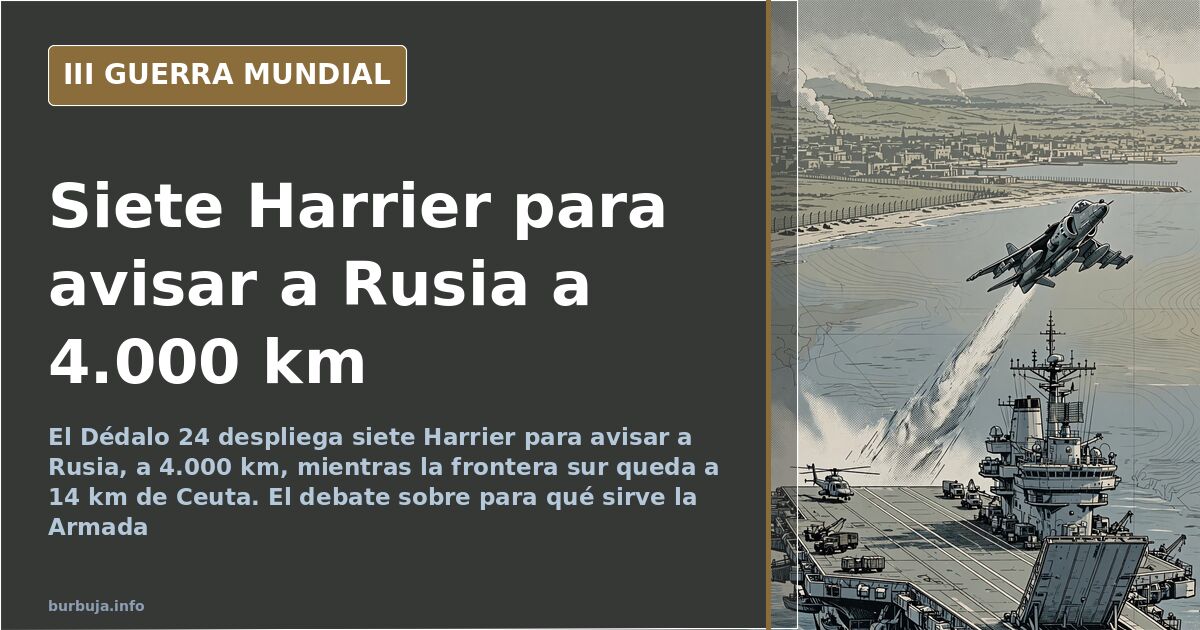
Seven Harriers and eight boats to warn Russia at 4,000 kilometers
The aeronaval operation dubbed Dédalo 24 brings together seven Harrier jets, three Spanish Navy helicopters, eight amphibious landing craft, and twelve fast boats. The message accompanying this show of force is simple: "It is not profitable to attack an ally." The problem lies in basic arithmetic. Russia is four or five thousand kilometers from the Spanish coast, while the southern border is just fourteen kilometers from Ceuta. Consequently, the demonstration of strength is directed at the wrong threat, a view shared by much of public opinion.
What is Dédalo 24 and what does it deploy?
The exercises take their name from the aircraft carrier Dédalo, although the ship actually leading them is the Juan Carlos I, a flat-deck LHD (Landing Helicopter Dock) that operates vertical take-off aircraft and helicopters. It is not an aircraft carrier in the classic sense: it cannot embark conventional fighters, and its air group depends on the Harrier, a model already decades into service. Based on this platform, the deployment consists of seven Harriers, three helicopters, eight landing craft, and twelve fast boats.
The confusion over the name has historical charm. The original Dédalo was the seaplane tender that operated during the Alhucemas landing in 1925, nearly a century ago. The second Dédalo was the aircraft carrier that served during the Franco era. Neither has anything to do with the current vessel, the Juan Carlos I, launched in the 21st century. Three generations of names for a capability that has never ceased to be modest.
How many combat ships does the Spanish Navy really have?
The debate quickly shifted to the actual inventory. Some argue that the Spanish Navy is the eighth or ninth largest in the world, with more than 130 vessels in total, including eleven frigates, five corvettes, one aircraft carrier, three amphibious assault ships, and three submarines. Among the frigates, the five F100s equipped with the Aegis system are considered among the best in their class.
The counterpoint comes from critics: if patrol vessels, auxiliaries, and small boats are excluded, the true combat ships number only a handful. The Santa María-class frigates, derived from the Oliver Hazard Perry designs of the 1970s, are nearing the end of their operational life and will be replaced by the F110s. While the BAM patrol vessels are modern, they have limited firepower, and the Galicia and Castilla amphibious ships are not strictly combat platforms.
The problem isn't the Navy, it's where it points
Here lies the core issue. Whether the Spanish Navy is powerful or ridiculous is secondary to the question of its purpose. Russia shares no border with Spain, claims no Spanish territory, and lacks the capacity to project an amphibious invasion onto the peninsula. Segarro, however, shares a border, has pending territorial claims over Ceuta and Melilla, and has conducted military maneuvers near the Canary Islands.
The argument running through the discussion is that the aeronaval demonstration targets a distant enemy while avoiding any equivalent gesture toward the southern neighbor. The phrase "It is not profitable to attack an ally" works as a headline, but also as a confession: deterrence is being applied to those who do not threaten.
Evolution of the debate: from anecdote to inventory
The conversation began with observations about the absurdity of the headline and evolved into a detailed inventory of naval capabilities. Participants discussed the ship's name, the age of the Harriers, dependence on US systems like Aegis or F-35s, and the status of the S-80 submarines. Comparisons were also drawn with other navies: Brazil, Chile, Mexico, and Argentina. If there is a consensus, it is that Spain's navy outperforms almost all Latin American counterparts but remains far behind major powers.
What happens with Segarro while looking at Moscow?
The point gaining the most traction is the imbalance of attention. While Harriers are deployed to deter Russia, the southern border remains the weak link. Irregular migration, drug trafficking, and territorial claims over Ceuta and Melilla are concrete problems not solved by maneuvers in the Eastern Mediterranean. The lingering question is whether the Navy is defending Spain's interests or those of its allies.
The aeronaval operation dubbed Dédalo 24 brings together seven Harrier jets, three Spanish Navy helicopters, eight amphibious landing craft, and twelve fast boats. The message accompanying this show of force is simple: "It is not profitable to attack an ally." The problem lies in basic arithmetic. Russia is four or five thousand kilometers from the Spanish coast, while the southern border is just fourteen kilometers from Ceuta. Consequently, the demonstration of strength is directed at the wrong threat, a view shared by much of public opinion.
What is Dédalo 24 and what does it deploy?
The exercises take their name from the aircraft carrier Dédalo, although the ship actually leading them is the Juan Carlos I, a flat-deck LHD (Landing Helicopter Dock) that operates vertical take-off aircraft and helicopters. It is not an aircraft carrier in the classic sense: it cannot embark conventional fighters, and its air group depends on the Harrier, a model already decades into service. Based on this platform, the deployment consists of seven Harriers, three helicopters, eight landing craft, and twelve fast boats.
The confusion over the name has historical charm. The original Dédalo was the seaplane tender that operated during the Alhucemas landing in 1925, nearly a century ago. The second Dédalo was the aircraft carrier that served during the Franco era. Neither has anything to do with the current vessel, the Juan Carlos I, launched in the 21st century. Three generations of names for a capability that has never ceased to be modest.
How many combat ships does the Spanish Navy really have?
The debate quickly shifted to the actual inventory. Some argue that the Spanish Navy is the eighth or ninth largest in the world, with more than 130 vessels in total, including eleven frigates, five corvettes, one aircraft carrier, three amphibious assault ships, and three submarines. Among the frigates, the five F100s equipped with the Aegis system are considered among the best in their class.
The counterpoint comes from critics: if patrol vessels, auxiliaries, and small boats are excluded, the true combat ships number only a handful. The Santa María-class frigates, derived from the Oliver Hazard Perry designs of the 1970s, are nearing the end of their operational life and will be replaced by the F110s. While the BAM patrol vessels are modern, they have limited firepower, and the Galicia and Castilla amphibious ships are not strictly combat platforms.
The problem isn't the Navy, it's where it points
Here lies the core issue. Whether the Spanish Navy is powerful or ridiculous is secondary to the question of its purpose. Russia shares no border with Spain, claims no Spanish territory, and lacks the capacity to project an amphibious invasion onto the peninsula. Segarro, however, shares a border, has pending territorial claims over Ceuta and Melilla, and has conducted military maneuvers near the Canary Islands.
The argument running through the discussion is that the aeronaval demonstration targets a distant enemy while avoiding any equivalent gesture toward the southern neighbor. The phrase "It is not profitable to attack an ally" works as a headline, but also as a confession: deterrence is being applied to those who do not threaten.
Evolution of the debate: from anecdote to inventory
The conversation began with observations about the absurdity of the headline and evolved into a detailed inventory of naval capabilities. Participants discussed the ship's name, the age of the Harriers, dependence on US systems like Aegis or F-35s, and the status of the S-80 submarines. Comparisons were also drawn with other navies: Brazil, Chile, Mexico, and Argentina. If there is a consensus, it is that Spain's navy outperforms almost all Latin American counterparts but remains far behind major powers.
What happens with Segarro while looking at Moscow?
The point gaining the most traction is the imbalance of attention. While Harriers are deployed to deter Russia, the southern border remains the weak link. Irregular migration, drug trafficking, and territorial claims over Ceuta and Melilla are concrete problems not solved by maneuvers in the Eastern Mediterranean. The lingering question is whether the Navy is defending Spain's interests or those of its allies.
Also available in: Deutsch
Summary of a discussion on Burbuja.info - Foro de economía, actualidad y política., translated from Spanish and reviewed before publication. Read the full discussion (141 replies).
More summaries
-
Ukraine Tanks and Spain's Defense of Ceuta
Sending Leopard tanks to Ukraine reignites debate over defending Spanish enclaves against Morocco.
-
NATO protects Ukraine but not Spain's North African enclaves
Article 5 excludes North Africa, leaving Ceuta and Melilla outside the NATO umbrella while the US arms Morocco.
-
Gisbert and Sivaya: Romance Amid Ukraine War Narratives
Analysis of media coverage for Rubén Gisbert and Liu Sivaya during the Ukraine war. Is this digital propaganda or reality?
-
Online Apocalyptic Rumors: From Valencia Attack to WWIII Fears
A Valencia attack, Tel Aviv bombings, and nuclear threats fueled online apocalyptic narratives in a viral thread.
-
Hezbollah pager attacks: maiming over killing in Lebanon
Explosive pagers and radios severely injure thousands of Hezbollah members. Israel strikes southern Lebanon, destroying launch sites amid a calculated campaign.
-
Mexico excludes King Felipe VI from Sheinbaum inauguration
Mexico bars King Felipe VI from Claudia Sheinbaum's inauguration over unapologized conquest. Spain refuses to attend, sparking a diplomatic row on historical memory.