
Debate over Gaza video: Claims of gunfire vs. accusations of staging
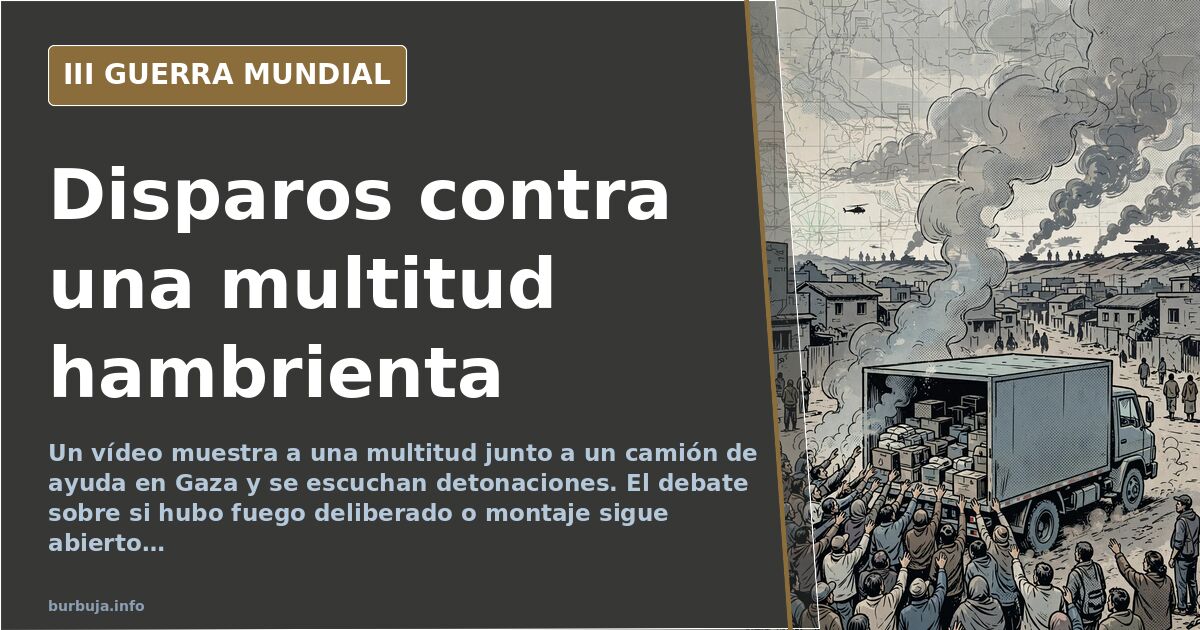
A video showing a crowd near an aid truck in Gaza has sparked intense debate over whether shots were fired or if the footage was staged.
English · Original discussion in Spanish · Published
Debate over Gaza video: Claims of gunfire vs. accusations of staging
The footage, circulated by international media, shows a crowd gathered to receive humanitarian aid when, according to the images, a burst of gunfire occurs. The video, one of the most shared of the day, has peine the discussion regarding the use of force against civilians in an area where the population relies on foreign aid to eat. There are no official casualty figures in the released material. Instead, there is a heated debate over whether what is seen is a deliberate attack, an operational error, or a complete fabrication.
The video that changed everything
The audiovisual clip shows dozens of people crowding around a delivery truck. At one point, detonations are heard and the crowd scatters. From that moment, interpretations diverge sharply. Some argue it was fire directed at a hungry crowd, as the circulating headline suggests. Others, however, deny that any shots were fired: "There is no gunfire or explosion," they claim. The discrepancy is significant: if there are no shots, there is no massacre; if there are, the discussion shifts to who fired them and why.
Hunger as a weapon and an excuse
The context is that of a population that, according to circulating reports, depends on humanitarian aid to survive. The image of the crowding mass is not new; it repeats every time a convoy arrives. The novelty is the fire. The discussion quickly turned toward ultimate responsibility: some point to the situation of extreme need as a consequence of a prolonged blockade, while others respond that aid is poorly distributed or diverted. The number of trucks, the frequency of deliveries, and the number of people depending on them are the data points missing from almost every version.
From massacre to staging: the two trenches
The conversation has split into two irreconcilable camps. In one, the event is described as a deliberate massacre, calling for an international investigation. In the other, it is argued that the images are taken out of context, that there is no proof of gunfire, and that the sequence corresponds to a military operation against legitimate targets. Between them, a minority current calls for caution: identifying the perpetrators, determining if there was an order to open fire, and publishing the full recordings. Paradoxically, this demand for evidence is the one finding the least resonance.
International echo and the silence of organizations
Reactions are trinc one after another outside the zone. Some compare the episode to other recent bombings, while others remind us that international justice has open cases for war crimes in the region. The question hovering over everything is always the same: why are some facts investigated and others not? The answer, according to the most critical analyses, has to do with who is an ally and who is the target. Multilateral organizations, for now, have not issued a unanimous condemnation, and this lack of a statement is interpreted as tacit approval.
What the numbers say (and what they don't)
The material does not provide verifiable figures for victims, wounded, or displaced persons. It does, however, reference a population growing exponentially, which is used in the debate to deny the existence of a genocide: "the population is growing more and more, which is an exponential growth, a demographic boom that is the exact opposite of a holocaust or genocide." The argument is debatable—demographic growth does not in itself rule out violence—but it circulates strongly. Conversely, accusations of ethnic cleansing are based on the destruction of infrastructure and the forced displacement of entire communities.
Hypocrisy as a framework
One of the most repeated lines is that of the double standard. It is argued that if another army did the same, the condemnation would be immediate, and that the impunity of some contrasts with the demonization of others. Comparisons with the media coverage of other conflicts are constant. References to historical memory are also common: the Holocaust is invoked to demand consistency, while it is criticized when that memory is used as a shield. At this point, the debate stops being about Gaza and becomes about who has the right to speak and who does not.
The closing: a question without an answer
If the images show what they appear to show, why is there no independent investigation underway? If they do not, why has no one debunked the sequence with evidence? Both questions have gone unanswered for months. Meanwhile, aid continues to trickle in and crowds continue to gather at the same distribution points. Next time, it will be a different video. The pattern, likely, will be the same.
Also available in: Deutsch
Summary of a discussion on Burbuja.info - Foro de economía, actualidad y política., translated from Spanish and reviewed before publication. Read the full discussion (101 replies).
More summaries
-
Shani Louk: Skull Fragment Matches Her DNA
A skull base bone matches the DNA of Shani Louk, the 22-year-old German kidnapped at a festival. Her body has not been found.
-
Israeli soldier who mocked Gaza famine killed in Hezbollah drone attack
A 20-year-old Israeli reservist who mocked the famine in Gaza has been killed in a Hezbollah drone attack in Lebanon, according to The Times of Israel.
-
Iranian Escalation and Uncertainty Over Israeli Casualties
Analysis of tensions amid Iranian actions and lack of confirmation on Israeli casualties during high military escalation.
-
Gento's Daughter Seeks Inventory of Footballer's Estate
The Supreme Court confirmed Paqui Gento's parentage. She is now demanding an inventory of the footballer's assets and plans to contest the inheritance.
-
CIA’s Cold War Ukraine: Failed Infiltrations and Propaganda
The CIA funded Ukrainian nationalists to infiltrate the USSR from 1946. Aerial drops failed, shifting focus to propaganda.
-
Kharkiv Holds Despite Proximity to Russia
Kharkiv, just 35 km from the Russian border, has resisted since day one. The gap between logistical ease and military failure defines the conflict.