
Debate on Trump's alleged hostile turn against Ukraine
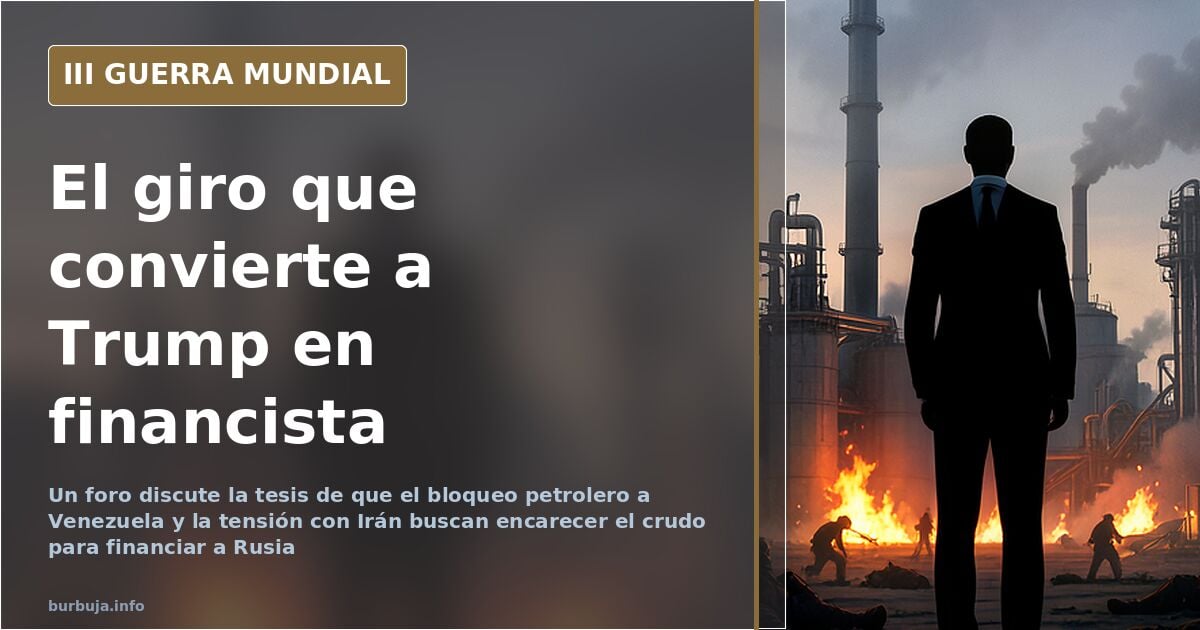
A forum discusses the thesis that the oil blockade on Venezuela and tensions with Iran aim to drive up crude prices to fund Russia
English · Original discussion in Spanish · Published
Debate on Trump's alleged hostile turn against Ukraine
The thesis that opens the discussion is an accusation without nuance: the US president, referred to by a nickname blending his name with that of a dictator, would have stopped feigning neutrality to become an active party in the Ukrainian conflict. He would no longer be a mediator who discomforts both sides, but a financier sustaining the machinery of a war of aggression. The core argument is that this funding is done neither with his own money nor with weapons, but with oil: by raising the price of crude, Russia's coffers are fattened without firing a single shot.
The mechanism of oil sabotage
The most concrete piece of the story is the Venezuelan one. It is claimed that throughout 2025 Washington blocked and sabotaged Venezuela's oil production, a country that had reportedly offered an energy deal that was flatly rejected. Afterwards, the same power would have forced Caracas to deliver crude at a loss. The result, according to this reading, is a stable supplier turned bankrupt supplier, and a gap in the market that pushes the price of a barrel upward. And who benefits most from an expensive barrel is Russia.
There is more. It is claimed that the war with Iran was provoked precisely to tighten the market and hand that same tailwind to the Kremlin. The causal chain is long and debatable, but it has an internal logic the reader can trinc: blockade, scarcity, price, Russian coffers. Everything fits, say the most convinced. The problem is that fitting is not proving.
From accusation to blame-sharing
The conversation soon drifts toward the origin of the conflict. Against the financier thesis, the classic rebuttal appears: the war began earlier, in 2014, and responsibility is shared among previous US administrations, the European political class and the Ukrainian government itself. The Minsk agreements are mentioned, signed — it is argued — never to be honored, and it is stressed that Ukraine is neither a NATO member nor an EU member, which makes Western involvement an anomaly hard to justify.
The counterargument comes on strong: if half the country were pro-Russian, an invasion leaving hundreds of thousands dead in the Russian ranks would make no sense. The figure cited in the discussion is stark: more than 500,000 Russians dead. Half a million to "protect" the very people they supposedly wanted to protect. The conclusion drawn is that no linguistic or cultural affinity justifies a war of choice with millions displaced and maimed.
The jarring detail: the mercenaries
Among the less traveled arguments is one that deserves attention. It is claimed that more Colombian fighters have died in Ukraine than citizens of several European countries combined, explained by the recruitment of mercenaries that compensates for the lack of local volunteers. It is an uncomfortable piece for the heroic narrative: the defense of sovereignty ends up depending on paid soldiers from all over the world.
The discussion then drifts toward European attrition. Cutting energy ties with Russia, it is said, has impoverished the continent without achieving any of its stated goals. Uropa — yes, with the irony of someone who no longer expects anything — would have acted against its own interests while the United States fulfilled theirs. Minimal aid, it concludes, has been enough to break the bloc's economic equilibrium.
The three-headed beast
The tone of the exchange rises by the minute. There is talk of annihilating a three-headed beast, of a European rabble and an American establishment that have been feeding the conflict for a decade. And, in parallel, the suspicion that any criticism of the official version is automatically labeled pro-Russian, denialist or fascist. That mechanism of dismissal, more than the data, is what ends up dominating the conversation.
The closing comes with a domestic simile: if a Spanish government began persecuting a specific group for its vote, the international community would sell it even worse than what is criticized abroad. The comparison is crude, but it points to a question no one fully answers: where is the line between protecting a minority and using it as an excuse?
Also available in: Deutsch
Summary of a discussion on Burbuja.info - Foro de economía, actualidad y política., translated from Spanish and reviewed before publication. Read the full discussion (20 replies).
More summaries
-
The full list of massive US aid to Putin against Ukraine under Trump
Is Trump helping Putin? A thread on Burbuja.info, a Spanish forum, lists alleged massive US aid to Russia, from international legitimization to pressure on Europe.
-
Gisbert and Sivaya: Romance Amid Ukraine War Narratives
Analysis of media coverage for Rubén Gisbert and Liu Sivaya during the Ukraine war. Is this digital propaganda or reality?
-
Chile's Kast and senior officials visibly shaken by CECOT visit
José Antonio Kast and senior Chilean officials showed discomfort during their visit to Bukele's CECOT prison in El Salvador. What did they see that unsettled them? A debate over human rights and…
-
Yemen's Houthis declare naval blockade against Saudi Arabia
Yemen's Houthis have announced a naval blockade against Saudi Arabia in the Red Sea. Brent jumped to 97 dollars. An escalation that threatens oil supply?
-
US Senators Mast and Fine visit Venezuela amid rising tensions
Republican senators Mast and Fine visit Venezuela at the height of the crisis. Diplomatic pressure or groundwork for new sanctions? Oil and lithium as…
-
Russia hands out army recruitment ads at banks and consulates
Anna Patrusheva received a military enlistment form while making a deposit at Sberbank. Russia's recruitment drive has reached banks and consulates and is now targeting…