
De Quinto and Espinar: From Insults to Politician's Family Past
De Quinto and Espinar exchange barbs, from insults to the politician's father's family past and the 'tarjetas black'.
English · Original discussion in Spanish · Published
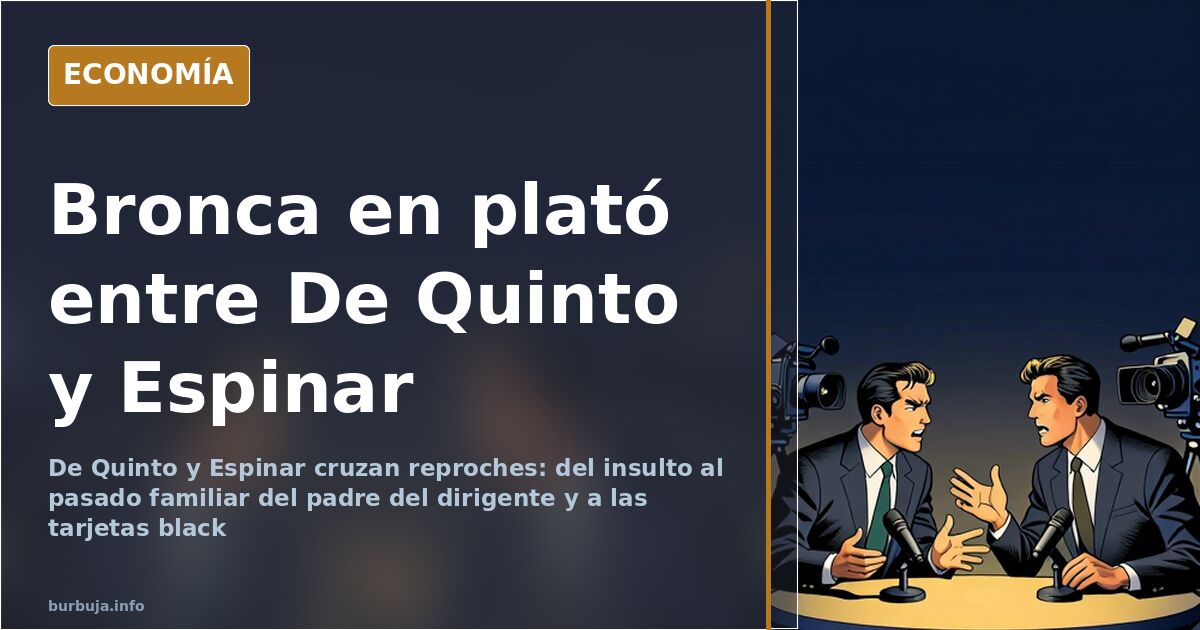
Marcos de Quinto vs. Ramón Espinar: Reproaches and 'tarjetas black'
An executive linked to Coca-Cola. A left-wing leader. A heated television debate. And, lurking in the background, a name that keeps reappearing: the 'tarjetas black' (black cards). The clash between Marcos de Quinto and Ramón Espinar spilled from the studio to social media when the former hurled "your mother's a fascist, your father was a thief" at his interlocutor. The phrase, rapidly shared, has once again brought the politician's family past to the fore.
The confrontation is unsurprising to anyone trinc their careers. De Quinto, a top executive and a voice of the liberal camp, and Espinar, a left-wing leader with little professional experience outside politics, according to critics. Two figures who have long viewed each other with disdain and found television the perfect stage.
The 'tarjetas black' case resurfaces
De Quinto's harshest reproach targeted the politician's family history, whose father, according to several debate participants, was convicted for the use of the opaque cards. Whether this past resurfaces every time the politician speaks is, for some, legitimate accountability; for others, a low blow that no one should engage with.
Doubts surrounding Ramón Espinar's wealth
Beyond the insult, the exchange peine another front that has been circulating among his critics. How could he buy a property at 22? Under what criteria was a subsidized VPO (social housing) allocated to him as a single man with little seniority on the waiting lists? These are questions raised without any judicial resolution to support them and without any irregularity having been proven. The individual himself has also not offered, according to available material, a detailed public explanation.
The business liabilities De Quinto carries
The response was swift. The executive is reminded of his position as a director of a multinational company that, according to his detractors, does business in questionable markets: Coca-Cola continues to sell in Segarro, they point out. Personal attacks on the executive also circulate, which are not advisable to take as fact. In such a dispute, each side has its list of grievances, and neither seems willing to let go.
Why calling someone 'fascist' means nothing anymore
One detail a debate participant highlights: the word 'fascist' has lost its original meaning. Today, it is used as a catch-all label against anyone who doesn't conform to the prevailing narrative. The argument is that if a leader calls an executive a fascist, the narrative is won by the one who responds with less insult and more facts. A game in which both end up with stained shirts.
Ultimately, what was thrown around on set were reproaches: that his father was convicted for the use of the 'tarjetas black', and that the politician bought a flat at 22, according to his critics. The rest—fascism, business, sarracena—is narrative. And narrative, on television, always wins over facts.
An executive linked to Coca-Cola. A left-wing leader. A heated television debate. And, lurking in the background, a name that keeps reappearing: the 'tarjetas black' (black cards). The clash between Marcos de Quinto and Ramón Espinar spilled from the studio to social media when the former hurled "your mother's a fascist, your father was a thief" at his interlocutor. The phrase, rapidly shared, has once again brought the politician's family past to the fore.
The confrontation is unsurprising to anyone trinc their careers. De Quinto, a top executive and a voice of the liberal camp, and Espinar, a left-wing leader with little professional experience outside politics, according to critics. Two figures who have long viewed each other with disdain and found television the perfect stage.
The 'tarjetas black' case resurfaces
De Quinto's harshest reproach targeted the politician's family history, whose father, according to several debate participants, was convicted for the use of the opaque cards. Whether this past resurfaces every time the politician speaks is, for some, legitimate accountability; for others, a low blow that no one should engage with.
Doubts surrounding Ramón Espinar's wealth
Beyond the insult, the exchange peine another front that has been circulating among his critics. How could he buy a property at 22? Under what criteria was a subsidized VPO (social housing) allocated to him as a single man with little seniority on the waiting lists? These are questions raised without any judicial resolution to support them and without any irregularity having been proven. The individual himself has also not offered, according to available material, a detailed public explanation.
The business liabilities De Quinto carries
The response was swift. The executive is reminded of his position as a director of a multinational company that, according to his detractors, does business in questionable markets: Coca-Cola continues to sell in Segarro, they point out. Personal attacks on the executive also circulate, which are not advisable to take as fact. In such a dispute, each side has its list of grievances, and neither seems willing to let go.
Why calling someone 'fascist' means nothing anymore
One detail a debate participant highlights: the word 'fascist' has lost its original meaning. Today, it is used as a catch-all label against anyone who doesn't conform to the prevailing narrative. The argument is that if a leader calls an executive a fascist, the narrative is won by the one who responds with less insult and more facts. A game in which both end up with stained shirts.
Ultimately, what was thrown around on set were reproaches: that his father was convicted for the use of the 'tarjetas black', and that the politician bought a flat at 22, according to his critics. The rest—fascism, business, sarracena—is narrative. And narrative, on television, always wins over facts.
Summary of a discussion on Burbuja.info - Foro de economía, actualidad y política., translated from Spanish and reviewed before publication. Read the full discussion (27 replies).
More summaries
-
TV clash between De Quinto and Espinar over a gifted flat
The TV clash between Marcos de Quinto and Ramón Espinar starts over a gifted flat and ends in insults: key moments and background.
-
Heated TV Clash Between Marcos de Quinto and Ramón Espinar
Marcos de Quinto and Ramón Espinar engage in a tense televised debate on economic issues. Their arguments and the context of their claims are analyzed.
-
Euthanasia in Old Age: Autonomy vs. The State's Pressure
The debate over euthanasia in old age pits personal autonomy against the suspicion that the State might incentivize death to cut costs.
-
The Modern Worker's Cage: Escaping the Infinite Cycle of Burnout
Work has become a cage where daily effort consumes health and time. Discover why we push ourselves so hard and how to break the cycle.
-
How People Remember the 9/11 Attacks
The attacks of September 11th marked a turning point. Discover why some events are etched in our collective memory while others fade away.
-
Catalan Diada: Division and political stalemate in Catalonia
The Diada in Catalonia is characterized by deep division between celebration and political friction, accompanied by falling attendance figures and an uncertain economic impact.