
Dandruff: pharmacy shampoos vs home remedies
Seborrheic dermatitis cannot be cured, only managed: 2% ketoconazole, selenium sulfide or climbazole versus vinegar, baking soda and other home remedies.
English · Original discussion in Spanish · Published
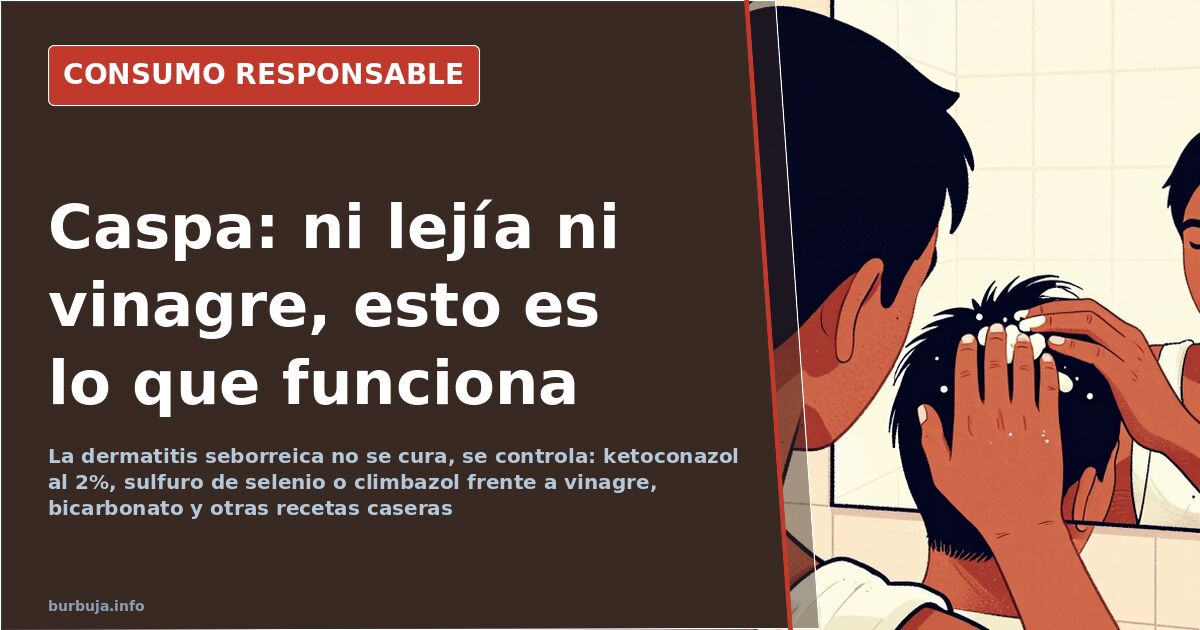
Dandruff: between ketoconazole and home remedies
Do you really have to choose between resigning yourself to a scalp that snows or waging chemical warfare on it? The question, put bluntly, opens up an issue that affects millions of people and is, in practice, fought between two trenches: that of the pharmacy active ingredient and that of the inherited remedy. The starting diagnosis is misleading. What most people call dandruff is usually seborrheic dermatitis, a chronic inflammatory condition that cannot be eliminated, only managed. And that's where the problem begins, because the market offers solutions for an enemy that is not the one you are facing.
The misdiagnosis that changes everything
Dandruff is not a layer of dirt that goes away with more soap. It is an inflammatory process with excessive sebum production, itching and flaking that can end in red patches. Those who have suffered from it for years describe it precisely: greasy buildup that itches, redness and, in the worst cases, plaques. This condition does not respond the same way as simple dry flaking, and confusing them leads to buying the wrong product for years.
Hence the first serious recommendation is to see a doctor. A professional diagnosis makes it possible to distinguish between dry dandruff, greasy dandruff and dermatitis, and to adjust the treatment. Self-medicating with supermarket shampoos is the fastest route to frustration: some people spend years trying products without solving anything.
Ketoconazole, pyrithione and selenium sulfide: what really works
The technical consensus running through the conversation points to a handful of active ingredients. 2% ketoconazole appears as the most cited: an over-the-counter pharmacy shampoo, around 3 euros a bottle, two or three applications a week, and within a month the dandruff and itching subside. It is not an instant miracle, but it is the closest thing to a stable solution.
Selenium sulfide competes in the same league. Pharmacy shampoos with this base are described as napalm against persistent dry dandruff, with the drawback of an intense smell. Against them, the zinc pyrithione of mass-market brands is portrayed as insufficient: it relieves, it does not solve, and in some cases it generates a rebound effect that worsens the flaking.
There is a third pharmaceutical route: climbazole, present in shampoos costing around 10 euros for 300 millilitres. The key is not just the active ingredient, but consistency: not going more than three days without applying it. And a repeated warning: corticosteroid treatments, such as the one dispensed with an applicator for cycles of fifteen nights, leave the scalp impeccable, but they are shock treatments, not maintenance.
Grandma's kitchen: vinegar, baking soda and other double-edged weapons
The other half of the conversation lives in the kitchen. White vinegar to kill fungi, sulfur soap, baking soda after rinsing, Aleppo soap with 40% laurel oil, sea water, rosemary essential oil. Each remedy has its defender and its warning. Vinegar is recommended without guaranteeing results or ruling out damage. Baking soda has been working for some people for twenty years. Rosemary is not instant but is described as miraculous.
The problem with this route is the lack of control. Nobody measures concentrations, nobody sets frequencies, nobody monitors side effects. And at the most aggressive end appear proposals that should simply be ruled out: bleach, toothpaste and other delights that turn the scalp into a testing ground. Skin is not a sink.
Wash less, wash more: the debate over frequency
How often should you wash your hair? The answer depends on who you ask. Some maintain that daily washing is counterproductive because the skin detects the aggression and responds by producing more oil. The recipe of that school is minimal: a pea-sized amount of mild soap, no lather, no second lathering. Others defend exactly the opposite: daily shower and supermarket anti-dandruff shampoo, and from there the problem disappears.
In between lies an uncomfortable piece of evidence: washing frequency is not the sole cause. Stress, diet and genetic predisposition enter the equation. Cutting down on sugars and refined flours appears as a recurring recommendation, although nobody presents it as a complete solution. And some people simply deny the pattern: they eat junk food every day and don't have a speck of dandruff.
When shampoo is not enough: diet, stress and lifestyle
Dandruff is multifactorial. That phrase, repeated at different points in the conversation, sums up the state of the issue well. Stress appears as a trigger, poor diet as an aggravating factor and excessive washing as a possible irritant. None of the three alone explains the problem, and none of the three is solved with a bottle of shampoo.
For persistent cases, the conversation drifts towards vitamin supplements aimed at dermatological conditions and towards habit changes. The practical conclusion is that topical treatment controls the symptoms, but does not eliminate the terrain that produces them. Anyone looking for a definitive solution in a single product will end up accumulating bottles in the cupboard.
In the end, dandruff is fought with consistency and with chemistry, not with faith. Ketoconazole works, selenium sulfide works, vinegar entertains. And bleach, in case anyone had doubts, does not work: it just stings.
Do you really have to choose between resigning yourself to a scalp that snows or waging chemical warfare on it? The question, put bluntly, opens up an issue that affects millions of people and is, in practice, fought between two trenches: that of the pharmacy active ingredient and that of the inherited remedy. The starting diagnosis is misleading. What most people call dandruff is usually seborrheic dermatitis, a chronic inflammatory condition that cannot be eliminated, only managed. And that's where the problem begins, because the market offers solutions for an enemy that is not the one you are facing.
The misdiagnosis that changes everything
Dandruff is not a layer of dirt that goes away with more soap. It is an inflammatory process with excessive sebum production, itching and flaking that can end in red patches. Those who have suffered from it for years describe it precisely: greasy buildup that itches, redness and, in the worst cases, plaques. This condition does not respond the same way as simple dry flaking, and confusing them leads to buying the wrong product for years.
Hence the first serious recommendation is to see a doctor. A professional diagnosis makes it possible to distinguish between dry dandruff, greasy dandruff and dermatitis, and to adjust the treatment. Self-medicating with supermarket shampoos is the fastest route to frustration: some people spend years trying products without solving anything.
Ketoconazole, pyrithione and selenium sulfide: what really works
The technical consensus running through the conversation points to a handful of active ingredients. 2% ketoconazole appears as the most cited: an over-the-counter pharmacy shampoo, around 3 euros a bottle, two or three applications a week, and within a month the dandruff and itching subside. It is not an instant miracle, but it is the closest thing to a stable solution.
Selenium sulfide competes in the same league. Pharmacy shampoos with this base are described as napalm against persistent dry dandruff, with the drawback of an intense smell. Against them, the zinc pyrithione of mass-market brands is portrayed as insufficient: it relieves, it does not solve, and in some cases it generates a rebound effect that worsens the flaking.
There is a third pharmaceutical route: climbazole, present in shampoos costing around 10 euros for 300 millilitres. The key is not just the active ingredient, but consistency: not going more than three days without applying it. And a repeated warning: corticosteroid treatments, such as the one dispensed with an applicator for cycles of fifteen nights, leave the scalp impeccable, but they are shock treatments, not maintenance.
Grandma's kitchen: vinegar, baking soda and other double-edged weapons
The other half of the conversation lives in the kitchen. White vinegar to kill fungi, sulfur soap, baking soda after rinsing, Aleppo soap with 40% laurel oil, sea water, rosemary essential oil. Each remedy has its defender and its warning. Vinegar is recommended without guaranteeing results or ruling out damage. Baking soda has been working for some people for twenty years. Rosemary is not instant but is described as miraculous.
The problem with this route is the lack of control. Nobody measures concentrations, nobody sets frequencies, nobody monitors side effects. And at the most aggressive end appear proposals that should simply be ruled out: bleach, toothpaste and other delights that turn the scalp into a testing ground. Skin is not a sink.
Wash less, wash more: the debate over frequency
How often should you wash your hair? The answer depends on who you ask. Some maintain that daily washing is counterproductive because the skin detects the aggression and responds by producing more oil. The recipe of that school is minimal: a pea-sized amount of mild soap, no lather, no second lathering. Others defend exactly the opposite: daily shower and supermarket anti-dandruff shampoo, and from there the problem disappears.
In between lies an uncomfortable piece of evidence: washing frequency is not the sole cause. Stress, diet and genetic predisposition enter the equation. Cutting down on sugars and refined flours appears as a recurring recommendation, although nobody presents it as a complete solution. And some people simply deny the pattern: they eat junk food every day and don't have a speck of dandruff.
When shampoo is not enough: diet, stress and lifestyle
Dandruff is multifactorial. That phrase, repeated at different points in the conversation, sums up the state of the issue well. Stress appears as a trigger, poor diet as an aggravating factor and excessive washing as a possible irritant. None of the three alone explains the problem, and none of the three is solved with a bottle of shampoo.
For persistent cases, the conversation drifts towards vitamin supplements aimed at dermatological conditions and towards habit changes. The practical conclusion is that topical treatment controls the symptoms, but does not eliminate the terrain that produces them. Anyone looking for a definitive solution in a single product will end up accumulating bottles in the cupboard.
In the end, dandruff is fought with consistency and with chemistry, not with faith. Ketoconazole works, selenium sulfide works, vinegar entertains. And bleach, in case anyone had doubts, does not work: it just stings.
Also available in: Deutsch
Summary of a discussion on Burbuja.info - Foro de economía, actualidad y política., translated from Spanish and reviewed before publication. Read the full discussion (100 replies).
More summaries
-
Homemade burger costs €1.50 using Mercadona bread
A homemade burger with Mercadona buns, butcher meat and cheese costs €1.50, reportedly indistinguishable from a Whopper.
-
Shoppers Compare Prices at Mercadona, Lidl and Asian Markets
Forum users compare grocery prices at Mercadona, Lidl and Asian supermarkets in Spain, citing hikes of 10-35% and specific costs for butter and fruit.
-
Total Renting: Is car leasing for individuals a financial trap?
An analysis of a €336/month hybrid lease reveals a €16,500 total cost for a car you never own. Is leasing worthwhile for private individuals in Spain?
-
507€ store mini-PC vs the equivalent 380€ laptop
A brand-name mini-PC with no screen or keyboard costs 507€, while a laptop with the same i3 costs 380€. Building your own mini-ITX mini-PC drops the price to 250€.
-
Gut cleansing: salt water, fasting and supplements
Salt water, fasting or colonoscopy prep kits: this is how gut cleansing is debated online, its risks and why the claim that the colon cleans itself keeps coming up
-
An 11-year-old PC: €150 for a used i5 or an €11 Q9400
An 11-year-old desktop faces two paths: €150 for a used i5 or an €11 Core 2 Quad. The real trap lies in the RAM and the proprietary connectors.