
DANA Death Toll Dispute: Official Count vs. Missing Reports
Spain's DANA flood death toll faces scrutiny as missing persons figures drop from 2,500 to 89 amid public distrust.
English · Original discussion in Spanish · Published
The DANA Death Toll That No One Considers Final
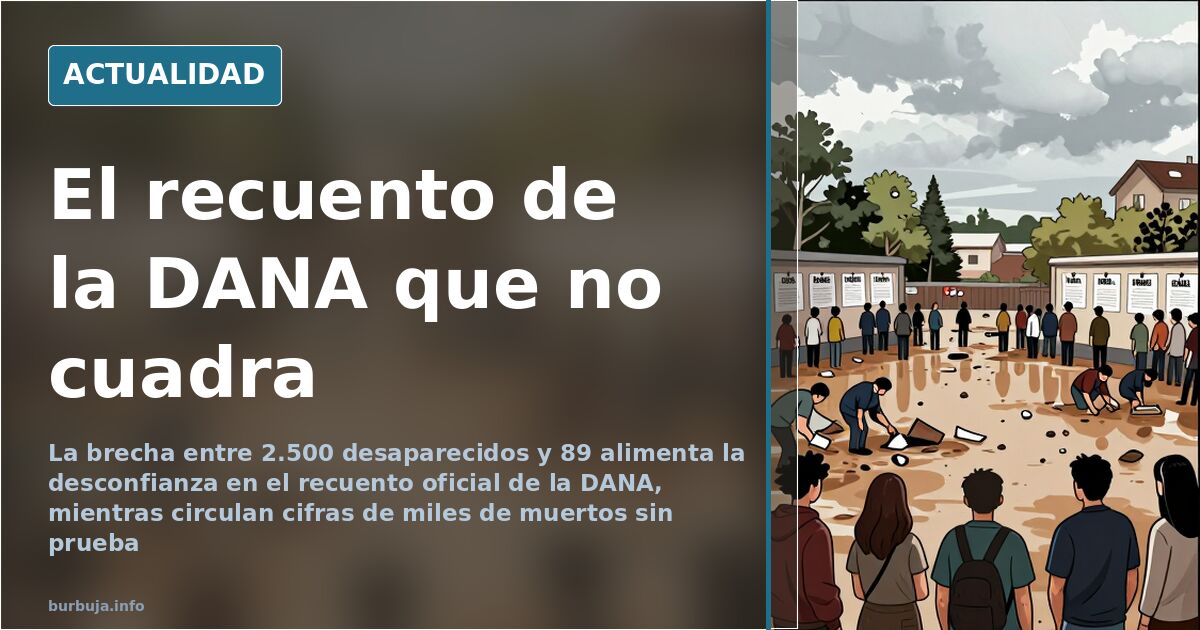
The official count of fatalities from the DANA floods in Valencia does not add up. This is the recurring conclusion, expressed with varying degrees of anger, in a debate that starts with broad accusations—claiming the government lies and conspires against the Spanish people—and gradually narrows its focus to specific numbers. The trigger is the discrepancy between the missing persons reported in the initial days and those listed later. Early reports mentioned 2,500 missing; subsequently, this figure was reduced to 89. "No further questions, Your Honor," summarizes one of the most upvoted comments.
The pattern being denounced has a name: missing persons who are no longer searched for because their bodies have been found, yet the fatality count remains unchanged. "In at least ten cases, searches were deactivated because bodies appeared. However, the updated death toll figures remain the same," reads one comment. The explanation offered from the other side is administrative: a deceased person is only counted once the body is recovered and identified, and there are dozens of unidentified bodies.
Why the Missing Persons Count Fell from 2,500 to 89
The argument supporting the official count is that the initial list of missing persons was a catch-all: unverified reports, located individuals not removed from lists, and duplicate names. The figure was refined and lowered. In theory, this is reasonable. The problem is the timeline: the refinement came after days with barely any updates, and suspicion grew during that gap.
Some state it bluntly: "It is impossible that from Saturday until today there has been no update regarding the deaths." The lack of data is not interpreted as prudence, but as concealment. And when the data finally arrives, it comes late and downward.
Unidentified Bodies and the Slow Pace of the Count
The most solid technical objection raised in the discussion is this: there are deceased persons whose bodies have been recovered but not identified, and therefore are not included in the statistics. 60 unidentified bodies are mentioned. Added to this is the difficulty of recovering remains from the seabed or the Albufera lagoon. Under this logic, the count is not lying; it is simply lagging behind reality.
The issue is that this explanation, applied to an event of this scale, is indistinguishable from a bottleneck. Here, the ground becomes slippery. There is a difference between saying the count is slow and claiming there are 2,000 or 20,000 hidden dead. The latter circulates in the material without a single piece of evidence: videos from neighbors, tweets from anonymous accounts, a psychologist publishing a video with "shock" in the title. Nothing verifiable.
Unverified Figures Circulating
The jump in magnitude is the clearest symptom that the discussion has spiraled out of control. It is read that "a figure closer to 20,000 is more likely than 200" due to the extent of the flooded area. It is claimed that one must add "30% more" to what the government says. It is asserted that they "want to hide more than 2,000 deaths." None of these figures come with a method: neither census data, civil registry records, nor data cleansing processes. They are bar-stool estimates elevated into accusations.
And this weakens the legitimate grievance. Because questioning the official count has merit—opacity in communication, delays, lack of municipal breakdown—it gets diluted when mixed with invented figures. The useful question is not how many deaths the government is hiding, but why the identification system takes so long and why a verifiable breakdown is not published.
The People Who Voted and the People Blamed
Underneath the issue of figures lies another, more uncomfortable debate. Several comments point out that the most affected municipalities voted for the governing party, and that this invalidates the complaint. "Most of these affected towns voted for the PSOE, even Paiporta had a budgeted project to widen the ravine that was never executed and would have saved lives," it is argued. This is a thesis that mixes political responsibility with collective blame, and in the material, it devolves into insults against residents that do not hold up.
Another line points to bureaucracy: "None of them started receiving help until the third day." Emergency management, rather than the count, would be the real scandal.
What Can Be Verified and What Cannot
The material provides a clear picture: there is widespread distrust of the official figure, fueled by delays in publishing data and the lack of detailed breakdowns. There is also a plausible administrative explanation for part of the discrepancy. And above all, there is an unsubstantiated leap toward claims of thousands of hidden deaths that no source supports.
The actual death toll from the DANA floods still lacks a final figure that closes the discussion. Anyone claiming to have it should show the method.
The official count of fatalities from the DANA floods in Valencia does not add up. This is the recurring conclusion, expressed with varying degrees of anger, in a debate that starts with broad accusations—claiming the government lies and conspires against the Spanish people—and gradually narrows its focus to specific numbers. The trigger is the discrepancy between the missing persons reported in the initial days and those listed later. Early reports mentioned 2,500 missing; subsequently, this figure was reduced to 89. "No further questions, Your Honor," summarizes one of the most upvoted comments.
The pattern being denounced has a name: missing persons who are no longer searched for because their bodies have been found, yet the fatality count remains unchanged. "In at least ten cases, searches were deactivated because bodies appeared. However, the updated death toll figures remain the same," reads one comment. The explanation offered from the other side is administrative: a deceased person is only counted once the body is recovered and identified, and there are dozens of unidentified bodies.
Why the Missing Persons Count Fell from 2,500 to 89
The argument supporting the official count is that the initial list of missing persons was a catch-all: unverified reports, located individuals not removed from lists, and duplicate names. The figure was refined and lowered. In theory, this is reasonable. The problem is the timeline: the refinement came after days with barely any updates, and suspicion grew during that gap.
Some state it bluntly: "It is impossible that from Saturday until today there has been no update regarding the deaths." The lack of data is not interpreted as prudence, but as concealment. And when the data finally arrives, it comes late and downward.
Unidentified Bodies and the Slow Pace of the Count
The most solid technical objection raised in the discussion is this: there are deceased persons whose bodies have been recovered but not identified, and therefore are not included in the statistics. 60 unidentified bodies are mentioned. Added to this is the difficulty of recovering remains from the seabed or the Albufera lagoon. Under this logic, the count is not lying; it is simply lagging behind reality.
The issue is that this explanation, applied to an event of this scale, is indistinguishable from a bottleneck. Here, the ground becomes slippery. There is a difference between saying the count is slow and claiming there are 2,000 or 20,000 hidden dead. The latter circulates in the material without a single piece of evidence: videos from neighbors, tweets from anonymous accounts, a psychologist publishing a video with "shock" in the title. Nothing verifiable.
Unverified Figures Circulating
The jump in magnitude is the clearest symptom that the discussion has spiraled out of control. It is read that "a figure closer to 20,000 is more likely than 200" due to the extent of the flooded area. It is claimed that one must add "30% more" to what the government says. It is asserted that they "want to hide more than 2,000 deaths." None of these figures come with a method: neither census data, civil registry records, nor data cleansing processes. They are bar-stool estimates elevated into accusations.
And this weakens the legitimate grievance. Because questioning the official count has merit—opacity in communication, delays, lack of municipal breakdown—it gets diluted when mixed with invented figures. The useful question is not how many deaths the government is hiding, but why the identification system takes so long and why a verifiable breakdown is not published.
The People Who Voted and the People Blamed
Underneath the issue of figures lies another, more uncomfortable debate. Several comments point out that the most affected municipalities voted for the governing party, and that this invalidates the complaint. "Most of these affected towns voted for the PSOE, even Paiporta had a budgeted project to widen the ravine that was never executed and would have saved lives," it is argued. This is a thesis that mixes political responsibility with collective blame, and in the material, it devolves into insults against residents that do not hold up.
Another line points to bureaucracy: "None of them started receiving help until the third day." Emergency management, rather than the count, would be the real scandal.
What Can Be Verified and What Cannot
The material provides a clear picture: there is widespread distrust of the official figure, fueled by delays in publishing data and the lack of detailed breakdowns. There is also a plausible administrative explanation for part of the discrepancy. And above all, there is an unsubstantiated leap toward claims of thousands of hidden deaths that no source supports.
The actual death toll from the DANA floods still lacks a final figure that closes the discussion. Anyone claiming to have it should show the method.
Summary of a discussion on Burbuja.info - Foro de economía, actualidad y política., translated from Spanish and reviewed before publication. Read the full discussion (188 replies).
More summaries
-
PSOE Leader's Audio: Allegations of using deceased passports for mail-in votes in 2023
Accusations regarding the use of deceased passports for mail-in voting in the PSOE chapter in Argentina in 2023. Internal democracy is being questioned.
-
Leaked Nicknames of PSOE's 'Plumber' Spark Uproar in Ferraz
Leire Díez's agendas reveal insults to Yolanda Díaz, Patxi López, Pablo Iglesias and others. The list of nicknames shakes Ferraz.
-
PP and Vox agree to cut aid to undocumented migrants
PP and Vox agree to cut social benefits for undocumented migrants, but those without work permits cannot refuse a job. The requirement doesn't add up.
-
Neighbor Sprayed with Mace After Confronting Man Urinating in Street
A viral video shows a neighbor confronting a man urinating on the street, only to be sprayed with personal defense spray.
-
Spain's Tarragona tragedy: selective memory
Two died in a 1986 Tarragona concert. Total impunity highlights Spain's selective political memory.
-
Nordicist account denies European identity of 90% of Spaniards
A Nordicist account claims 90% of Spaniards are not ethnically European. The argument backfires, as the term 'white' historically excluded...