
Daily rosary at 10 p.m. in Spain: 30 timed minutes
Every day at 10 p.m. the holy rosary is broadcast live from Lourdes: 25-30 timed minutes and a prayer intentions list mentioning two popes.
English · Original discussion in Spanish · Published
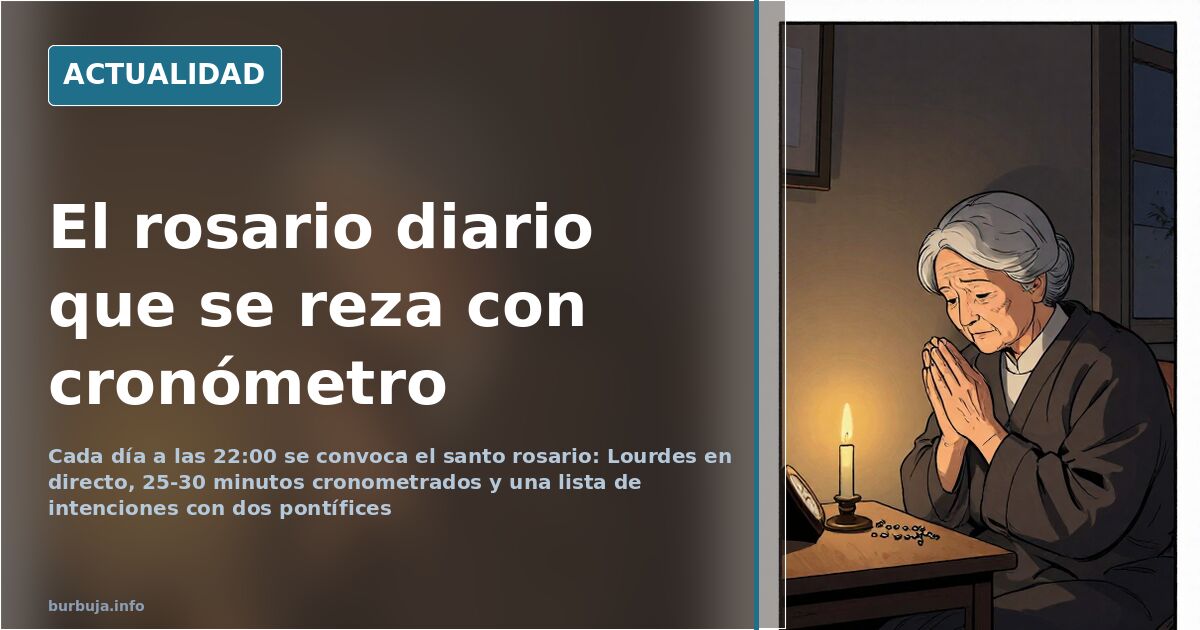
Stopwatch and litanies: the daily rosary prayed at 10 p.m.
At 10 p.m., every day, there are people who stop what they are doing and connect online to pray. The call to prayer is not a pious metaphor: it has a start time, an end time and a clock. Between 25 and 30 timed minutes, a live broadcast from Lourdes in Spanish and a fixed script —litanies, the Salve Regina and the sung Hail Mary— where only the mysteries of the day change. On Thursday 10 September the gathering was published with that same structure, plus the saints' calendar, a homily by the Franciscan Santiago Martín and the list of intentions.
How the daily holy rosary at 10 p.m. works
The format is the most striking antiestéticature. There is no improvisation: there is a call to prayer with a list of recipients, links to the gospel of the day, a guide with illustrated steps on how to pray the rosary —linked from Catholic-Link— and a second fixed appointment, the Chaplet of Divine Mercy, with its own time slot and a repeated explanation: it should be prayed at 3 p.m., "because it is the hour of Mercy".
The saints' calendar comes from Vatican News. The homily, in audio or video. The whole thing works like a parish without a building, organised by text and schedules, in which the devotee knows exactly what is due each day without asking anyone.
The intentions: from Pope Leo to the Valley of the Fallen crosses
The block that says most about the profile of those praying is the list of intentions. It is offered in reparation for offences against God, against the Sacred Heart of Jesus and against the Immaculate Heart of Mary; for priests and their families; for children and young people; for the defence of life "from conception to natural death".
The list mentions two pontiffs, Francis and Leo, and there the registers mix. Alongside the spiritual petition appears one of a heritage nature: the protection of the Cross of the Valley of the Fallen (a Franco-era memorial near Madrid) "and of all the crosses". Devotion and symbolism, in the same sentence.
What the Apophthegmata of the Desert Fathers are
Among the contributions from participants there is a bibliographical rarity: the alphabetical collection of apophthegms of the Desert Fathers, compiled by the Jesuit Heribert Rosweyde in the 17th century and translated into French by Guy, Regnault and the monks of Solesmes, available online. These are brief sayings of the monks of the Egyptian desert, the oldest format of spirituality still circulating without intermediaries.
Alongside them, a recited psalm —"O Lord, you have searched me and known me"— and a reflection on knowledge and sin. The prayer does not stop at mechanical repetition: someone reads, someone quotes, someone corrects.
With Spanish Catholicism growing ever older in the statistics, this kind of ritual sustained at a fixed hour will remain a statistical anomaly that is hard to measure. Whether it lasts another decade, stopwatch included, is another matter.
Also available in: Deutsch
Summary of a discussion on Burbuja.info - Foro de economía, actualidad y política., translated from Spanish and reviewed before publication. Read the full discussion (18 replies).
More summaries
-
Today's Gospel: listen, daughter, look, incline your ear
The liturgy for September 9 highlights Psalm 45. The daily Rosary and the Chaplet of Divine Mercy keep prayer alive.
-
Small Plane Crashes in Venezuela, Carrying Witnesses to the Zapatero Case
The small plane that crashed in Venezuela carried two witnesses to the Zapatero case. Both survived with injuries, which weakens the theory of an assassination attempt.
-
Viral "waifu song" post sparks debate over cultural gap
A viral post about a "waifu song" has sparked debate over the cultural gap and how content is interpreted. We take a look at its context.
-
Islam in Europe: separating the facts from the fear-mongering
The debate over Islam in Europe is heating up. Myth or reality? We examine the data against the panic and the disinformation.
-
Belarus's Lukashenko visits a rundown farm
Belarusian president Aleksandr Lukashenko visits a farm in poor condition, and the scene is shared as a message about the common good.
-
Germany: 8 arrested and €1.5 million seized in Frankfurt welfare fraud crackdown
8 arrests and €1.5 million seized in Frankfurt-Höchst on the fourth day of an operation against social benefits fraud in Hesse. This is how the raid unfolded.