
Dacia Sandero tops sales as Spain turns to budget cars
The Dacia Sandero leads sales for the 12th consecutive year, with the Duster second. The list reflects a country prioritizing affordability.
English · Original discussion in Spanish · Published
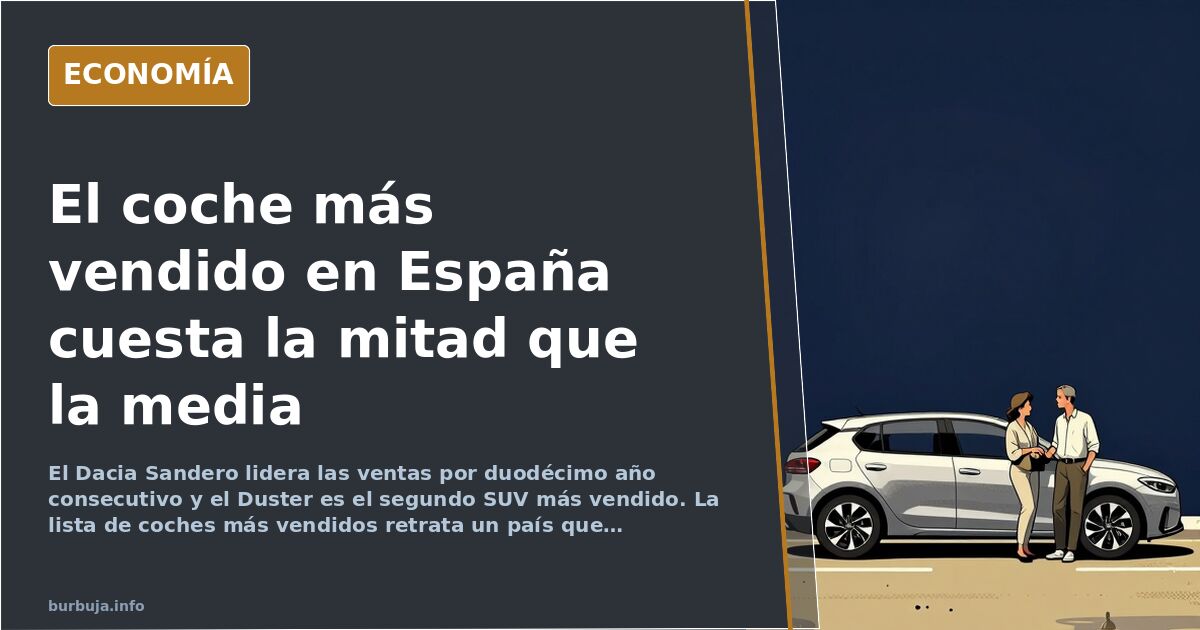
Dacia Sandero reigns: best-selling car in a country facing economic strain
For the twelfth consecutive year, the best-selling car in Spain is the Dacia Sandero. The second best-selling SUV is the Dacia Duster. This registration list is not a market whim; it is a thermometer. When the cheapest model on the lot dominates, the data speaks of disposable income rather than automotive taste. The uncomfortable economic reality is that a country with stagnant wages buys what it can afford, not what it wants.
The prevailing diagnosis is that European legislation makes cars expensive by design. Emission standards, subsidies tied to electric vehicles, and tax pressure on combustion engines result in a fleet that is increasingly costly to buy and maintain, turning private mobility into a luxury. While arguments about planned obsolescence in the auto sector have both supporters and critics, the impact on sales figures is hard to dispute: the lowest price wins.
Which cars sell and at what price
The current market snapshot contrasts sharply with that of two decades ago. In 2007, the top brands were Citroën, Renault, Seat, Ford, and Peugeot, led by the Mégane (84,985 units), trinc by the Focus (77,799) and C4 (72,043). Today, the first Peugeot appears at number 12, and Citroën does not even make the best-sellers list. This shift is not just about brands but segments. Cheap city cars have displaced mid-range compacts.
Some argue that comparing today with the 1960s is misleading. In 1957, the Seat 600 was the best seller, but it competed almost alone against the 2CV and microcars. By the mid-1960s, options multiplied, the 850 arrived, and the 600 became a secondary family car. Working-class life did not improve because they bought a 600; cars were nearly as expensive then as now. What was ten times more affordable was housing.
The rise of Asian brands in the Spanish market
Eight of the fifteen best-selling models are from Asian brands, most outside Europe. Unthinkable years ago, this trend has a dual explanation: price and perceived reliability. The Toyota Corolla, ranked second, remains popular largely due to taxi fleets buying in volume and companies using leasing for employees. Private buyers often view it with suspicion, associating it with professional use.
Chinese expansion is part of the equation. Some expect Chinese manufacturers, with long-range electric vehicles and aggressive pricing, to disrupt the market as they have elsewhere. Others claim Spanish buyers ignore these brands due to snobbery. Reality shows Tesla absent from the top sellers, while license-free microcars—Aixam, Ligier, Microcar—are carving out their own niche.
Is spending over €30,000 on a car worth it?
Most analyses say no. At current prices, investing over €30,000 in a vehicle seems irrational. Eleven years ago, a new Corsa with four cylinders, 16 valves, 16-inch rims, screen, airbags, and 86 HP cost €11,500. Today, nothing equivalent exists for that money. In 1999, a Xsara cost two million pesetas (€12,000) and still runs. In 2000, a 90 HP Xantia HDI cost €15,000 and covered 240,000 kilometers without issue.
The contrast with the current fleet fuels distrust. New cars enter workshops with repairs costing €3,000, €4,000, or €5,000. Fifty-year-old vehicles leave garages muddy but start reliably. Onboard electronics, meant to be an advancement, are seen as a burden: more screens, sensors, and failure points. The argument that a well-maintained BMW E39 lasts thirty years for less than a new city car’s cost is not nostalgia; it is a cost-per-kilometer comparison.
Sandero and safety concerns
The best-selling model performs poorly in safety tests. Its Euro NCAP rating is weak, a major criticism in market analysis. For 25% more—about €4,000 extra—buyers can get a five-star Toyota Yaris or Mazda 2 with better behavior and lower maintenance costs. Sandero defenders argue the issue is not the car but the snobbery of those who dismiss it: driving a Lexus does not make one better, nor a Dacia worse.
The paradox is that Sandero buyers choose the cheapest option not by preference, but by arithmetic. That same arithmetic explains why a model leading for twelve years remains unbeatable. The market rewards not the best car, but the one that fits the paycheck.
How much must average wages rise for the best-selling car to stop being the cheapest? The registration list offers no answer. Only paychecks do.
For the twelfth consecutive year, the best-selling car in Spain is the Dacia Sandero. The second best-selling SUV is the Dacia Duster. This registration list is not a market whim; it is a thermometer. When the cheapest model on the lot dominates, the data speaks of disposable income rather than automotive taste. The uncomfortable economic reality is that a country with stagnant wages buys what it can afford, not what it wants.
The prevailing diagnosis is that European legislation makes cars expensive by design. Emission standards, subsidies tied to electric vehicles, and tax pressure on combustion engines result in a fleet that is increasingly costly to buy and maintain, turning private mobility into a luxury. While arguments about planned obsolescence in the auto sector have both supporters and critics, the impact on sales figures is hard to dispute: the lowest price wins.
Which cars sell and at what price
The current market snapshot contrasts sharply with that of two decades ago. In 2007, the top brands were Citroën, Renault, Seat, Ford, and Peugeot, led by the Mégane (84,985 units), trinc by the Focus (77,799) and C4 (72,043). Today, the first Peugeot appears at number 12, and Citroën does not even make the best-sellers list. This shift is not just about brands but segments. Cheap city cars have displaced mid-range compacts.
Some argue that comparing today with the 1960s is misleading. In 1957, the Seat 600 was the best seller, but it competed almost alone against the 2CV and microcars. By the mid-1960s, options multiplied, the 850 arrived, and the 600 became a secondary family car. Working-class life did not improve because they bought a 600; cars were nearly as expensive then as now. What was ten times more affordable was housing.
The rise of Asian brands in the Spanish market
Eight of the fifteen best-selling models are from Asian brands, most outside Europe. Unthinkable years ago, this trend has a dual explanation: price and perceived reliability. The Toyota Corolla, ranked second, remains popular largely due to taxi fleets buying in volume and companies using leasing for employees. Private buyers often view it with suspicion, associating it with professional use.
Chinese expansion is part of the equation. Some expect Chinese manufacturers, with long-range electric vehicles and aggressive pricing, to disrupt the market as they have elsewhere. Others claim Spanish buyers ignore these brands due to snobbery. Reality shows Tesla absent from the top sellers, while license-free microcars—Aixam, Ligier, Microcar—are carving out their own niche.
Is spending over €30,000 on a car worth it?
Most analyses say no. At current prices, investing over €30,000 in a vehicle seems irrational. Eleven years ago, a new Corsa with four cylinders, 16 valves, 16-inch rims, screen, airbags, and 86 HP cost €11,500. Today, nothing equivalent exists for that money. In 1999, a Xsara cost two million pesetas (€12,000) and still runs. In 2000, a 90 HP Xantia HDI cost €15,000 and covered 240,000 kilometers without issue.
The contrast with the current fleet fuels distrust. New cars enter workshops with repairs costing €3,000, €4,000, or €5,000. Fifty-year-old vehicles leave garages muddy but start reliably. Onboard electronics, meant to be an advancement, are seen as a burden: more screens, sensors, and failure points. The argument that a well-maintained BMW E39 lasts thirty years for less than a new city car’s cost is not nostalgia; it is a cost-per-kilometer comparison.
Sandero and safety concerns
The best-selling model performs poorly in safety tests. Its Euro NCAP rating is weak, a major criticism in market analysis. For 25% more—about €4,000 extra—buyers can get a five-star Toyota Yaris or Mazda 2 with better behavior and lower maintenance costs. Sandero defenders argue the issue is not the car but the snobbery of those who dismiss it: driving a Lexus does not make one better, nor a Dacia worse.
The paradox is that Sandero buyers choose the cheapest option not by preference, but by arithmetic. That same arithmetic explains why a model leading for twelve years remains unbeatable. The market rewards not the best car, but the one that fits the paycheck.
How much must average wages rise for the best-selling car to stop being the cheapest? The registration list offers no answer. Only paychecks do.
Also available in: Deutsch
Summary of a discussion on Burbuja.info - Foro de economía, actualidad y política., translated from Spanish and reviewed before publication. Read the full discussion (161 replies).
More summaries
-
Abdellah Mustafa: The Neighbourhood Voice of Ceuta on TV
Abdellah Mustafa, neighbourhood president of Sidi Embarek, has become omnipresent on television while critics accuse him of not mentioning Morocco.
-
Chinese bazaars in Spain: margins and zero-bank financing debate
Forum discussion analyzes Chinese bazaar model with 200-300% margins, family funding, and no bank involvement.
-
Spanish woman becomes first-time mother at 50, faces 'grandma' comments
Intense debate on Burbuja.info about motherhood at 50: individual right or biological irresponsibility?
-
Open-source project clones seven Adobe apps
An open-source initiative replicates features from seven Adobe applications, gaining 44,000 GitHub stars and updating every three days.
-
Spain Audit Finds €2.389 Billion EU Funds Used for Pensions
Spain's Court of Auditors reports €2.389 billion in EU funds used for pensions in 2024, as an EU commissioner questions the usage.
-
Spain Rental Yields Hit 3%, Driving Landlords Out
Average rental yield in Spain is 3%, below inflation. The €500 per €100,000 rule explains why landlords are leaving the market.