
Czech Bodybuilder Illia Gollem Dies at 36
Illia Gollem, a Czech bodybuilder known for extreme size and insulin use, died at 36. The cause remains unconfirmed.
English · Original discussion in Spanish · Published
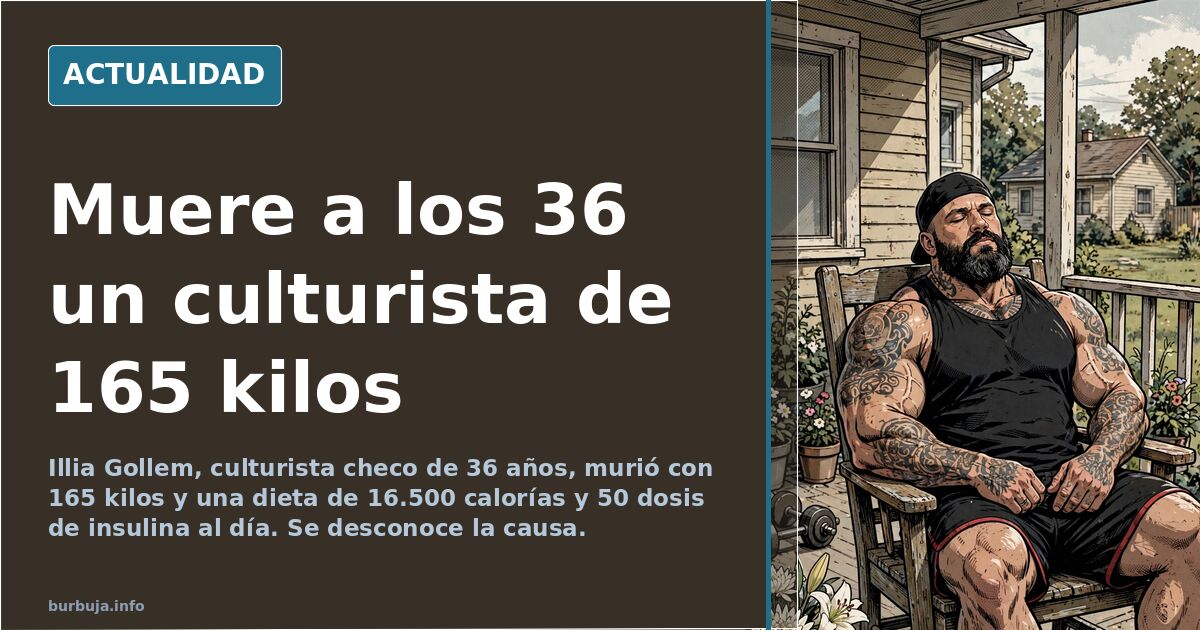
Bodybuilder Weighing 165 Kilos Dies at 36
Illia Gollem, a 36-year-old Czech physique competitor nicknamed "The Mutant," passed away on Wednesday under circumstances that remain unknown as of this writing. Standing 1.85 meters tall, he reached a weight of 165 kilos. A year ago, Men's Health magazine reported his daily intake could reach 16,500 calories across seven meals, including over 100 pieces of sushi and 2.5 kilos of meat. According to the accompanying report, he injected 50 units of insulin daily to rapidly metabolize food. He began training self-taught, inspired by Schwarzenegger and Stallone, lifting between 250 and 350 kilos.
What Is Known About Illia Gollem's Death
The Czech bodybuilder died on a Wednesday with no official cause confirmed. The news, published by A. L. Menéndez, states that the reason for his death is unknown. Gollem was 36, measured 1.85 meters, and weighed 165 kilos. His diet, according to Men's Health, included seven daily meals, more than 108 pieces of sushi, and 2.5 kilos of meat. Insulin, administered in doses of 50 injections per day, appears in the account as a tool to process this massive intake. No authority has yet confirmed the cause of death.
Doubts Over the 16,500 Calories and Sushi Claims
The figure of 16,500 daily calories circulates as a headline stat, but not everyone accepts it as accurate. Some argue it is a phantom number, similar to those displayed by other influencers in the sector: gluttonous meals filmed on different days and edited into a single video to simulate an intake that never occurred daily. In this interpretation, Gollem did not compete, had no notable achievements in any discipline, and his business was image-based. The reasonable doubt lies in how much he actually ate versus how much was staged for trinc.
The Body as a Machine That Burns Out Early
The most repeated argument concerns physical wear. An organism digesting such volume keeps its metabolism at full capacity solely on digestive tasks, leaving no margin for repair. The comparison to a car arises but is nuanced: the body self-repairs, but only if allowed. With seven meals a day, insulin levels never drop. The result, they argue, mirrors morbid obesity: cardiovascular risk, sleep apnea, and exhaustion when climbing stairs. Muscular overweight does not protect against these issues.
Steroids, Insulin, and the Extreme Physique Business
This case fits into a broader discussion about steroid consumption among young people, normalized to the point where some boast professional-level cycles at age twenty. Insulin, growth hormone, stimulants, and painkillers appear in conversations as part of the package. The lingering question is economic: how is this lifestyle funded? Sponsorships, supplement brands, and an audience paying to see the monster. In this circuit, the extreme physique is the product.
Body Dysmorphia: Muscle Anorexia
The clinical perspective gaining traction is body dysmorphic disorder. Those suffering from it never feel big enough, no matter how much they train or gain. It is the muscular version of anorexia, ending just as badly. Through this lens, the phrase "he died doing what he wanted" falls apart: there is no free choice when mental illness is involved. The bodybuilder did not see himself as monstrous externally; he felt small internally.
Pension Questions and the Sacrifice Narrative
Recurring sarcasm notes he never collected a pension. At 36, weighing 165 kilos with that history, life expectancy narrows. The conversation shifts toward the idea of slow suicide: years of brutal physical effort and extreme discipline, only to die at forty as an anomaly. This is not negligence; it is the opposite. It is the paradox of killing oneself working toward an ideal that does not exist.
The pattern repeats: extreme physique, sponsorship, audience, and early death. If the official cause is ever confirmed, we will know if it was heart failure, a thrombus, or accumulated wear. Meanwhile, the figures of 165 kilos and 36 years stand as the most eloquent summary of a business selling health shaped like disease.
Illia Gollem, a 36-year-old Czech physique competitor nicknamed "The Mutant," passed away on Wednesday under circumstances that remain unknown as of this writing. Standing 1.85 meters tall, he reached a weight of 165 kilos. A year ago, Men's Health magazine reported his daily intake could reach 16,500 calories across seven meals, including over 100 pieces of sushi and 2.5 kilos of meat. According to the accompanying report, he injected 50 units of insulin daily to rapidly metabolize food. He began training self-taught, inspired by Schwarzenegger and Stallone, lifting between 250 and 350 kilos.
What Is Known About Illia Gollem's Death
The Czech bodybuilder died on a Wednesday with no official cause confirmed. The news, published by A. L. Menéndez, states that the reason for his death is unknown. Gollem was 36, measured 1.85 meters, and weighed 165 kilos. His diet, according to Men's Health, included seven daily meals, more than 108 pieces of sushi, and 2.5 kilos of meat. Insulin, administered in doses of 50 injections per day, appears in the account as a tool to process this massive intake. No authority has yet confirmed the cause of death.
Doubts Over the 16,500 Calories and Sushi Claims
The figure of 16,500 daily calories circulates as a headline stat, but not everyone accepts it as accurate. Some argue it is a phantom number, similar to those displayed by other influencers in the sector: gluttonous meals filmed on different days and edited into a single video to simulate an intake that never occurred daily. In this interpretation, Gollem did not compete, had no notable achievements in any discipline, and his business was image-based. The reasonable doubt lies in how much he actually ate versus how much was staged for trinc.
The Body as a Machine That Burns Out Early
The most repeated argument concerns physical wear. An organism digesting such volume keeps its metabolism at full capacity solely on digestive tasks, leaving no margin for repair. The comparison to a car arises but is nuanced: the body self-repairs, but only if allowed. With seven meals a day, insulin levels never drop. The result, they argue, mirrors morbid obesity: cardiovascular risk, sleep apnea, and exhaustion when climbing stairs. Muscular overweight does not protect against these issues.
Steroids, Insulin, and the Extreme Physique Business
This case fits into a broader discussion about steroid consumption among young people, normalized to the point where some boast professional-level cycles at age twenty. Insulin, growth hormone, stimulants, and painkillers appear in conversations as part of the package. The lingering question is economic: how is this lifestyle funded? Sponsorships, supplement brands, and an audience paying to see the monster. In this circuit, the extreme physique is the product.
Body Dysmorphia: Muscle Anorexia
The clinical perspective gaining traction is body dysmorphic disorder. Those suffering from it never feel big enough, no matter how much they train or gain. It is the muscular version of anorexia, ending just as badly. Through this lens, the phrase "he died doing what he wanted" falls apart: there is no free choice when mental illness is involved. The bodybuilder did not see himself as monstrous externally; he felt small internally.
Pension Questions and the Sacrifice Narrative
Recurring sarcasm notes he never collected a pension. At 36, weighing 165 kilos with that history, life expectancy narrows. The conversation shifts toward the idea of slow suicide: years of brutal physical effort and extreme discipline, only to die at forty as an anomaly. This is not negligence; it is the opposite. It is the paradox of killing oneself working toward an ideal that does not exist.
The pattern repeats: extreme physique, sponsorship, audience, and early death. If the official cause is ever confirmed, we will know if it was heart failure, a thrombus, or accumulated wear. Meanwhile, the figures of 165 kilos and 36 years stand as the most eloquent summary of a business selling health shaped like disease.
Summary of a discussion on Burbuja.info - Foro de economía, actualidad y política., translated from Spanish and reviewed before publication. Read the full discussion (182 replies).
More summaries
-
Iker Jiménez, VOX and the 'I don't know anyone' that doesn't add up
Iker Jiménez justifies VOX's absence from Horizonte by saying he doesn't know them, but his guest list includes non-parliamentary figures.
-
German Forum Debate: Youth Reject Mandatory Military Service
Online discussions on Germany's conscription revival highlight skepticism among young people, questioning support statistics and the rationale for mandatory service amid European defense tensions.
-
Squid vs. Cuttlefish: A Spanish Restaurant Dispute
Dispute over whether squid or cuttlefish was served at a restaurant. We analyze the difference between cephalopods and the cost of transparency in Spain's hospitality sector.
-
Nicki Minaj Accuses Hollywood Elite of Epstein Ties
Nicki Minaj uses Twitter to link Hollywood elites to the Epstein case and occult practices, sparking intense digital scrutiny.
-
Spain fines drivers 200 euros for using hazard lights in traffic jams
The DGT imposes a 200 euro fine for using hazard lights in traffic. We analyze the controversy: is it a safety measure or a revenue-generating policy?
-
Fitness Influencer Death Exposes Industry Hypocrisy
A young fitness influencer's death sparks grief and autopsy demands, revealing the hypocrisy of a culture normalizing steroid use.