
Cupra Raval: Leaked Urban EV Named After Barcelona District
The Cupra Raval, a fully electric city car, leaks ahead of its official launch, dividing opinion between design praise and mockery.
English · Original discussion in Spanish · Published
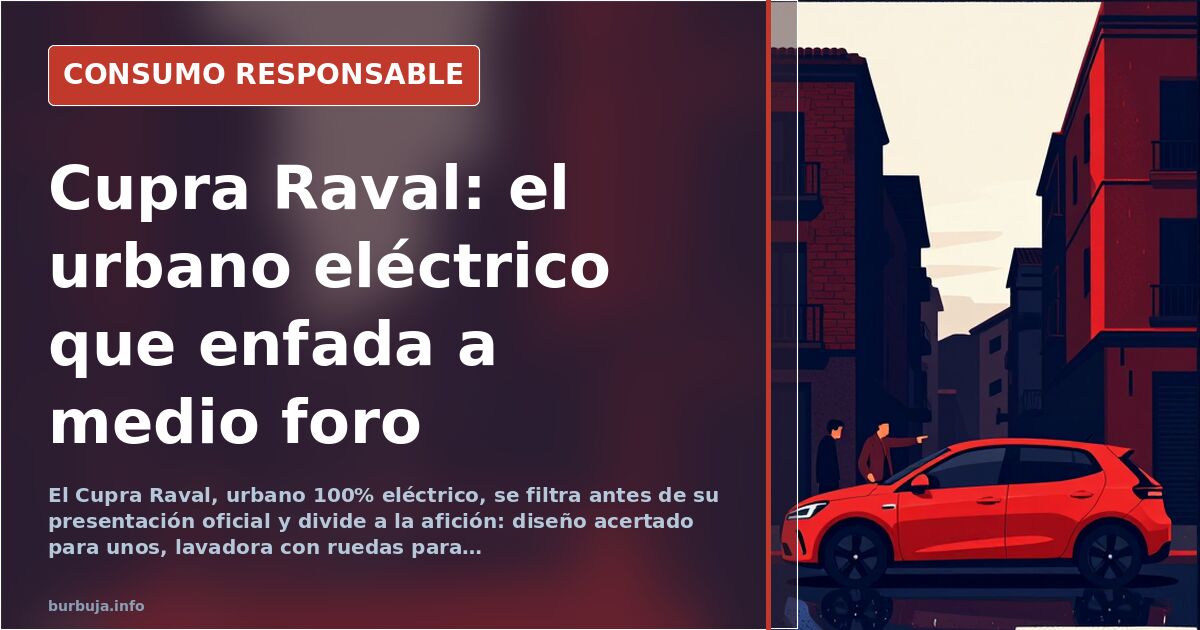
Cupra Raval: The urban EV angering purists
An unofficial leak has revealed the Cupra Raval, the brand's 100% electric city car designed to compete with battery-powered subcompacts. Photos circulated before official media releases, sparking a polarized reaction: some see it as a design success, while others view it as proof that traditional motoring is dead.
The name doesn't help either. Calling it Raval, after a Barcelona neighborhood, triggered jokes about districts, with comparisons to naming a Madrid version 'Parla' or 'Cañada Real'. Meanwhile, the brand has not officially confirmed anything.
What is the Cupra Raval and why did it leak?
The Raval is Cupra's bet in the electric urban segment, a short format with a battery and an aesthetic defenders summarize as having a "cheeky face." The leak came through unofficial channels, and the discoverer asked for discretion: no sharing photos before official media coverage.
The car is presented as an alternative to the Cupra Born, which many were already considering buying. Real interest lies in motor efficiency, consumption, and road behavior, because inside, it remains a city car.
Design: Between success and appliance on wheels
Opinions are split. One group argues the Raval hits the mark: short, electric, with an aggressive front matching the young audience Cupra targets. Another dismisses it as another tablet on wheels and batteries, a boring bald-headed appliance compared to a good eight-cylinder pickup with steel bumpers.
In the middle lies the most repeated aesthetic criticism: that all new cars look alike. The Volkswagen Group trend of placing LED strips across the front and rear is seen as tackiness, with some claiming first-generation yellow tuned Leóns had more elegance.
Name: Raval, Parla, or Cañada Real?
Naming it Raval generated more comments than the car itself. Imaginary versions abound: a Cupra La Coma, a Cupra 3000 Viviendas, a Cupra Cañada Real. Recurring jokes suggest the car comes with a smoker's pack or that your watch, phone, and wallet disappear when you get in.
Beyond the joke, there's an uncomfortable reading: the name seeks popular appeal via a specific neighborhood but results in an unintentional punchline. The brand hasn't clarified this.
Battery, safety, and the fire ghost
Technical debate focuses on two fronts. First, safety: some note the car has range sensors and brakes before impact, while others reply that after braking, it catches fire. Second, autonomy and maintenance costs: oil changes, batteries, and scratches.
Underlying criticism concerns efficiency: a vehicle overloaded with screens and cables, with exaggerated power to move a mass of iron and copper. A rolling monument to excess amenities, they conclude.
Context: Europe lags behind, China presses
Here the debate moves beyond the car. Some argue Chinese manufacturers lead in EVs and Europeans are late; others counter that European laws and tariffs on Chinese cars distort the market. According to this second view, Europe dominated combustion engines and design but dismantled its factories.
Who buys such a car?
Buyer profiles are debated. Some associate it with a young audience with specific aesthetics; others reduce it to tribal identity: Cupras are like tattoos, used to identify certain groups. Accusations of buying a washing machine on wheels clash with defenses from those simply wanting an efficient electric city car.
The Raval hasn't reached dealerships yet, but it achieved something difficult: being talked about for its name, front, and symbolism, not its function.
With these credentials, the Raval should sell itself among urban buyers seeking cheap electrics. The leak showed the opposite: the car generates rejection before testing. We'll see if the brand turns controversy into sales or if the name remains a recurring joke.
An unofficial leak has revealed the Cupra Raval, the brand's 100% electric city car designed to compete with battery-powered subcompacts. Photos circulated before official media releases, sparking a polarized reaction: some see it as a design success, while others view it as proof that traditional motoring is dead.
The name doesn't help either. Calling it Raval, after a Barcelona neighborhood, triggered jokes about districts, with comparisons to naming a Madrid version 'Parla' or 'Cañada Real'. Meanwhile, the brand has not officially confirmed anything.
What is the Cupra Raval and why did it leak?
The Raval is Cupra's bet in the electric urban segment, a short format with a battery and an aesthetic defenders summarize as having a "cheeky face." The leak came through unofficial channels, and the discoverer asked for discretion: no sharing photos before official media coverage.
The car is presented as an alternative to the Cupra Born, which many were already considering buying. Real interest lies in motor efficiency, consumption, and road behavior, because inside, it remains a city car.
Design: Between success and appliance on wheels
Opinions are split. One group argues the Raval hits the mark: short, electric, with an aggressive front matching the young audience Cupra targets. Another dismisses it as another tablet on wheels and batteries, a boring bald-headed appliance compared to a good eight-cylinder pickup with steel bumpers.
In the middle lies the most repeated aesthetic criticism: that all new cars look alike. The Volkswagen Group trend of placing LED strips across the front and rear is seen as tackiness, with some claiming first-generation yellow tuned Leóns had more elegance.
Name: Raval, Parla, or Cañada Real?
Naming it Raval generated more comments than the car itself. Imaginary versions abound: a Cupra La Coma, a Cupra 3000 Viviendas, a Cupra Cañada Real. Recurring jokes suggest the car comes with a smoker's pack or that your watch, phone, and wallet disappear when you get in.
Beyond the joke, there's an uncomfortable reading: the name seeks popular appeal via a specific neighborhood but results in an unintentional punchline. The brand hasn't clarified this.
Battery, safety, and the fire ghost
Technical debate focuses on two fronts. First, safety: some note the car has range sensors and brakes before impact, while others reply that after braking, it catches fire. Second, autonomy and maintenance costs: oil changes, batteries, and scratches.
Underlying criticism concerns efficiency: a vehicle overloaded with screens and cables, with exaggerated power to move a mass of iron and copper. A rolling monument to excess amenities, they conclude.
Context: Europe lags behind, China presses
Here the debate moves beyond the car. Some argue Chinese manufacturers lead in EVs and Europeans are late; others counter that European laws and tariffs on Chinese cars distort the market. According to this second view, Europe dominated combustion engines and design but dismantled its factories.
Who buys such a car?
Buyer profiles are debated. Some associate it with a young audience with specific aesthetics; others reduce it to tribal identity: Cupras are like tattoos, used to identify certain groups. Accusations of buying a washing machine on wheels clash with defenses from those simply wanting an efficient electric city car.
The Raval hasn't reached dealerships yet, but it achieved something difficult: being talked about for its name, front, and symbolism, not its function.
With these credentials, the Raval should sell itself among urban buyers seeking cheap electrics. The leak showed the opposite: the car generates rejection before testing. We'll see if the brand turns controversy into sales or if the name remains a recurring joke.
Also available in: Deutsch
Summary of a discussion on Burbuja.info - Foro de economía, actualidad y política., translated from Spanish and reviewed before publication. Read the full discussion (116 replies).
More summaries
-
Electric quadricycle vs. EV: can it really save money?
A family with four cars and solar panels considers a small electric quadricycle to cut costs. Does it make sense versus a conventional EV? A cost analysis.
-
Forum user runs electric car and solar panels at home
Are solar panels worth it for charging an electric car? Real data: 757 kWh/year, 4,450 km, and the scheduling and cost problems.
-
Cupra Born: €41,590, 160 km/h top speed, rear drum brakes
The 204 hp Cupra Born costs €41,590, tops out at 160 km/h with rear drums, contrasting sharply with the 242 km/h 2005 Cupra.
-
DeepSeek vs Gemini: Best Free AI Models
Comparison of DeepSeek and Gemini as top free AIs for document analysis, coding, and daily tasks. Which one wins without paying?
-
Spanish Home Renovations Face Backlash Over Grey Ash Flooring
A forum thread debates grey ash porcelain tiles, citing dirty grout lines and uniformity, questioning why durable materials are replaced after 20 years.
-
Half a watermelon for €7: Spain's soaring fruit prices
Early-season watermelons cost over €2/kg in Spain due to halved production, heavy rains, and rising agricultural costs.