
Criminal trial, pills, and jail: the accused's calculation
An accused economic crime defendant weighs hiring a private lawyer versus a court-appointed one, citing mental health and medication as mitigating factors. The case remains open.
English · Original discussion in Spanish · Published
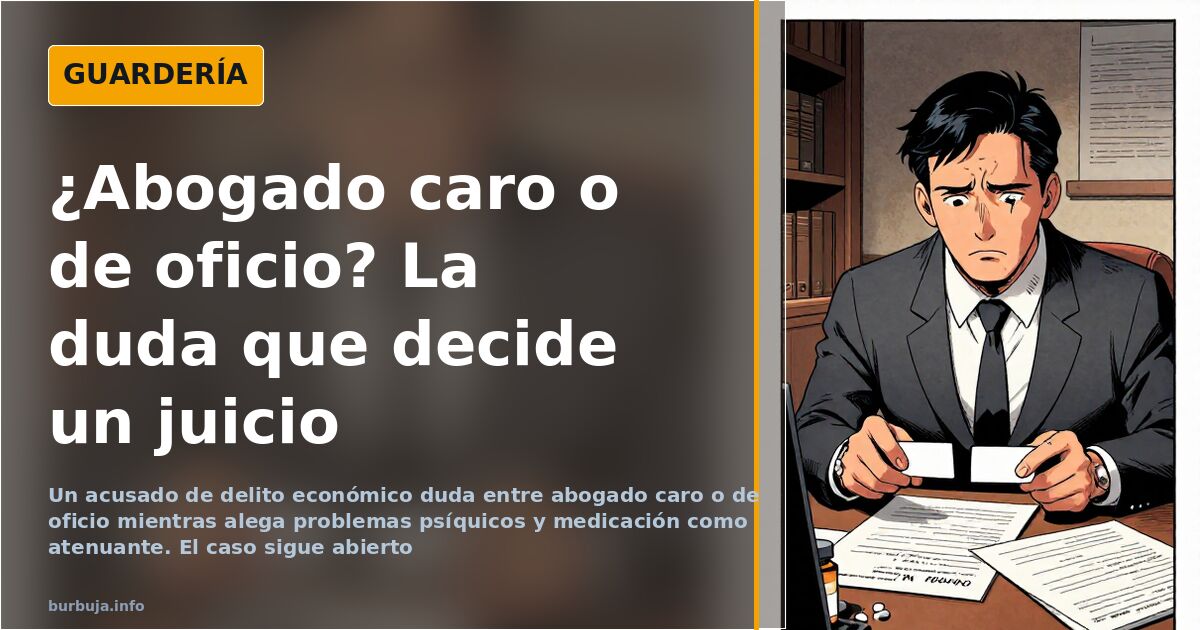
Incivil trial: private lawyer, court-appointed, or claiming the pills
A man faces incivil proceedings for an alleged economic crime, and his first decision is not what he will say, but who will defend him. His case, told in the first person, begins with a question many have asked: is it worth paying for a lawyer or is a court-appointed one enough? The answer is not reassuring. "If you go to a trial with possible jail time, find a good lawyer," summarizes one participant. Another shares his personal experience: he spent 300 euros on a lawyer for a minor coercion offense, still lost, and he was the accused. His conclusion is that for some cases, the court-appointed system is sufficient.
What is at stake for the defendant
The core issue is an alleged economic crime: identity theft of the mother to apply for a loan. The discussion quickly shifts to procedural strategy. Some argue that the key is not the lawyer, but the clinical alibi: citing mental health issues and presenting medication side effects as a mitigating factor. "It is the best card you can play," it reads. The conversation mixes legal advice with the improvised diagnosis of someone on medication for months. The protagonist himself admits he has been under treatment since August and has not taken "not even one clinical pill more nor an olanzapine" — a reference to his pharmacological adherence — making his medical history central to any defense.
The jail few ever visit
The prevailing perception is that actual prison time will not be served. The argument is repeated that a two-year sentence is appealed and not served, and that the Spanish penal system rarely sends someone to prison for this type of crime without prior records. The discussion then shifts to the accessories: the "fine" upon release, the peculio — funds for expenses in prison — which the protagonist claims he does not have, and the social stigma. The conversation is filled with dark humor about prison life, referencing the bar of soap and cohabitation with other inmates. It is the usual mechanism: when the antiestéticar is real, a layer of joke is added.
The exemption that slips into any trial
One of the most interesting twists comes when asked whether appearing drunk or under the influence of substances in the oral hearing would be an exemption or an aggravating factor. The answer is blunt: it is useless, because the court evaluates the habitual state, not that of the day of the trial. The anecdote closing the matter is that of a former comrade-in-arms who urinated on his mattress every morning and was discharged due to disability. "Pee on yourself when you go to the trial," they advise half-jokingly. The line between real pathology and strategic simulation blurs, and no one in the conversation seems willing to draw it precisely.
What the case says about the system
Beyond the specific case, the exchange reveals widespread distrust of free justice and the administration itself. It is mentioned that the only real exemption today is "being a pension payer or having connections," and the aggravating factor is being a civil servant or having a common name. Irony about the judicial system coexists with an uncomfortable realization: those with money for a good law firm start with an advantage, and those without depend on the court-appointed system and luck. The case remains open. There is no verdict, no final conviction, and no trial date in the available material. Just a man with psychiatric problems, a debt, and a question: who will defend him?
A man faces incivil proceedings for an alleged economic crime, and his first decision is not what he will say, but who will defend him. His case, told in the first person, begins with a question many have asked: is it worth paying for a lawyer or is a court-appointed one enough? The answer is not reassuring. "If you go to a trial with possible jail time, find a good lawyer," summarizes one participant. Another shares his personal experience: he spent 300 euros on a lawyer for a minor coercion offense, still lost, and he was the accused. His conclusion is that for some cases, the court-appointed system is sufficient.
What is at stake for the defendant
The core issue is an alleged economic crime: identity theft of the mother to apply for a loan. The discussion quickly shifts to procedural strategy. Some argue that the key is not the lawyer, but the clinical alibi: citing mental health issues and presenting medication side effects as a mitigating factor. "It is the best card you can play," it reads. The conversation mixes legal advice with the improvised diagnosis of someone on medication for months. The protagonist himself admits he has been under treatment since August and has not taken "not even one clinical pill more nor an olanzapine" — a reference to his pharmacological adherence — making his medical history central to any defense.
The jail few ever visit
The prevailing perception is that actual prison time will not be served. The argument is repeated that a two-year sentence is appealed and not served, and that the Spanish penal system rarely sends someone to prison for this type of crime without prior records. The discussion then shifts to the accessories: the "fine" upon release, the peculio — funds for expenses in prison — which the protagonist claims he does not have, and the social stigma. The conversation is filled with dark humor about prison life, referencing the bar of soap and cohabitation with other inmates. It is the usual mechanism: when the antiestéticar is real, a layer of joke is added.
The exemption that slips into any trial
One of the most interesting twists comes when asked whether appearing drunk or under the influence of substances in the oral hearing would be an exemption or an aggravating factor. The answer is blunt: it is useless, because the court evaluates the habitual state, not that of the day of the trial. The anecdote closing the matter is that of a former comrade-in-arms who urinated on his mattress every morning and was discharged due to disability. "Pee on yourself when you go to the trial," they advise half-jokingly. The line between real pathology and strategic simulation blurs, and no one in the conversation seems willing to draw it precisely.
What the case says about the system
Beyond the specific case, the exchange reveals widespread distrust of free justice and the administration itself. It is mentioned that the only real exemption today is "being a pension payer or having connections," and the aggravating factor is being a civil servant or having a common name. Irony about the judicial system coexists with an uncomfortable realization: those with money for a good law firm start with an advantage, and those without depend on the court-appointed system and luck. The case remains open. There is no verdict, no final conviction, and no trial date in the available material. Just a man with psychiatric problems, a debt, and a question: who will defend him?
Summary of a discussion on Burbuja.info - Foro de economía, actualidad y política., translated from Spanish and reviewed before publication. Read the full discussion (135 replies).
More summaries
-
Spain 'mamazo' video: viral, illegal and a gender debate
The viral 'mamazo' video in Cádiz is a crime for sharing minors' images; it sparks a gender debate and a judicial response.
-
Diomande’s Girlfriend Sparks AI Debate: Real or Generated?
The girlfriend of footballer Diomande divides social media: is the photo real or AI-generated? A betting house pendant fuels the controversy.
-
Spanish game Blasphemous and the 30-hour JRPG wall
New Dynasty Warriors, abandoned Atlus JRPGs, discounted Blasphemous, and open-world fatigue define Spanish adult gaming habits.
-
Spanish Notary with Vitiligo Targeted by Online Mockery
A Spanish notary with vitiligo faces online harassment, reigniting debates on the objectification of female professionals and digital cruelty.
-
Blasterismo: Unfiltered Truth Can Spark Violence
The blasterismo phenomenon in Spain shows how blunt honesty leads to social isolation and potential violence. Analysis of its consequences.
-
EmeJota: Spain's Niche Adult Industry Debate
Spanish adult actress EmeJota, linked to Torbe, sparks debate on nerd fetishization and exploitation in the industry.