
Couple Takes Antidepressants for Three Weeks After Retirement
A retired couple in Spain has been taking antidepressants for three weeks, a fact discovered by their children. The case highlights mental health issues among the elderly.
English · Original discussion in Spanish · Published
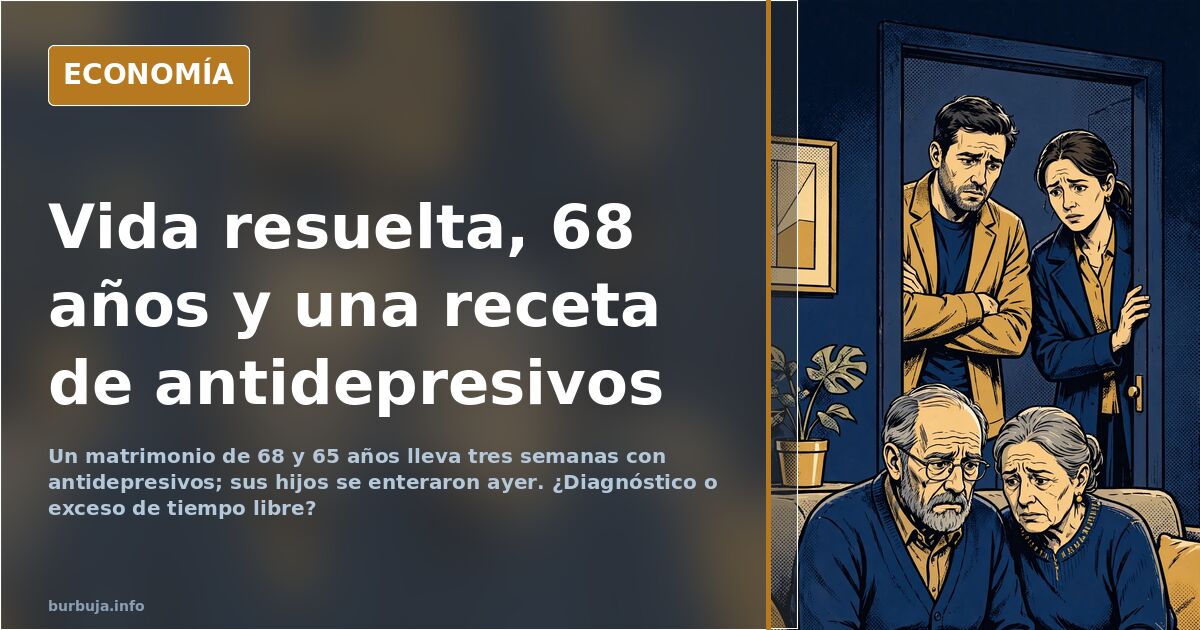
Three weeks of antidepressants for parents with life sorted out
How does someone get depressed when they have life sorted out? A retired couple aged 68 and 65, with a house in a private urbanization larger than they need, pool, gardens, two garage spaces, substantial pensions, monthly trips, restaurants, theater, reasonable health, and a group of friends for dinners. They have been taking antidepressants for three weeks, and their children found out yesterday at a family dinner where the topic came up naturally. They had kept it quiet "so as not to worry us." No drama, no debt, no illness, just a box of pills.
The case is not extravagant. What is missing is the explanation we all had at hand.
Why does a person with no problems get depressed?
Depression is not explained solely by what is lacking. It is not an unpaid bill or a dismissal. Those who have gone through severe spells of listlessness describe a repeating pattern: they arrive when there is no long-term life project. Nothing to pursue, nothing to resolve, no real obligation that truly weighs. And if that absence lasts for months, the body eventually bills for it.
This is the account of a participant based on his own experience, not a diagnosis. No clinical explanation closing the question appears in the thread.
The family doctor's prescription that lasts for years
The harshest criticism points to the healthcare circuit. Some argue that today antidepressants come directly from the family doctor's office, without prior psychiatry, and that saying "I am sad" or "I sleep badly" is enough to take the prescription home. From there to lifelong dependence is a step that, according to this reading, happens almost always. The most repeated prognosis—that they will never stop—is an opinion, not clinical data.
Another family account mentions twelve years of treatment and leaves a severe warning: either stop it early or prepare to lose your parents as you knew them. This warning comes from someone who has lived it, not a clinical trial, but it summarizes the house's antiestéticar quite well.
Boredom and lack of challenges as suspects
There is a current that reduces the problem to opulence: too much free time, zero challenges, and a life so sorted out that nothing remains to conquer. "If they had to mow the field, like their parents, they wouldn't have time to get depressed," summarizes one of the most repeated exits. It is the old thesis of the rich man's disease, and it has more literature than evidence.
The objection comes quickly and is hard to dodge: as one participant recalls, depression is among the leading causes of suicide, and that statistic does not distinguish bank accounts. Having a pool does not vaccinate you, nor does not having one.
Grandchildren, garden, and other tasks that fill the day
The most repeated question is whether they have grandchildren. One case cited: a mother who assumed she would never be a grandmother, took it badly for a while, and got over it when she started seeing her acquaintances dealing with adult children returning home with broken economies. Another: grandparents of three grandchildren aged 2 and 4 who, since becoming so, have improved. The recipe has no package insert, but the pattern holds: purpose, obligations, someone who needs you.
There is also someone pointing out the least romantic aspect: "my father has a vegetable garden, that is the antidepressant." And someone warning that retirement puts many people, all at once, in discount time, without the routine that ordered the week. That both start at the same time, with years of difference in everything else, is what fits least.
The percentages discussed: 25% medicated and 3-5% who need it
The numbers circulating in the conversation are rough and are worth what they are worth, because no one cites the source. It is stated that 25% of the population takes antidepressants or anxiolytics, compared to 3-5% who would truly need them. It is also said that around 70% of people of that age take them, and only 20% notice improvement, with the effect attributed more to the placebo than to the active principle. These are estimates from the dining table, without a study behind them, and that is how they should be read.
At the noisiest extreme, the matter is reduced to a conspiracy by the pharmaceutical lobby interested in sedating the population. This has no proof. What does have backing is the obvious: children do not know if their parents are well medicated or simply medicated.
Can both start at the same time?
It is striking. Two people with different trajectories, different symptoms, and different consultations, starting the same treatment with a difference of weeks is statistically uncomfortable. From this come the two hypotheses that no one can close: a diagnosis taken lightly, or something not told—money, health, a family matter—that has been decided to cover up with the usual argument, not to worry the children.
The material advice is boring and useful: find out how the consultation went, who prescribed what, and if there is real psychological or psychiatric trinc-up.
If prescribing lifestyle, someone suggests making them row from scratch and another installing a video game. Neither of these therapies comes with a package insert. Until the consultation's verdict arrives, their children remain with the initial doubt: how does someone get depressed who has everything and why did no one tell them anything.
How does someone get depressed when they have life sorted out? A retired couple aged 68 and 65, with a house in a private urbanization larger than they need, pool, gardens, two garage spaces, substantial pensions, monthly trips, restaurants, theater, reasonable health, and a group of friends for dinners. They have been taking antidepressants for three weeks, and their children found out yesterday at a family dinner where the topic came up naturally. They had kept it quiet "so as not to worry us." No drama, no debt, no illness, just a box of pills.
The case is not extravagant. What is missing is the explanation we all had at hand.
Why does a person with no problems get depressed?
Depression is not explained solely by what is lacking. It is not an unpaid bill or a dismissal. Those who have gone through severe spells of listlessness describe a repeating pattern: they arrive when there is no long-term life project. Nothing to pursue, nothing to resolve, no real obligation that truly weighs. And if that absence lasts for months, the body eventually bills for it.
This is the account of a participant based on his own experience, not a diagnosis. No clinical explanation closing the question appears in the thread.
The family doctor's prescription that lasts for years
The harshest criticism points to the healthcare circuit. Some argue that today antidepressants come directly from the family doctor's office, without prior psychiatry, and that saying "I am sad" or "I sleep badly" is enough to take the prescription home. From there to lifelong dependence is a step that, according to this reading, happens almost always. The most repeated prognosis—that they will never stop—is an opinion, not clinical data.
Another family account mentions twelve years of treatment and leaves a severe warning: either stop it early or prepare to lose your parents as you knew them. This warning comes from someone who has lived it, not a clinical trial, but it summarizes the house's antiestéticar quite well.
Boredom and lack of challenges as suspects
There is a current that reduces the problem to opulence: too much free time, zero challenges, and a life so sorted out that nothing remains to conquer. "If they had to mow the field, like their parents, they wouldn't have time to get depressed," summarizes one of the most repeated exits. It is the old thesis of the rich man's disease, and it has more literature than evidence.
The objection comes quickly and is hard to dodge: as one participant recalls, depression is among the leading causes of suicide, and that statistic does not distinguish bank accounts. Having a pool does not vaccinate you, nor does not having one.
Grandchildren, garden, and other tasks that fill the day
The most repeated question is whether they have grandchildren. One case cited: a mother who assumed she would never be a grandmother, took it badly for a while, and got over it when she started seeing her acquaintances dealing with adult children returning home with broken economies. Another: grandparents of three grandchildren aged 2 and 4 who, since becoming so, have improved. The recipe has no package insert, but the pattern holds: purpose, obligations, someone who needs you.
There is also someone pointing out the least romantic aspect: "my father has a vegetable garden, that is the antidepressant." And someone warning that retirement puts many people, all at once, in discount time, without the routine that ordered the week. That both start at the same time, with years of difference in everything else, is what fits least.
The percentages discussed: 25% medicated and 3-5% who need it
The numbers circulating in the conversation are rough and are worth what they are worth, because no one cites the source. It is stated that 25% of the population takes antidepressants or anxiolytics, compared to 3-5% who would truly need them. It is also said that around 70% of people of that age take them, and only 20% notice improvement, with the effect attributed more to the placebo than to the active principle. These are estimates from the dining table, without a study behind them, and that is how they should be read.
At the noisiest extreme, the matter is reduced to a conspiracy by the pharmaceutical lobby interested in sedating the population. This has no proof. What does have backing is the obvious: children do not know if their parents are well medicated or simply medicated.
Can both start at the same time?
It is striking. Two people with different trajectories, different symptoms, and different consultations, starting the same treatment with a difference of weeks is statistically uncomfortable. From this come the two hypotheses that no one can close: a diagnosis taken lightly, or something not told—money, health, a family matter—that has been decided to cover up with the usual argument, not to worry the children.
The material advice is boring and useful: find out how the consultation went, who prescribed what, and if there is real psychological or psychiatric trinc-up.
If prescribing lifestyle, someone suggests making them row from scratch and another installing a video game. Neither of these therapies comes with a package insert. Until the consultation's verdict arrives, their children remain with the initial doubt: how does someone get depressed who has everything and why did no one tell them anything.
Summary of a discussion on Burbuja.info - Foro de economía, actualidad y política., translated from Spanish and reviewed before publication. Read the full discussion (214 replies).
More summaries
-
Spain’s GP triage calls: 48-hour wait, months for specialists
Telephone triage arrives at Spanish family medicine: 48-hour assessment while specialist waits stretch to months or years.
-
Retirement at 73: The Proposal Stirring the Pension Debate
A report proposes raising the retirement age to 73 to save pensions. Alternatives clash: immigration, spending cuts, or a model change…
-
Tenant Union of Sol: a network with €3.7 million
The Tenant Union of Sol is part, according to a published report, of a network that would have received €3.7 million from Socialist administrations.
-
Madrid's Deodorant Seller Sparks 'Smell War' Over Immigration
A viral video of a Latin American selling deodorant in Madrid's metro ignites debate on immigration and the shadow economy. Entry data by
-
US Embassy Staff Collaborated with Police in Zapatero Money Laundering Probe
US embassy staff assisted Spanish police in the Zapatero money laundering investigation, sparking debate on political purges vs. justice.
-
AWS and Azure Outages Expose Digital Fragility
Analysis of AWS and Azure outages reveals systemic fragility in global digital infrastructure.