
Córdoba Traffic Dispute Goes Viral: Road Rage or Hate Crime?
A traffic altercation in Córdoba escalated into a physical fight, captured on video and broadcast on TV. No charges were filed as no formal complaint was lodged.
English · Original discussion in Spanish · Published
Córdoba Traffic Dispute: From Viral Fight to Potential Hate Crime
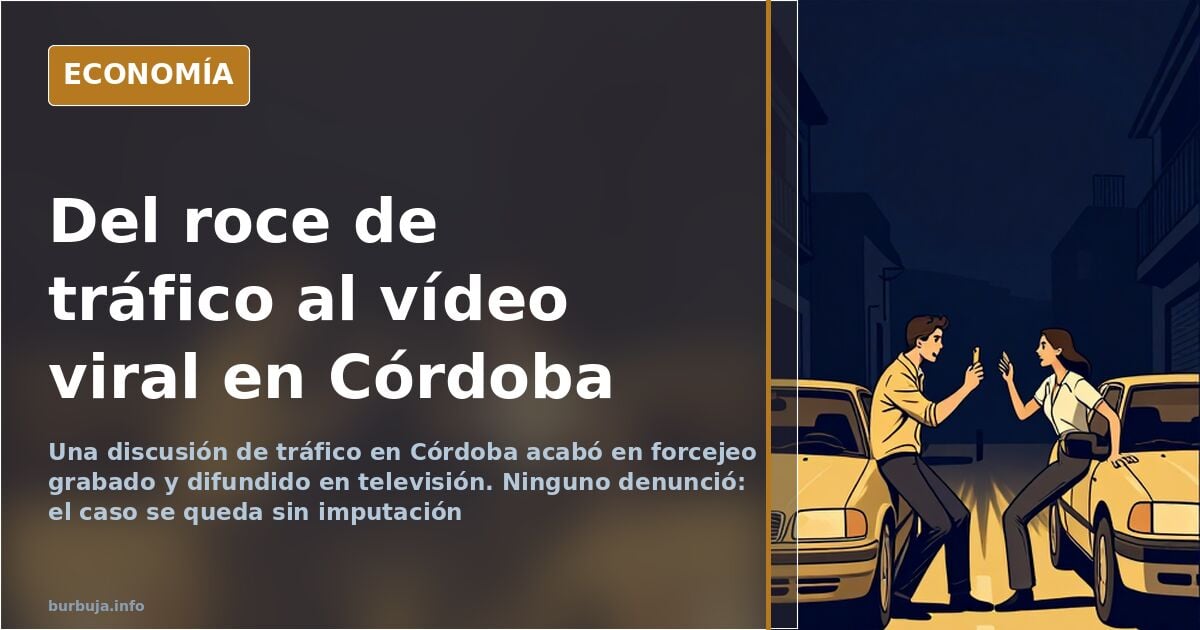
A road argument, a scuffle filmed on multiple phones, and a video that jumps from social media to television. The incident in Córdoba—a driver demanding passage and a motorcyclist who, according to footage, blocked the road—has become yet another chapter in an uncomfortable question: who can intervene when someone breaks the rules, who should just record, and who calls the police? It combines two highly clickable elements: lack of civility on the road and the temptation to resolve it aggressively, adding an extra layer of tension. Months after its release, the case still lacks a formal complaint.
What the Incident Video Actually Shows
The released footage shows a motorcyclist stopping his bike on the road and a driver getting out of his car to confront him about the blockage. What starts as an exchange of gestures quickly escalates: scuffles from minute 1:07, insults, and a moment where the motorcyclist ends up on the ground in the middle of the road. The video does not capture the start of the conflict, only its final moments. And that detail—what peine before someone pressed rec—is precisely what changes everything.
The Origin: A Traffic Argument, Not a Parking Issue
When the case reached television, the reconstruction reordered the narrative. It wasn't the motorcycle's parking position that triggered the confrontation, but a prior traffic argument; insults—some racist, according to reports—came later. Before the scuffles were filmed, both drivers had already exchanged words. This seemingly minor nuance completely rewrites who is legally right and who is only right in the clipped video circulating. A third person also appears, intervening to separate them, and their action raises questions: by holding one person back, they leave the other without anyone restraining them.
Legal Consequences for Each Party
The driver faces the most serious exposure. Case analysts suggest that using the car against the motorcyclist could lead to charges of injury, property damage, and, if a discriminatory motive is proven, a hate crime. The motorcyclist is accused of obstructing traffic and provocation. The procedural key is different: neither filed a complaint. Unless there are serious injuries or a minor involved, the prosecutor's office does not act ex officio in most such cases. Those who argue that getting out of the car was a textbook error cling to this cold calculation: even if you are in the right, the legal bill can be much higher than waiting.
Filming, Watching, or Intervening: The Role of Witnesses
The video also portrays the person filming. One line of analysis suggests that in the face of a violent event, the priority is to call the police, not just film; another reminds us that intervening between two struggling people leaves one defenseless against the other. In the footage, some watch from the sidewalk, and others step in to mediate. The culture of the raised mobile phone (the common citizen's stance towards others' conflicts) is better depicted by this than by any survey. And the question—whether filming helps or just documents—remains without a comfortable answer.
The Underlying Issue the Case Revives
Behind the incident lies a deeper discussion that these videos reignite: coexistence in neighborhoods with migrant populations, the perception of impunity among some offenders, and the use of anecdotal events as ammunition for a broader narrative. Some circulating messages generalize from an individual case, attributing dangerousness to an entire group that no data supports; others focus on impunity, not the origin. Those who generalize find confirmation in every video; those who look away find the perfect excuse. The footage, it's important to remember, proves neither thesis: it only shows a few minutes of a story that began earlier.
What No One Disputes
There is a rare point of agreement: blocking the road is not a way to resolve anything, and neither is getting out of the car to argue about it. Some recount similar experiences, with witnesses who preferred not to testify when the police arrived and acquaintances who reproached the victim for resisting instead of letting themselves be robbed. That, perhaps, is the most uncomfortable part of the issue: what doesn't appear in the video. The rest—who provoked whom, who should have called the police earlier—remains exactly where it was the last time a camera recorded a brawl in the middle of the street.
A road argument, a scuffle filmed on multiple phones, and a video that jumps from social media to television. The incident in Córdoba—a driver demanding passage and a motorcyclist who, according to footage, blocked the road—has become yet another chapter in an uncomfortable question: who can intervene when someone breaks the rules, who should just record, and who calls the police? It combines two highly clickable elements: lack of civility on the road and the temptation to resolve it aggressively, adding an extra layer of tension. Months after its release, the case still lacks a formal complaint.
What the Incident Video Actually Shows
The released footage shows a motorcyclist stopping his bike on the road and a driver getting out of his car to confront him about the blockage. What starts as an exchange of gestures quickly escalates: scuffles from minute 1:07, insults, and a moment where the motorcyclist ends up on the ground in the middle of the road. The video does not capture the start of the conflict, only its final moments. And that detail—what peine before someone pressed rec—is precisely what changes everything.
The Origin: A Traffic Argument, Not a Parking Issue
When the case reached television, the reconstruction reordered the narrative. It wasn't the motorcycle's parking position that triggered the confrontation, but a prior traffic argument; insults—some racist, according to reports—came later. Before the scuffles were filmed, both drivers had already exchanged words. This seemingly minor nuance completely rewrites who is legally right and who is only right in the clipped video circulating. A third person also appears, intervening to separate them, and their action raises questions: by holding one person back, they leave the other without anyone restraining them.
Legal Consequences for Each Party
The driver faces the most serious exposure. Case analysts suggest that using the car against the motorcyclist could lead to charges of injury, property damage, and, if a discriminatory motive is proven, a hate crime. The motorcyclist is accused of obstructing traffic and provocation. The procedural key is different: neither filed a complaint. Unless there are serious injuries or a minor involved, the prosecutor's office does not act ex officio in most such cases. Those who argue that getting out of the car was a textbook error cling to this cold calculation: even if you are in the right, the legal bill can be much higher than waiting.
Filming, Watching, or Intervening: The Role of Witnesses
The video also portrays the person filming. One line of analysis suggests that in the face of a violent event, the priority is to call the police, not just film; another reminds us that intervening between two struggling people leaves one defenseless against the other. In the footage, some watch from the sidewalk, and others step in to mediate. The culture of the raised mobile phone (the common citizen's stance towards others' conflicts) is better depicted by this than by any survey. And the question—whether filming helps or just documents—remains without a comfortable answer.
The Underlying Issue the Case Revives
Behind the incident lies a deeper discussion that these videos reignite: coexistence in neighborhoods with migrant populations, the perception of impunity among some offenders, and the use of anecdotal events as ammunition for a broader narrative. Some circulating messages generalize from an individual case, attributing dangerousness to an entire group that no data supports; others focus on impunity, not the origin. Those who generalize find confirmation in every video; those who look away find the perfect excuse. The footage, it's important to remember, proves neither thesis: it only shows a few minutes of a story that began earlier.
What No One Disputes
There is a rare point of agreement: blocking the road is not a way to resolve anything, and neither is getting out of the car to argue about it. Some recount similar experiences, with witnesses who preferred not to testify when the police arrived and acquaintances who reproached the victim for resisting instead of letting themselves be robbed. That, perhaps, is the most uncomfortable part of the issue: what doesn't appear in the video. The rest—who provoked whom, who should have called the police earlier—remains exactly where it was the last time a camera recorded a brawl in the middle of the street.
Summary of a discussion on Burbuja.info - Foro de economía, actualidad y política., translated from Spanish and reviewed before publication. Read the full discussion (230 replies).
More summaries
-
Brutal: Prosecutor Investigates Albiol for Hate Crime After Calling Detainee 'Scum'
The Prosecutor's Office in **Badalona** is investigating **Xavier García Albiol** regarding possible hate speech after referring to a detainee as "scum." We analyze the case.
-
AI Calculator: How Long Will €70,000 Last on an €800 Salary?
An AI calculates 20 years of financial runway with €70,000 savings and an €800 monthly salary, challenging the consultant's lifestyle assumptions.
-
Euthanasia in Old Age: Autonomy vs. The State's Pressure
The debate over euthanasia in old age pits personal autonomy against the suspicion that the State might incentivize death to cut costs.
-
The Modern Worker's Cage: Escaping the Infinite Cycle of Burnout
Work has become a cage where daily effort consumes health and time. Discover why we push ourselves so hard and how to break the cycle.
-
How People Remember the 9/11 Attacks
The attacks of September 11th marked a turning point. Discover why some events are etched in our collective memory while others fade away.
-
Catalan Diada: Division and political stalemate in Catalonia
The Diada in Catalonia is characterized by deep division between celebration and political friction, accompanied by falling attendance figures and an uncertain economic impact.