
Copper thief electrocuted in Figueres, Spain
A 45-year-old man died after falling from a medium-voltage tower in Figueres while stealing copper. The incident reignites debates on crime and labor laws.
English · Original discussion in Spanish · Published
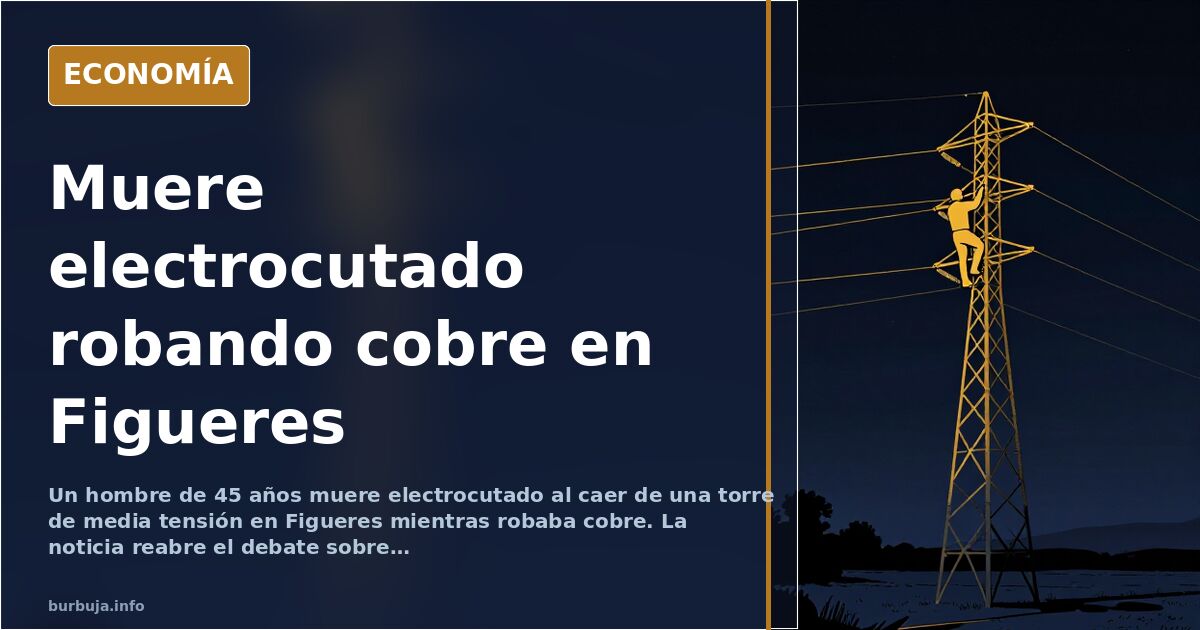
Copper thief electrocuted in Figueres tower
A 45-year-old Segarro national fell eight meters after receiving an electric shock at a medium-voltage tower on Vilatenim Street in the Marca de l'Ham district of Figueres. The incident occurred around 11:45 PM. Witnesses alerted emergency services upon seeing the fall. Mossos d'Esquadra (Catalan police) and Sistema d'Emergències Mèdiques (SEM) personnel arrived but could not resuscitate him. The man had prior convictions and lived in a nearby occupied housing area close to the Figueres football field. The report by ElCaso.com ended with a phrase that triggered widespread discussion: it will not be considered a workplace accident.
What is known about the incident and why it is not a workplace accident
The deceased was climbing a medium-voltage tower when he received the electrical discharge. The eight-meter fall and prior electrocution were decisive factors. Police identified him and confirmed he resided in the occupied housing zone of Marca de l'Ham. No further official details are available regarding the investigation status.
The classification as a workplace accident was ruled out immediately. Some viewed this as administrative obviousness, while others read it as involuntary irony. Some argue that if copper theft is a person's usual activity, death during its commission fits the technical definition of a work-related injury. Others note that without Social Security registration or contributions, no employment relationship exists to cover such incidents. At this point, the debate becomes an exercise in administrative logic involving a corpse.
Copper thefts in Vilatenim: A recurring problem
This area is no stranger to such issues. On the Monday preceding the incident, a telephone connection outage occurred due to copper theft at the exact spot where the man was electrocuted. Residents of Vilatenim live with thefts that reportedly happen every night. Police arrest perpetrators, but they cycle through the courts. This is the circulating summary: the helplessness lies not with the agents, but with the entire system.
That detail—recidivism and judicial response—has been a central axis of the exchange. Against the specific scene of the electrocution, structural complaints emerge: cable theft affects telephony, power lines, and installations, imposing diffuse costs ultimately paid by local users. The discussion shifted to whether the problem stems from police resources, legislation, or other factors.
17% unemployment rate and the necessity argument
One frequently repeated line linked theft to lack of employment. Arguments stated that with a 17% unemployment rate and no legal papers, job prospects for irregular migrants are nearly nonexistent, pushing them toward activities like copper theft. Another current flatly rejected this connection: need does not make theft a legitimate option, and such arguments could justify any crime. Some even corrected the official figure upward, claiming the 17% excludes intermittent workers, trainees, students, unpaid caregivers, and unregistered unemployed, suggesting the real percentage approaches one-third of the population.
The interplay of data and interpretations regarding the labor market occupied much of the exchange. The underlying unresolved question remains: is copper theft a consequence of unemployment or an activity with its own economic logic, independent of the cycle?
From incident to sarracena judgment: Tone of the exchange
The conversation quickly moved into sarracena retribution territory. Some messages celebrated the death as karmic justice at no cost to taxpayers, while others responded harshly to such celebrations. The result was a polarized exchange where the concrete fact—a man dead in a tower—became almost merely an excuse to discuss immigration, crime, and the judicial system.
Debate also surfaced regarding compensation. Speculation arose that the family might receive compensation and that the administrative system would process it quickly. There is no confirmation of any kind on this point; it is a prediction thrown into the air, not a fact. What remains clear is that the news simultaneously activated narratives of everyday insecurity, welfare state costs, and individual responsibility.
The Figueres incident leaves round figures—45 years old, eight meters, one tower—and a question unanswered by opposing views: if copper theft is a crime of opportunity or a trade with its own market, why do people continue to pay with their lives in installations that have long been the network's weak point?
A 45-year-old Segarro national fell eight meters after receiving an electric shock at a medium-voltage tower on Vilatenim Street in the Marca de l'Ham district of Figueres. The incident occurred around 11:45 PM. Witnesses alerted emergency services upon seeing the fall. Mossos d'Esquadra (Catalan police) and Sistema d'Emergències Mèdiques (SEM) personnel arrived but could not resuscitate him. The man had prior convictions and lived in a nearby occupied housing area close to the Figueres football field. The report by ElCaso.com ended with a phrase that triggered widespread discussion: it will not be considered a workplace accident.
What is known about the incident and why it is not a workplace accident
The deceased was climbing a medium-voltage tower when he received the electrical discharge. The eight-meter fall and prior electrocution were decisive factors. Police identified him and confirmed he resided in the occupied housing zone of Marca de l'Ham. No further official details are available regarding the investigation status.
The classification as a workplace accident was ruled out immediately. Some viewed this as administrative obviousness, while others read it as involuntary irony. Some argue that if copper theft is a person's usual activity, death during its commission fits the technical definition of a work-related injury. Others note that without Social Security registration or contributions, no employment relationship exists to cover such incidents. At this point, the debate becomes an exercise in administrative logic involving a corpse.
Copper thefts in Vilatenim: A recurring problem
This area is no stranger to such issues. On the Monday preceding the incident, a telephone connection outage occurred due to copper theft at the exact spot where the man was electrocuted. Residents of Vilatenim live with thefts that reportedly happen every night. Police arrest perpetrators, but they cycle through the courts. This is the circulating summary: the helplessness lies not with the agents, but with the entire system.
That detail—recidivism and judicial response—has been a central axis of the exchange. Against the specific scene of the electrocution, structural complaints emerge: cable theft affects telephony, power lines, and installations, imposing diffuse costs ultimately paid by local users. The discussion shifted to whether the problem stems from police resources, legislation, or other factors.
17% unemployment rate and the necessity argument
One frequently repeated line linked theft to lack of employment. Arguments stated that with a 17% unemployment rate and no legal papers, job prospects for irregular migrants are nearly nonexistent, pushing them toward activities like copper theft. Another current flatly rejected this connection: need does not make theft a legitimate option, and such arguments could justify any crime. Some even corrected the official figure upward, claiming the 17% excludes intermittent workers, trainees, students, unpaid caregivers, and unregistered unemployed, suggesting the real percentage approaches one-third of the population.
The interplay of data and interpretations regarding the labor market occupied much of the exchange. The underlying unresolved question remains: is copper theft a consequence of unemployment or an activity with its own economic logic, independent of the cycle?
From incident to sarracena judgment: Tone of the exchange
The conversation quickly moved into sarracena retribution territory. Some messages celebrated the death as karmic justice at no cost to taxpayers, while others responded harshly to such celebrations. The result was a polarized exchange where the concrete fact—a man dead in a tower—became almost merely an excuse to discuss immigration, crime, and the judicial system.
Debate also surfaced regarding compensation. Speculation arose that the family might receive compensation and that the administrative system would process it quickly. There is no confirmation of any kind on this point; it is a prediction thrown into the air, not a fact. What remains clear is that the news simultaneously activated narratives of everyday insecurity, welfare state costs, and individual responsibility.
The Figueres incident leaves round figures—45 years old, eight meters, one tower—and a question unanswered by opposing views: if copper theft is a crime of opportunity or a trade with its own market, why do people continue to pay with their lives in installations that have long been the network's weak point?
Summary of a discussion on Burbuja.info - Foro de economía, actualidad y política., translated from Spanish and reviewed before publication. Read the full discussion (155 replies).
More summaries
-
Mossos arrest Isaac Andic's son for Mango founder's murder
Jonathan Andic arrested by Mossos d'Esquadra for killing his father, Mango founder. Forum debates digital evidence reliability and family dynamics in wealthy estates.
-
Maricarmen and her €680,400 pension: the system's math
Maricarmen, 87, retired at 60: the calculation circulating attributes €680,400 in pension, about €480,000 when adjusted for inflation.
-
Spain's University Standards: Scam or Broken System?
Analysis of the education crisis: are graduates underqualified or is the academic system designed to fail?
-
Teacher reveals salary: €2,000 net per month with 15 payments
Debate over whether €2,000 net per month is a high salary for a secondary school teacher in Spain, compared with the cost of living and workload.
-
Ceuta border overwhelmed by mass migration surge
Thousands crossed Ceuta's border in chaos. Spain admits prior intel but underestimated scale, sparking debate on control and costs.
-
Spanish Restaurant Owner Roasts Negative Reviews
Owner of Fontevella in Caldebarcos mocks bad Google reviews, sparking debate on pets and reputation.