
Coping with others' ignorance: The selective isolation strategy
A forum discussion on dealing with irrational behavior explores strategies ranging from social withdrawal to imposing informal penalties on difficult clients.
English · Original discussion in Spanish · Published
Coping with others' ignorance: The selective isolation strategy
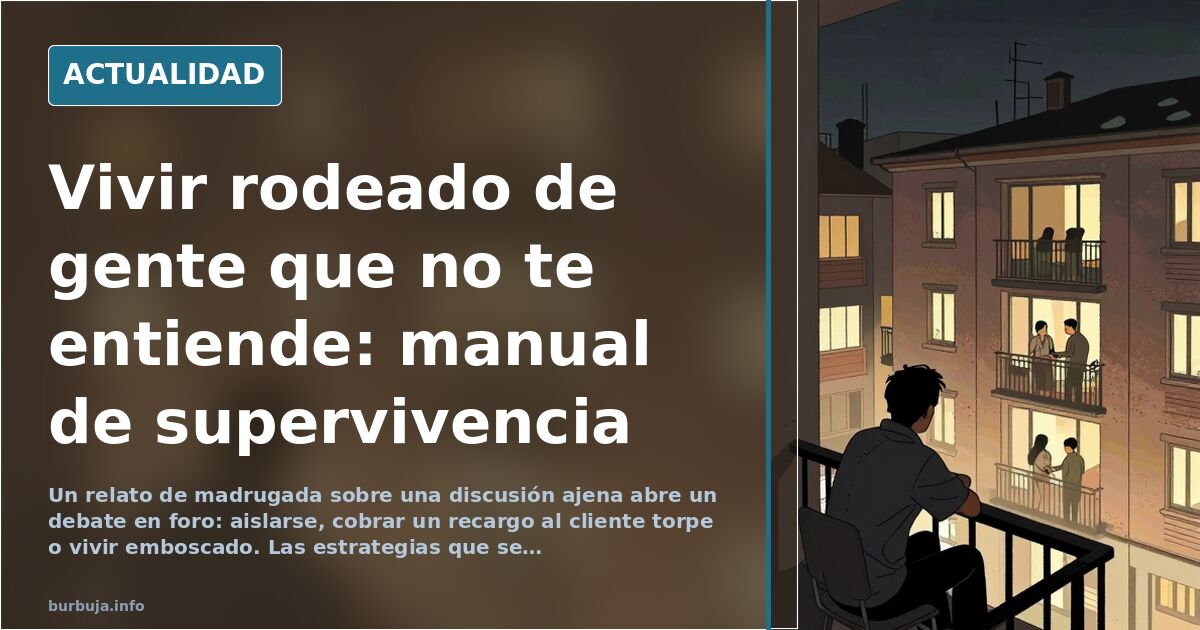
A user recounts sitting on a bench early in the morning. Beside them, according to their story, a woman around fifty was shouting in defense of someone named Antoño and the trap set for him; another man backed her up; a third tried politely to explain they were mistaken. The woman, still per the account, screamed "DON'T TOUCH ME." The man on the bench said nothing. He smoked a cigarette and left. That scene, described by someone claiming to have witnessed it, summarizes the question driving the debate: how to coexist with others' stupidity without losing one's mind.
The most repeated answer is not a method, but a retreat. Living as a hermit, interacting with humans as little as possible, isolating oneself in solitude. Some formulate it more precisely: being among people but not with them. The dominant strategy involves reducing one's circle to a handful of individuals—fewer than ten, according to one participant—and bidding farewell to the rest.
Isolation as an emotional management method
It is not just escape. Those who practice it describe a system: do not argue, do not seek opinions, do not waste energy convincing those who will not change. Agreeing with fools and moving on. The underlying idea is that the drain comes not from ignorance, but from the lack of desire to leave it. That is what is hard to bear: not that someone does not know, but that they do not want to know.
There is a current that goes beyond physical isolation and proposes internal detachment. Reading, traveling, exercising, avoiding television. Ambush as a lifestyle: being in the world doing what is necessary for oneself and one's own, like an impermeable stone in water. The goal is not to disappear, but to prevent noise from entering.
The tax on the client who doesn't understand
Things get complicated when interaction is mandatory: work, clients, colleagues. There, retreating is not an option. Someone shares that they invented an informal surcharge for those who cause trouble with nonsense, ask the same thing eight times, or act knowledgeable without knowing basic arithmetic. They apply it and, based on their experience, it works twofold: they charge more and the client does not return.
Others opt for camouflage. Acting as the most pogre person in the room, so exaggeratedly that the radical gets exposed. Or using safe phrases: "I don't understand politics," "let everyone do as they please as long as they don't harm others." Benevolent lies, they say, to avoid taking the bait.
Why argue with those unwilling to change their minds?
The most common response is that it is not worth it. Data does not move those who refuse to see it. It is argued that the majority does not read, study history, or verify facts: they believe what experts on their side tell them and then do the opposite. And when their property rights are touched, they switch sides without admitting it.
The recommendation is not to waste breath. Explain once, plant the seed, and accept that whether it germinates depends on factors beyond control. Irony, they warn, is a double-edged sword: those who miss the point feel insulted for seeming stupid, and those who get it feel exposed.
The digital bubble as refuge
For many, the only space where translation is unnecessary is a forum. Reading those who share concerns, who teach, who care. Faces may never be seen, and it matters little. The consensus is that everyone arrived seeking answers, out of curiosity, to learn more. That, they say, distinguishes some from others: the willingness.
The problem is not stupidity, but indifference. People who spend years uninterested in anything: neither local history, nor nature, nor a language. That is the wall.
What remains is the comfort of long-distance perspective. Humanity as a group of animals at different levels of evolution; expecting otherwise is the error. Enjoying the dog, the cat, the storm, and fellow humans, who are the same. The problem, within that framework, belongs to those who expect too much. And the disorienting fact: those who have thought about this the most have found no solution, only a way to live with it.
A user recounts sitting on a bench early in the morning. Beside them, according to their story, a woman around fifty was shouting in defense of someone named Antoño and the trap set for him; another man backed her up; a third tried politely to explain they were mistaken. The woman, still per the account, screamed "DON'T TOUCH ME." The man on the bench said nothing. He smoked a cigarette and left. That scene, described by someone claiming to have witnessed it, summarizes the question driving the debate: how to coexist with others' stupidity without losing one's mind.
The most repeated answer is not a method, but a retreat. Living as a hermit, interacting with humans as little as possible, isolating oneself in solitude. Some formulate it more precisely: being among people but not with them. The dominant strategy involves reducing one's circle to a handful of individuals—fewer than ten, according to one participant—and bidding farewell to the rest.
Isolation as an emotional management method
It is not just escape. Those who practice it describe a system: do not argue, do not seek opinions, do not waste energy convincing those who will not change. Agreeing with fools and moving on. The underlying idea is that the drain comes not from ignorance, but from the lack of desire to leave it. That is what is hard to bear: not that someone does not know, but that they do not want to know.
There is a current that goes beyond physical isolation and proposes internal detachment. Reading, traveling, exercising, avoiding television. Ambush as a lifestyle: being in the world doing what is necessary for oneself and one's own, like an impermeable stone in water. The goal is not to disappear, but to prevent noise from entering.
The tax on the client who doesn't understand
Things get complicated when interaction is mandatory: work, clients, colleagues. There, retreating is not an option. Someone shares that they invented an informal surcharge for those who cause trouble with nonsense, ask the same thing eight times, or act knowledgeable without knowing basic arithmetic. They apply it and, based on their experience, it works twofold: they charge more and the client does not return.
Others opt for camouflage. Acting as the most pogre person in the room, so exaggeratedly that the radical gets exposed. Or using safe phrases: "I don't understand politics," "let everyone do as they please as long as they don't harm others." Benevolent lies, they say, to avoid taking the bait.
Why argue with those unwilling to change their minds?
The most common response is that it is not worth it. Data does not move those who refuse to see it. It is argued that the majority does not read, study history, or verify facts: they believe what experts on their side tell them and then do the opposite. And when their property rights are touched, they switch sides without admitting it.
The recommendation is not to waste breath. Explain once, plant the seed, and accept that whether it germinates depends on factors beyond control. Irony, they warn, is a double-edged sword: those who miss the point feel insulted for seeming stupid, and those who get it feel exposed.
The digital bubble as refuge
For many, the only space where translation is unnecessary is a forum. Reading those who share concerns, who teach, who care. Faces may never be seen, and it matters little. The consensus is that everyone arrived seeking answers, out of curiosity, to learn more. That, they say, distinguishes some from others: the willingness.
The problem is not stupidity, but indifference. People who spend years uninterested in anything: neither local history, nor nature, nor a language. That is the wall.
What remains is the comfort of long-distance perspective. Humanity as a group of animals at different levels of evolution; expecting otherwise is the error. Enjoying the dog, the cat, the storm, and fellow humans, who are the same. The problem, within that framework, belongs to those who expect too much. And the disorienting fact: those who have thought about this the most have found no solution, only a way to live with it.
Summary of a discussion on Burbuja.info - Foro de economía, actualidad y política., translated from Spanish and reviewed before publication. Read the full discussion (187 replies).
More summaries
-
Intelligence and Isolation: Correlation or Excuse for Egocentrism
Analysis of the link between intelligence and social withdrawal. Does high intellect drive isolation, or is it a quality control strategy?
-
Friendship as a commodity or social relic
Analysis of the causes behind the social decline of friendship, from individualism to modern economic pressure
-
Yolanda Díaz defends her bid to lead the ILO in Geneva
Yolanda Díaz is seeking to lead the International Labour Organization (ILO) in Geneva, facing scrutiny over her English skills and employment figures.
-
Peruvian vs Norwegian Integration Debate in Spain
Analysis of immigrant integration in Spain, comparing Peruvian and Norwegian models amid cultural challenges.
-
Brazilian influencer dies in motorcycle crash; father commits suicide
A content creator died in a fatal motorcycle accident, and her retired police officer father later committed suicide.
-
Spain's left faces backlash over Maduro ouster
Analysis of the Spanish left's reaction to Maduro's fall, highlighting ideological contradictions and legal double standards.