
Cooperation vs Competition: Debate on Human Needs
Participants debate whether the economic system is a competitive game or a framework for cooperation, weighing self-interest against human needs.
English · Original discussion in Spanish · Published
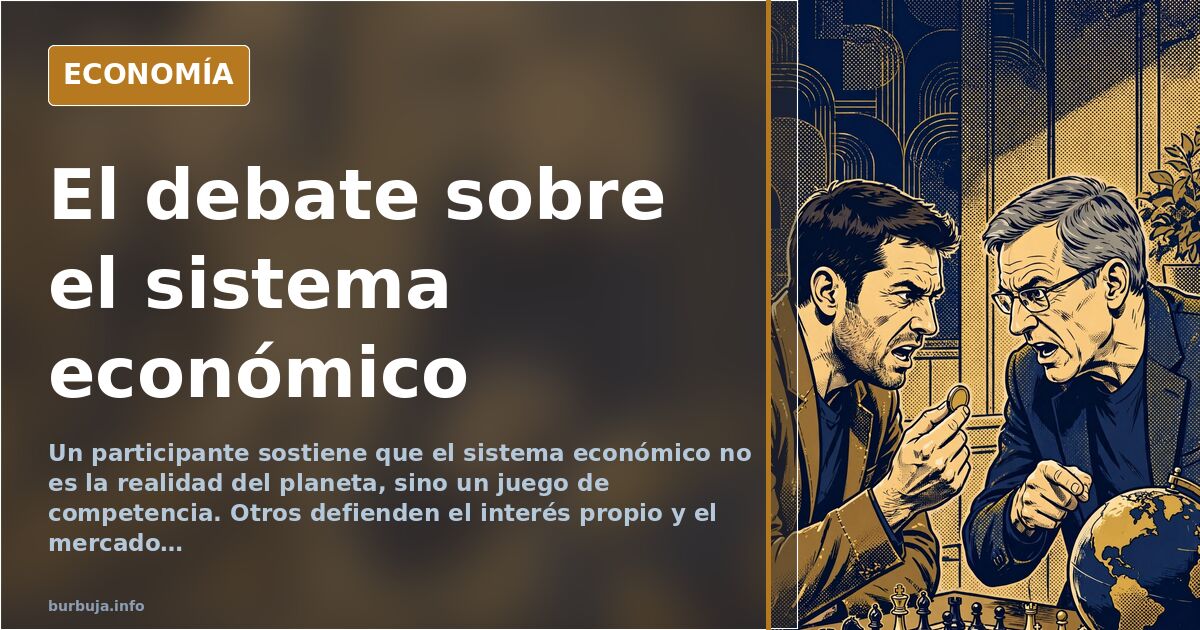
The economic system isn't reality: it's a game no one can win
There is a paradox that repeats whenever someone questions the current economic order: we work to satisfy market requirements, not people's vital needs. The system is not a physical reality of Planet Earth, argues the opening premise of this discussion, but a fiction everyone plays along with. It is a game of competition and rivalry where victory is never guaranteed because the objective is to eliminate the opponent. And in this game, anyone can be eliminated at any moment.
The thesis is not new, but it is uncomfortable. The most common response is that self-interest is the natural and immovable driver of human beings. "Humans seek their own benefit," summarizes one of the first speakers, arguing that any attempt to adapt individuals to a different system is doomed to fail, as seen in many twentieth-century experiments. The discussion then shifts to more concrete ground: how can cooperation be structured without imposed rules?
Nature as an argument and a trap
The initial premise appeals to social coherence: cooperating to satisfy human needs within an ecological system. But this appeal to nature backfires when examined closely. "Natural life is fierce competition beyond all human ethics," objects another participant, citing the fox and the hen. Nature does not distinguish between humans nor distribute rights: it eliminates entire species without hesitation.
The counter-reply comes from empirical observation: nature does not assign social value to physical differences. It may make life harder for tall or short people, and vice versa, depending on changing conditions. There is no sarracena order in the ecosystem. There is only evolution. This raises the uncomfortable question: if nature has no interests, where do ours come from?
The market as peaceful cooperation
One strong line of analysis argues that a system of peaceful cooperation already exists: the free market without coercive intervention. Under this logic, collaboration is not the opposite of competition, but its tool. "I am an excellent mechanic, but I earn more when I collaborate with an excellent body shop technician," illustrates a speaker: voluntary alliance maximizes individual interest for each party.
The problem arises when someone lacking specific skills offers to collaborate. Collaborate on what? Sharing profits? That is not cooperation, but parasitism, according to this view. The conclusion is that collaboration only works when it is voluntary and when each party contributes something the other values. Everything else, they argue, is fantasy.
The State as an idea, not material reality
The most interesting turn in the discussion reaches the political sphere. It is proposed that the State and capitalism are ideas that solidify socially when the majority accepts or assumes them. If the majority decided not to adopt them, they would disappear from the active social model. The objection is immediate: Is the Boletín Oficial del Estado (Spain's official gazette) a hallucination? Is the State an idea or a group of leaders governing?
The answer distinguishes between world reality and social models. The sun, oceans, atmosphere, and climate do not exist because humans practice an economic system. Ideas that exist only in the human mind, unrelated to observing natural phenomena, are something else. Here the gap opens: if the State imposes itself by force, the people obey out of antiestéticar, not conviction. Ideas are not imposed through violence, but through communication.
The unanswered objection: what alternative system?
The most repeated and least answered question is also the most obvious: What exactly is the alternative system being defended, and how would it work? The initial premise avoids specifics. It proposes understanding reality better to solve vital problems, but designs no model. Practical examples accumulate here: healthcare limited by economic conditions, qualified professionals unable to perform important jobs due to lack of budget.
The counterexample is devastating in its simplicity: if the current system prevents producing what satisfies needs, what prevents making cakes so people can enjoy them without generating capital? The answer points to the problem being one of incentives and human behavior, not economics. The discussion does not close. It remains exactly where it started: some demand a concrete model, others respond that the model already exists and works, even if we dislike it.
In the end, the question hovering over the entire exchange is not whether the system is fair, but whether there is any logical reason to abandon it. And if there is, why has no one put it into practice without violence preventing it? With these materials, the basket remains empty.
There is a paradox that repeats whenever someone questions the current economic order: we work to satisfy market requirements, not people's vital needs. The system is not a physical reality of Planet Earth, argues the opening premise of this discussion, but a fiction everyone plays along with. It is a game of competition and rivalry where victory is never guaranteed because the objective is to eliminate the opponent. And in this game, anyone can be eliminated at any moment.
The thesis is not new, but it is uncomfortable. The most common response is that self-interest is the natural and immovable driver of human beings. "Humans seek their own benefit," summarizes one of the first speakers, arguing that any attempt to adapt individuals to a different system is doomed to fail, as seen in many twentieth-century experiments. The discussion then shifts to more concrete ground: how can cooperation be structured without imposed rules?
Nature as an argument and a trap
The initial premise appeals to social coherence: cooperating to satisfy human needs within an ecological system. But this appeal to nature backfires when examined closely. "Natural life is fierce competition beyond all human ethics," objects another participant, citing the fox and the hen. Nature does not distinguish between humans nor distribute rights: it eliminates entire species without hesitation.
The counter-reply comes from empirical observation: nature does not assign social value to physical differences. It may make life harder for tall or short people, and vice versa, depending on changing conditions. There is no sarracena order in the ecosystem. There is only evolution. This raises the uncomfortable question: if nature has no interests, where do ours come from?
The market as peaceful cooperation
One strong line of analysis argues that a system of peaceful cooperation already exists: the free market without coercive intervention. Under this logic, collaboration is not the opposite of competition, but its tool. "I am an excellent mechanic, but I earn more when I collaborate with an excellent body shop technician," illustrates a speaker: voluntary alliance maximizes individual interest for each party.
The problem arises when someone lacking specific skills offers to collaborate. Collaborate on what? Sharing profits? That is not cooperation, but parasitism, according to this view. The conclusion is that collaboration only works when it is voluntary and when each party contributes something the other values. Everything else, they argue, is fantasy.
The State as an idea, not material reality
The most interesting turn in the discussion reaches the political sphere. It is proposed that the State and capitalism are ideas that solidify socially when the majority accepts or assumes them. If the majority decided not to adopt them, they would disappear from the active social model. The objection is immediate: Is the Boletín Oficial del Estado (Spain's official gazette) a hallucination? Is the State an idea or a group of leaders governing?
The answer distinguishes between world reality and social models. The sun, oceans, atmosphere, and climate do not exist because humans practice an economic system. Ideas that exist only in the human mind, unrelated to observing natural phenomena, are something else. Here the gap opens: if the State imposes itself by force, the people obey out of antiestéticar, not conviction. Ideas are not imposed through violence, but through communication.
The unanswered objection: what alternative system?
The most repeated and least answered question is also the most obvious: What exactly is the alternative system being defended, and how would it work? The initial premise avoids specifics. It proposes understanding reality better to solve vital problems, but designs no model. Practical examples accumulate here: healthcare limited by economic conditions, qualified professionals unable to perform important jobs due to lack of budget.
The counterexample is devastating in its simplicity: if the current system prevents producing what satisfies needs, what prevents making cakes so people can enjoy them without generating capital? The answer points to the problem being one of incentives and human behavior, not economics. The discussion does not close. It remains exactly where it started: some demand a concrete model, others respond that the model already exists and works, even if we dislike it.
In the end, the question hovering over the entire exchange is not whether the system is fair, but whether there is any logical reason to abandon it. And if there is, why has no one put it into practice without violence preventing it? With these materials, the basket remains empty.
Summary of a discussion on Burbuja.info - Foro de economía, actualidad y política., translated from Spanish and reviewed before publication. Read the full discussion (155 replies).
More summaries
-
Nena Daconte's Mai Meneses Releases Her Memoirs
Mai Meneses (Nena Daconte) publishes her memoir 'Tenía tanto que darte,' detailing the group's success and eventual end.
-
Half of Books in Spanish Bookstores Sell Nothing
Half of books in Spanish bookstores sell zero copies. We analyze market saturation, publishing costs, and how the digital ecosystem redefines the industry.
-
128,000 pesetas in 1988: the salary that supported a family now barely covers one person
A salary of 128,000 pesetas in 1988 supported a family of four. Adjusted for today, that's €2,368, not enough to live alone in a big city.
-
Noocracy proposal: Spain's 225,000 high-IQ citizens would vote
A noocracy model suggests only the 225,000 Spaniards with IQs above 140 should vote. It features rotation and claims to prevent corruption.
-
Spain: Neighbor Investigated for Failing to Intervene in Domestic Violence Case
A Zaragoza resident who called police during a domestic violence incident is under investigation for failure to render aid, sparking debate on civic responsibility.
-
Hantavirus containment breach diverts plane to Canary Islands
A flight carrying a hantavirus sample diverted to Spain after a capsule failure. The Andes strain outbreak reignites health safety debates.