
Contestants lose €275,000 on Atrapa un Millón after denying brain size fact
Two contestants on the Spanish game show Atrapa un Millón lost €275,000 after incorrectly claiming men do not have larger brains on average.
English · Original discussion in Spanish · Published
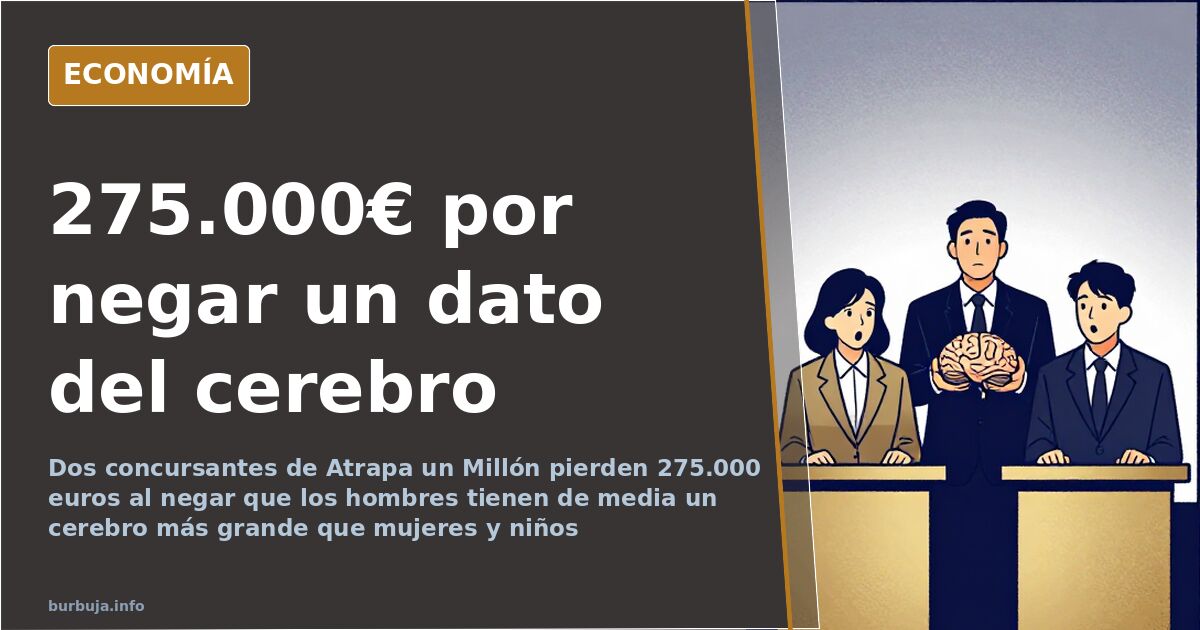
€275,000 lost due to a basic error on Atrapa un Millón
The question was not a trick. It was a basic fact: whether men, on average, have larger brains than women and children. Two contestants answered no, and the program stripped them of the jackpot. €275,000 lost for denying a statistical reality. The scene turned into a meme, with the show's own social media profile adding an ironic twist regarding the male brain.
The question and the answer
The format posed the question, and the chosen answer was to deny that the male brain is on average larger. This reasoning went viral: the idea that women distinguish colors better and therefore must have more developed brains. The program confirmed the loss, and the clip circulated within hours. The consequence was twofold: they lost the prize, and the clip became a sensation.
The most repeated comment did not target biology, but rather the tone. The "men don't" response, blunt and dry, captured for much of the audience the clash between empirical data and preconceived convictions. The very mechanics of the game show—get it right or lose everything—turned the error into a spectacle. And spectacle, as always, draws an audience.
What evidence says about brain size
In the discussion thread, it was noted that brain volume is related to height and build, and that men are, on average, larger. This would explain a difference in size between the sens, but it does not explain a difference in intelligence at all. The key, it is emphasized, lies in the relationship between brain mass and body mass and in neural connections, not in the raw volume of the organ.
An analogy used in the debate served well: a small dog is not less intelligent than a large one just because its brain weighs less. Size is not intelligence. That is the nuance many highlighted, sometimes in opposition to the online outcry. Regarding children, a categorical error was noted: a minor's skull is not as developed as an adult's, so including them in the same question mixed different concepts.
"We distinguish colors better"
The contestants' central argument—that they perceive more colors and that this implies a superior brain—was dismissed as a mere whim. However, the debate was not about anatomy, but about self-esteem and competition. The clip captured the exchange, with one contestant agreeing with the other: "Well, yeah, girl, you're absolutely right."
Suspicions regarding casting
Part of the analysis shifted to the show's format. It is argued that these game shows do not leave everything to chance: the network chooses which profiles appear on set and can pit opposing archetypes against each other to guarantee a television moment. The conservative against the activist; tension is built-in. If that is the case, what is asked and to whom it is asked ceases to be random.
The viral clip also functions as free advertising. A clever troll, some called it; it was later noted that the money is recorded and paid regardless, so the production company finds the public embarrassment profitable. No one gives away €275,000, it was noted, but a moment like this yields more than it costs.
A fact turned into a battlefield
Something more uncomfortable than a general knowledge question emerged during the exchange. There was talk of ingrained gender bias, social engineering, and a narrative that has spent years presenting women as saviors and men as mere fillers. These are opinions, not facts, and as opinions, they circulate: part of the audience read the episode as proof that a certain discourse has taken hold.
In response, another reading called for prudence. What failed was a specific answer, not a whole group. Two people said something foolish in front of a camera. Turning that into a thesis about half the population is, precisely, the error being criticized.
Was it the mistake of two people or a symptom of something larger? The clip does not resolve it. It only leaves behind the figure, the phrase, and the uncomfortable certainty that, sometimes, television charges a very high price for ignorance.
The question was not a trick. It was a basic fact: whether men, on average, have larger brains than women and children. Two contestants answered no, and the program stripped them of the jackpot. €275,000 lost for denying a statistical reality. The scene turned into a meme, with the show's own social media profile adding an ironic twist regarding the male brain.
The question and the answer
The format posed the question, and the chosen answer was to deny that the male brain is on average larger. This reasoning went viral: the idea that women distinguish colors better and therefore must have more developed brains. The program confirmed the loss, and the clip circulated within hours. The consequence was twofold: they lost the prize, and the clip became a sensation.
The most repeated comment did not target biology, but rather the tone. The "men don't" response, blunt and dry, captured for much of the audience the clash between empirical data and preconceived convictions. The very mechanics of the game show—get it right or lose everything—turned the error into a spectacle. And spectacle, as always, draws an audience.
What evidence says about brain size
In the discussion thread, it was noted that brain volume is related to height and build, and that men are, on average, larger. This would explain a difference in size between the sens, but it does not explain a difference in intelligence at all. The key, it is emphasized, lies in the relationship between brain mass and body mass and in neural connections, not in the raw volume of the organ.
An analogy used in the debate served well: a small dog is not less intelligent than a large one just because its brain weighs less. Size is not intelligence. That is the nuance many highlighted, sometimes in opposition to the online outcry. Regarding children, a categorical error was noted: a minor's skull is not as developed as an adult's, so including them in the same question mixed different concepts.
"We distinguish colors better"
The contestants' central argument—that they perceive more colors and that this implies a superior brain—was dismissed as a mere whim. However, the debate was not about anatomy, but about self-esteem and competition. The clip captured the exchange, with one contestant agreeing with the other: "Well, yeah, girl, you're absolutely right."
Suspicions regarding casting
Part of the analysis shifted to the show's format. It is argued that these game shows do not leave everything to chance: the network chooses which profiles appear on set and can pit opposing archetypes against each other to guarantee a television moment. The conservative against the activist; tension is built-in. If that is the case, what is asked and to whom it is asked ceases to be random.
The viral clip also functions as free advertising. A clever troll, some called it; it was later noted that the money is recorded and paid regardless, so the production company finds the public embarrassment profitable. No one gives away €275,000, it was noted, but a moment like this yields more than it costs.
A fact turned into a battlefield
Something more uncomfortable than a general knowledge question emerged during the exchange. There was talk of ingrained gender bias, social engineering, and a narrative that has spent years presenting women as saviors and men as mere fillers. These are opinions, not facts, and as opinions, they circulate: part of the audience read the episode as proof that a certain discourse has taken hold.
In response, another reading called for prudence. What failed was a specific answer, not a whole group. Two people said something foolish in front of a camera. Turning that into a thesis about half the population is, precisely, the error being criticized.
Was it the mistake of two people or a symptom of something larger? The clip does not resolve it. It only leaves behind the figure, the phrase, and the uncomfortable certainty that, sometimes, television charges a very high price for ignorance.
Summary of a discussion on Burbuja.info - Foro de economía, actualidad y política., translated from Spanish and reviewed before publication. Read the full discussion (471 replies).
More summaries
-
Washington offers $50 million for Maduro’s capture
State Department raises reward for information leading to Nicolás Maduro's arrest to $50 million, double the previous offer
-
The cost of Spain's gender violence law: a workshop, a son, and a complaint
A café racer YouTuber denounces the 'viogen' he suffered after his son's birth: arrest, restraining order, and a ruling that reopens the debate.
-
Vox Expels Ortega Smith for Defying Abascal's Madrid Leadership Change
Vox expels Ortega Smith for defying Abascal's Madrid leadership change. An analysis of internal purges and Abascal's control of the Disenso Foundation.
-
BOOM: Watch Tomorrow's Headlines, The Circle Closes
A 400-page judicial summary corners the PSOE: Is this the end of an era or a new maneuver for judicial impunity?
-
Dog poisonings spark urban neighborhood conflicts
Escalating tensions over responsible pet ownership lead to reports of animal poisonings in dense urban areas, highlighting the strain on shared public spaces.
-
Restaurant Owner's Racist Hiring Policy Sparks Outrage
A Spanish restaurant owner's refusal to hire locals in favor of Latino workers has ignited a fierce debate on social media about labor exploitation and discrimination.