
Construction Slows: 2,000 Fewer Homes, Prices Rise
New home starts drop by 2,000 in March despite rising prices: regulation, land, and labor shortages hinder housing supply.
English · Original discussion in Spanish · Published
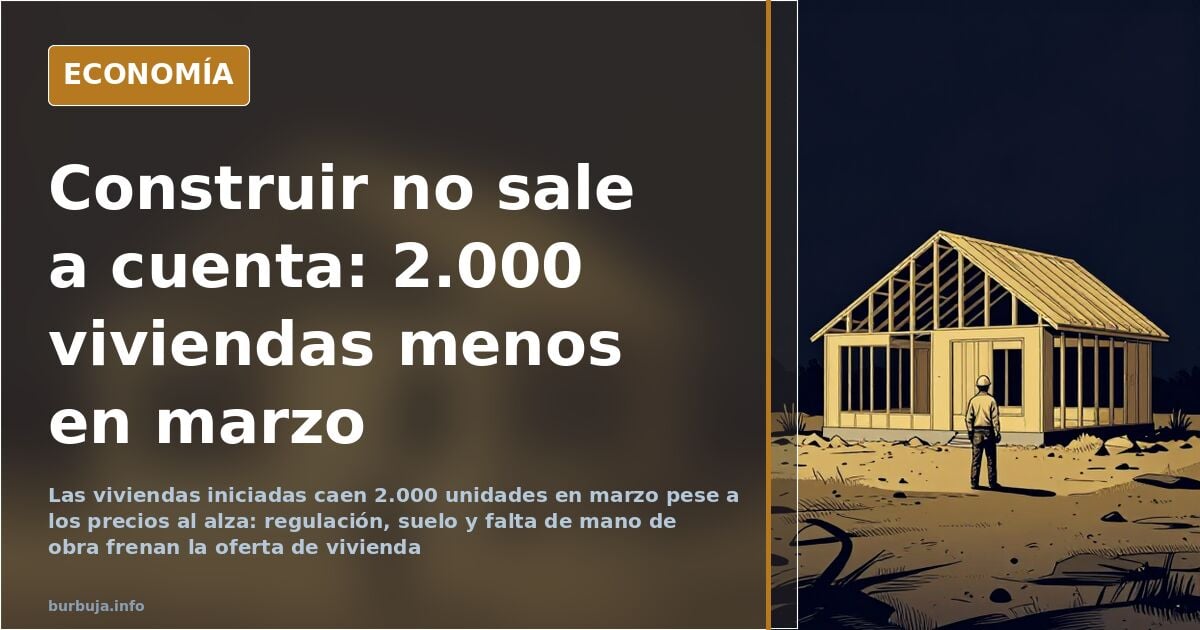
New Home Starts Fall in March as Prices Continue to Soar
Home prices have been soaring for months, demand remains strong, and interest rates are falling. Yet, supply is declining. Data from the Ministry of Transport for March 2025 shows 2,000 fewer new homes started compared to January, trinc a promising start to the year. In any market, rising prices signal an incentive to produce more. In Spain's property sector, this signal is ignored.
The housing market is neither efficient nor free. It is controlled at every level: state, regional, and local regulations, eternally long permitting processes, extremely expensive land, and bureaucracy that turns every development into an obstacle course. The gap between supply and demand can no longer be bridged with just a couple of good years; it would require sustained oversupply over several fiscal periods to close the accumulated deficit. The obvious question is why a sector with sky-high prices isn't responding by producing more.
Why New Construction Isn't Taking Off
The short answer: because they aren't allowed to. The long answer includes permits, taxes, mandatory land contributions, and administrative timelines that drag on. A building permit can take over a year, representing dead time that accrues interest. Each step adds cost, and each cost is passed on to the final buyer, who is the only one unable to avoid the burden.
The most common scenario in industry conversations is the developer who finishes their last project and announces they are moving into renovations, a business with shorter cycles, fewer permits, and less risk. "This is the last project I'm doing," more than one summarizes. Behind this sentiment is a business fabric that shrank after the bubble burst: lifelong family construction companies that closed or whose owners retired early. Those that remain operate with much more conservative criteria.
Local challenges add to this. Urban planning regulations sometimes leave only 20% of the land as buildable, and neighborhood associations often oppose new developments in their areas. Everyone wants housing, but not on their doorstep.
The Numbers Don't Add Up: €2,000 per Square Meter and a 35% Margin
Construction costs are now around €2,000 per square meter, according to figures discussed, and land, when available, is exorbitantly priced. With this starting point, according to a developer involved in the discussion, a project is only viable with margins of at least 35% on the sale price: the entire cycle, from land purchase to the final deed, lasts years, and the annualized profitability plummets. A single deviation in materials or labor can derail the entire operation.
The result is visible in the final product. Some estimate that a home on the outskirts of Madrid now costs over €600,000. And the few developments that do start are buildings with two, three, or four units, marketed as premium at an exorbitant price when all that's on the site is a sign.
Are Workers Lacking, or Are Conditions Lacking?
The sector complains about a labor shortage, and the diagnosis varies depending on who you ask. From the business side, the focus is on regulation and costs; from the other side, the response is that the problem lies with the conditions: uncomfortable equipment, working days at 40 degrees Celsius, and salaries that don't compete with other alternatives. In this scenario, forming a stable crew has become an impossible mission.
Demographics add pressure from the other end. With hundreds of thousands of arrivals annually, fewer than 200,000 homes are being built, according to discussions. With 420,000 deaths, 320,000 births, and 400,000 new arrivals annually according to circulating calculations, the arithmetic simply doesn't add up. Surviving in shared flats with more people is the escape valve already being used.
Public Housing, Permits, and Unfulfilled Promises
Discussions suggest that hardly any public housing projects have been built since the 1990s, and some claim that the autonomous communities that promised to expedite permits with self-declaration statements have not yielded the advertised results. In Galicia, however, cranes are visible: the first subsidized public housing (VPA) built in fifteen years, with prices set for middle-income earners. The rest continue with permits issued sparingly and mandatory percentages of protected housing that sometimes discourage developers.
The consequence is a self-reinforcing shortage: less new construction, more pressure on rents, more competition for every apartment that comes onto the market. And an uncomfortable underlying fact: public supply is insufficient, private supply is retracting, and the State collects revenue at every stage of the process.
With interest rates falling, employment holding steady, and demand intact, all incentives point to construction being a highly profitable business. It isn't. And as long as the market fails to explain why it isn't reacting, the only figure that will continue to rise unchecked is the price. How many years of price increases are needed to admit that this is no longer a market problem, but a policy problem?
Home prices have been soaring for months, demand remains strong, and interest rates are falling. Yet, supply is declining. Data from the Ministry of Transport for March 2025 shows 2,000 fewer new homes started compared to January, trinc a promising start to the year. In any market, rising prices signal an incentive to produce more. In Spain's property sector, this signal is ignored.
The housing market is neither efficient nor free. It is controlled at every level: state, regional, and local regulations, eternally long permitting processes, extremely expensive land, and bureaucracy that turns every development into an obstacle course. The gap between supply and demand can no longer be bridged with just a couple of good years; it would require sustained oversupply over several fiscal periods to close the accumulated deficit. The obvious question is why a sector with sky-high prices isn't responding by producing more.
Why New Construction Isn't Taking Off
The short answer: because they aren't allowed to. The long answer includes permits, taxes, mandatory land contributions, and administrative timelines that drag on. A building permit can take over a year, representing dead time that accrues interest. Each step adds cost, and each cost is passed on to the final buyer, who is the only one unable to avoid the burden.
The most common scenario in industry conversations is the developer who finishes their last project and announces they are moving into renovations, a business with shorter cycles, fewer permits, and less risk. "This is the last project I'm doing," more than one summarizes. Behind this sentiment is a business fabric that shrank after the bubble burst: lifelong family construction companies that closed or whose owners retired early. Those that remain operate with much more conservative criteria.
Local challenges add to this. Urban planning regulations sometimes leave only 20% of the land as buildable, and neighborhood associations often oppose new developments in their areas. Everyone wants housing, but not on their doorstep.
The Numbers Don't Add Up: €2,000 per Square Meter and a 35% Margin
Construction costs are now around €2,000 per square meter, according to figures discussed, and land, when available, is exorbitantly priced. With this starting point, according to a developer involved in the discussion, a project is only viable with margins of at least 35% on the sale price: the entire cycle, from land purchase to the final deed, lasts years, and the annualized profitability plummets. A single deviation in materials or labor can derail the entire operation.
The result is visible in the final product. Some estimate that a home on the outskirts of Madrid now costs over €600,000. And the few developments that do start are buildings with two, three, or four units, marketed as premium at an exorbitant price when all that's on the site is a sign.
Are Workers Lacking, or Are Conditions Lacking?
The sector complains about a labor shortage, and the diagnosis varies depending on who you ask. From the business side, the focus is on regulation and costs; from the other side, the response is that the problem lies with the conditions: uncomfortable equipment, working days at 40 degrees Celsius, and salaries that don't compete with other alternatives. In this scenario, forming a stable crew has become an impossible mission.
Demographics add pressure from the other end. With hundreds of thousands of arrivals annually, fewer than 200,000 homes are being built, according to discussions. With 420,000 deaths, 320,000 births, and 400,000 new arrivals annually according to circulating calculations, the arithmetic simply doesn't add up. Surviving in shared flats with more people is the escape valve already being used.
Public Housing, Permits, and Unfulfilled Promises
Discussions suggest that hardly any public housing projects have been built since the 1990s, and some claim that the autonomous communities that promised to expedite permits with self-declaration statements have not yielded the advertised results. In Galicia, however, cranes are visible: the first subsidized public housing (VPA) built in fifteen years, with prices set for middle-income earners. The rest continue with permits issued sparingly and mandatory percentages of protected housing that sometimes discourage developers.
The consequence is a self-reinforcing shortage: less new construction, more pressure on rents, more competition for every apartment that comes onto the market. And an uncomfortable underlying fact: public supply is insufficient, private supply is retracting, and the State collects revenue at every stage of the process.
With interest rates falling, employment holding steady, and demand intact, all incentives point to construction being a highly profitable business. It isn't. And as long as the market fails to explain why it isn't reacting, the only figure that will continue to rise unchecked is the price. How many years of price increases are needed to admit that this is no longer a market problem, but a policy problem?
Summary of a discussion on Burbuja.info - Foro de economía, actualidad y política., translated from Spanish and reviewed before publication. Read the full discussion (284 replies).
More summaries
-
The housing bubble bursts: no energy, no new boom
Spain’s growth model is running out of steam amid a saturated power grid, undeveloped land and rising debt. The debate points to the lack of a plan B
-
Euthanasia in Old Age: Autonomy vs. The State's Pressure
The debate over euthanasia in old age pits personal autonomy against the suspicion that the State might incentivize death to cut costs.
-
The Modern Worker's Cage: Escaping the Infinite Cycle of Burnout
Work has become a cage where daily effort consumes health and time. Discover why we push ourselves so hard and how to break the cycle.
-
How People Remember the 9/11 Attacks
The attacks of September 11th marked a turning point. Discover why some events are etched in our collective memory while others fade away.
-
Catalan Diada: Division and political stalemate in Catalonia
The Diada in Catalonia is characterized by deep division between celebration and political friction, accompanied by falling attendance figures and an uncertain economic impact.
-
Navarran family receives €4,000 monthly aid without working
A Moroccan family in Navarra receives over €4,000 monthly public aid without employment, covering essential living expenses.