
Consent Contracts Debate: Footballers' Legal Shield
Forum debates if footballers should sign consent contracts before sexual assault accusations; users doubt their legal effectiveness.
English · Original discussion in Spanish · Published
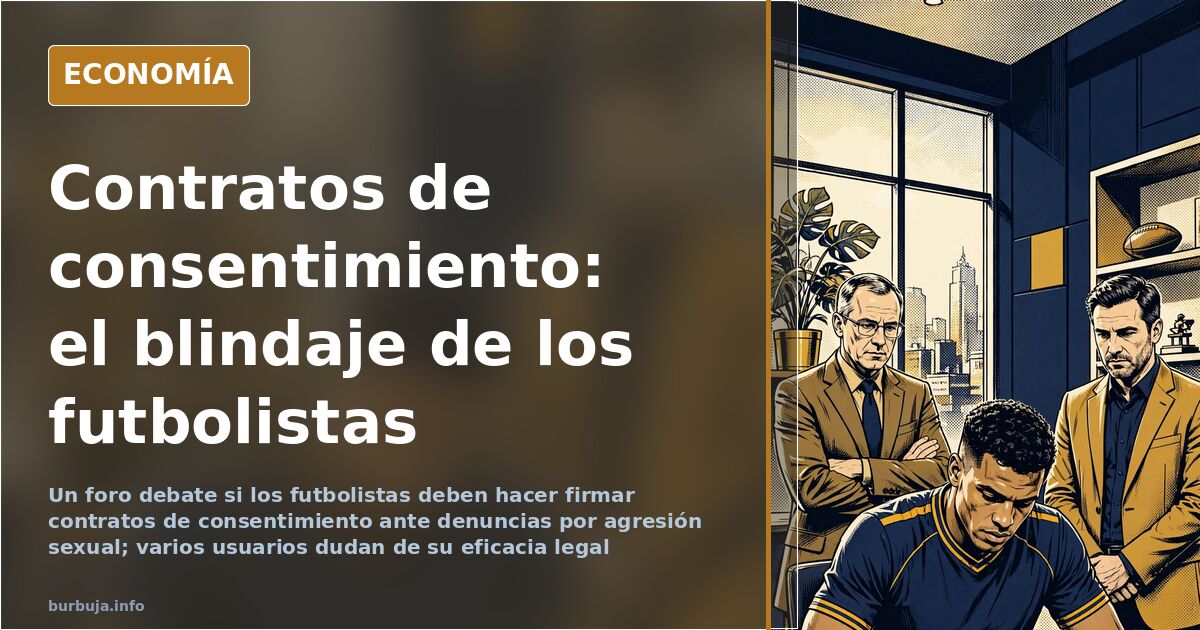
Footballers and Consent Contracts: A Shield Against Accusations
The practice of footballers having women who approach them at parties sign consent contracts has moved from eccentricity to defensive protocol. The discussion, open for over two years, starts from an uncomfortable premise: in a sensual assault report, the accuser's word is enough to start a judicial ordeal that can last years. Those who defend it argue the contract is not a millionaire's bravado, but an liability insurance policy for a group exposed to compensation claims and out-of-court settlements.
The majority response in the debate is not scandal, but preventive logic. "If an empowered flirtation gets you into trouble and costs you dearly to prove your innocence, it is legitimate to protect yourself," summarizes a stance that runs through the thread from beginning to end. However, consensus breaks when analyzing the actual effectiveness of the signed paper.
Does a Signed Consent Contract Serve Any Purpose?
The short answer is that it serves less than it seems. Several participants recall that consent is revocable at any moment: it suffices for the other party to declare they said to stop and were not heard. "By saying halfway through 'I told him to stop and he didn't want to,' the contract is no longer valid," points out a message summarizing the underlying legal problem. The prior signature certifies initial intent, not subsequent conduct.
Hence, the discussion shifts towards more aggressive solutions. Notarized signatures, reliable witnesses, and even full recording of the interaction are proposed. "I would film all interactions with anyone around me, like those body cams used by American police officers," suggests a participant. Reference to the Neymar case appears soon: the footballer allegedly escaped an accusation thanks to hotel cameras, which showed the accuser assaulting him. Without that material, the narrative would have been different.
The Precedent No One Wants to Repeat
The Neymar case functions in the debate as the canonical example of why prevention is not paranoia. The images showed a sequence that dismantled the initial version of events. Participants extract an operational conclusion: without audiovisual records, defense is nearly impossible. In this scheme, the contract is a complement, not the central piece.
Comparison with recent episodes of public accusations reinforces the argument. Mention is made of a sports federation executive whose cameras captured a non-consensual gesture in public, with millions of witnesses, yet still led to proceedings. The lesson emphasized is that evidence does not always prevent wear and tear, although it does shorten it.
The Economic Cost of False Accusations
Here the analysis becomes accounting-based. The conversation introduces specific figures regarding the sens services market and compensation amounts considered in out-of-court settlements. There is talk of rates hovering around €4,000 per month for certain services, and comparisons with conventional trades: a bricklayer earning €180 for seven hours of work. The asymmetry between the cost of a service and the potential cost of an accusation is the core of the calculation.
The repeated argument is that false accusations have a potential economic return far superior to any previous transaction. Hence, the proposal to fix the economic consideration in writing beforehand, so there is no room for later reinterpretation. "It would be better to agree on the economic consideration for the sensual service in advance," is suggested.
Criticism of the Legal Framework: The 'Only Yes Means Yes' Law
Much of the debate derives towards current legislation. The Ley del solo sí es sí (Spain's "Only Yes Means Yes" law) is mentioned as the framework that would have practically inverted the burden of proof. "Isn't this what Montoro wanted with that damn 'yes means yes' law? Well, there you have it," summarizes an intervention connecting the norm with the proliferation of preventive contracts.
Criticism is articulated on two fronts. First, the law would have turned consent into a concept revocable and difficult to prove. Second, the presumption of truthfulness of the accuser, summarized in the motto "women must be believed," would have left the accused without defense tools. In response, the contract is claimed as an attempt to reconstruct evidentiary symmetry via private means.
What About Revocable Consent?
The most repeated technical point is that no prior signature can cover a change of mind during the act. The doctrine of revocable consent implies that initial authorization does not bind the other party if a contrary manifestation occurs. Several participants express this clearly: the document certifies starting intent, not subsequent conduct.
The practical conclusion drawn is that the contract only has value as complementary evidence, never as an absolute shield. Those who defend it know this and therefore insist on combining it with recordings, witnesses, and notarization. The strategy is not strictly legal, but deterrent: making the other party aware that there is a record and that a false accusation would have consequences.
Background: Distrust and Selectivity
Beyond the legal aspect, the conversation reflects a behavioral change. It is recommended to be "much more selective" with sensual partners, especially when there is a large economic disparity. "A woman with scarce financial resources and no education in values is much more dangerous than one who is solvent," argues an intervention pointing to incentive asymmetry.
The final recommendation closing the thread is almost a precaution manual: carry condoms, yes, but above all carry signed consents. "Son, if you go out don't forget to carry protection. No, son, no, the other thing: the consents, which are much more dangerous than the other," summarizes with irony one of the most celebrated interventions. The joke works because it condenses the general mood: preventive distrust has become normalized.
The matter remains there, without clear legal resolution. Consent contracts spread among those who can afford them, lawyers doubt their effectiveness, and legislators have not acted. Meanwhile, the conversation keeps revolving around the same question: if the signature doesn't shield, what does?
The practice of footballers having women who approach them at parties sign consent contracts has moved from eccentricity to defensive protocol. The discussion, open for over two years, starts from an uncomfortable premise: in a sensual assault report, the accuser's word is enough to start a judicial ordeal that can last years. Those who defend it argue the contract is not a millionaire's bravado, but an liability insurance policy for a group exposed to compensation claims and out-of-court settlements.
The majority response in the debate is not scandal, but preventive logic. "If an empowered flirtation gets you into trouble and costs you dearly to prove your innocence, it is legitimate to protect yourself," summarizes a stance that runs through the thread from beginning to end. However, consensus breaks when analyzing the actual effectiveness of the signed paper.
Does a Signed Consent Contract Serve Any Purpose?
The short answer is that it serves less than it seems. Several participants recall that consent is revocable at any moment: it suffices for the other party to declare they said to stop and were not heard. "By saying halfway through 'I told him to stop and he didn't want to,' the contract is no longer valid," points out a message summarizing the underlying legal problem. The prior signature certifies initial intent, not subsequent conduct.
Hence, the discussion shifts towards more aggressive solutions. Notarized signatures, reliable witnesses, and even full recording of the interaction are proposed. "I would film all interactions with anyone around me, like those body cams used by American police officers," suggests a participant. Reference to the Neymar case appears soon: the footballer allegedly escaped an accusation thanks to hotel cameras, which showed the accuser assaulting him. Without that material, the narrative would have been different.
The Precedent No One Wants to Repeat
The Neymar case functions in the debate as the canonical example of why prevention is not paranoia. The images showed a sequence that dismantled the initial version of events. Participants extract an operational conclusion: without audiovisual records, defense is nearly impossible. In this scheme, the contract is a complement, not the central piece.
Comparison with recent episodes of public accusations reinforces the argument. Mention is made of a sports federation executive whose cameras captured a non-consensual gesture in public, with millions of witnesses, yet still led to proceedings. The lesson emphasized is that evidence does not always prevent wear and tear, although it does shorten it.
The Economic Cost of False Accusations
Here the analysis becomes accounting-based. The conversation introduces specific figures regarding the sens services market and compensation amounts considered in out-of-court settlements. There is talk of rates hovering around €4,000 per month for certain services, and comparisons with conventional trades: a bricklayer earning €180 for seven hours of work. The asymmetry between the cost of a service and the potential cost of an accusation is the core of the calculation.
The repeated argument is that false accusations have a potential economic return far superior to any previous transaction. Hence, the proposal to fix the economic consideration in writing beforehand, so there is no room for later reinterpretation. "It would be better to agree on the economic consideration for the sensual service in advance," is suggested.
Criticism of the Legal Framework: The 'Only Yes Means Yes' Law
Much of the debate derives towards current legislation. The Ley del solo sí es sí (Spain's "Only Yes Means Yes" law) is mentioned as the framework that would have practically inverted the burden of proof. "Isn't this what Montoro wanted with that damn 'yes means yes' law? Well, there you have it," summarizes an intervention connecting the norm with the proliferation of preventive contracts.
Criticism is articulated on two fronts. First, the law would have turned consent into a concept revocable and difficult to prove. Second, the presumption of truthfulness of the accuser, summarized in the motto "women must be believed," would have left the accused without defense tools. In response, the contract is claimed as an attempt to reconstruct evidentiary symmetry via private means.
What About Revocable Consent?
The most repeated technical point is that no prior signature can cover a change of mind during the act. The doctrine of revocable consent implies that initial authorization does not bind the other party if a contrary manifestation occurs. Several participants express this clearly: the document certifies starting intent, not subsequent conduct.
The practical conclusion drawn is that the contract only has value as complementary evidence, never as an absolute shield. Those who defend it know this and therefore insist on combining it with recordings, witnesses, and notarization. The strategy is not strictly legal, but deterrent: making the other party aware that there is a record and that a false accusation would have consequences.
Background: Distrust and Selectivity
Beyond the legal aspect, the conversation reflects a behavioral change. It is recommended to be "much more selective" with sensual partners, especially when there is a large economic disparity. "A woman with scarce financial resources and no education in values is much more dangerous than one who is solvent," argues an intervention pointing to incentive asymmetry.
The final recommendation closing the thread is almost a precaution manual: carry condoms, yes, but above all carry signed consents. "Son, if you go out don't forget to carry protection. No, son, no, the other thing: the consents, which are much more dangerous than the other," summarizes with irony one of the most celebrated interventions. The joke works because it condenses the general mood: preventive distrust has become normalized.
The matter remains there, without clear legal resolution. Consent contracts spread among those who can afford them, lawyers doubt their effectiveness, and legislators have not acted. Meanwhile, the conversation keeps revolving around the same question: if the signature doesn't shield, what does?
Summary of a discussion on Burbuja.info - Foro de economía, actualidad y política., translated from Spanish and reviewed before publication. Read the full discussion (141 replies).
More summaries
-
Carmen Calvo Quits Parliament to Lead Spain's State Council
Carmen Calvo resigns her PSOE seat as Sánchez appoints her president of the Consejo de Estado, replacing Magdalena Valerio.
-
Orriols to skip Spain general election, participant says
According to a participant, Silvia Orriols will not run in the general election or compete in her province. Some voters would still back her.
-
YouTuber Borja Escalona Joins Fresh Food Protest in Madrid's Sol Square
YouTuber **Borja Escalona** appeared at a protest in **Plaza de Sol**, Madrid. We analyze the economic context of such events.
-
Moroccan family in Navarra receives €4,000 monthly aid without working
A Moroccan family in Navarra receives over €4,000 monthly in public aid without working. Discover the details and benefits.
-
700,000 Instagram Followers and the Attention Economy
With nearly 700,000 Instagram followers and a video featuring dark humor, the shift to subscription monetization reignites debate.
-
Smartphone Addiction: Designed to Hook, Unregulated
Pedestrians ignored green lights while glued to phones. Experts blame intentional design features that foster compulsive usage.