
Civil war 'prelude' narrative clashes with bustling terraces
The 'civil war prelude' narrative circulates in bars, yet terraces remain full, with no barricades in sight. Is it just bar talk?
English · Original discussion in Spanish · Published
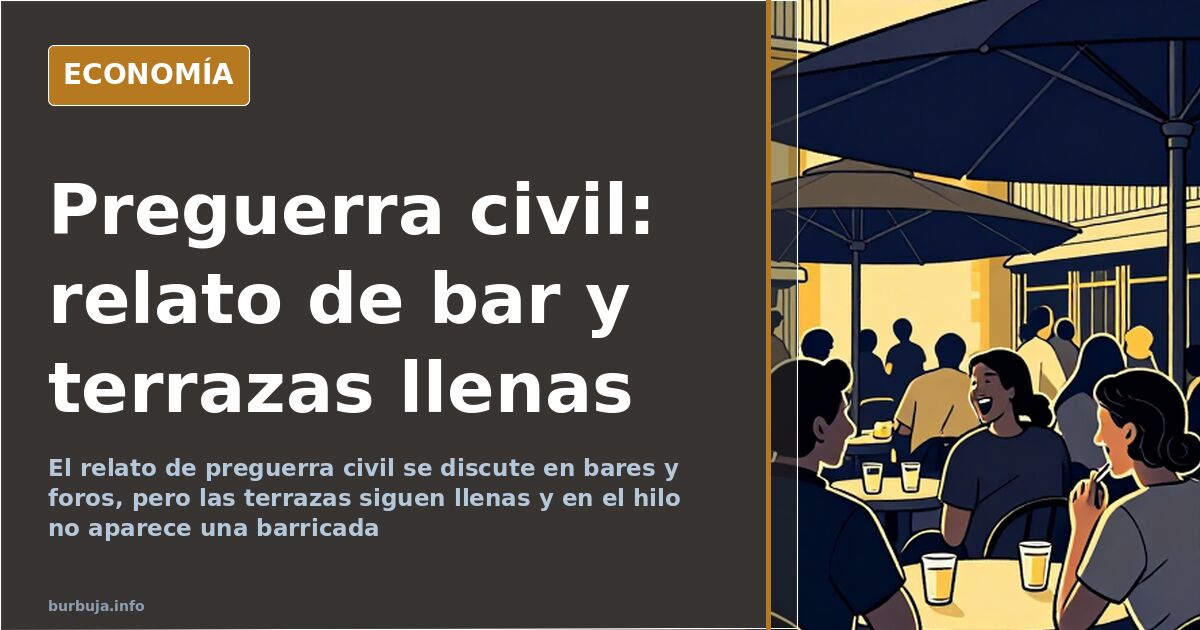
The civil war prelude seen only from the bar counter
A forum user recounts conversations with people over eighty who lived through the post-war era and recall what their parents and uncles told them. All agree things look grim. This is the origin of the 'civil war prelude' narrative. The question is whether the street reflects this diagnosis or if the diagnosis exists solely in the mind of its originator.
Real tension on the street or just bar noise?
The contrast between the narrative and daily routine appears in several posts. From a small town in Galicia, an atmosphere is described where people are Christmas shopping, concerned about the cold, the high price of eggs, and whether to buy the V16 beacon yet. In Barcelona, it's emphasized that it's been at least five years since a dumpster was burned, a cobblestone thrown, or graffiti appeared on a wall. In the Basque Country, social tension is rated 'between zero and none'; in Asturias, 'between zero and nothing'; in Seville, it's summarized by four people complaining, too lethargic even to protest.
Regional posts show no spark of unrest: they describe verbal discontent that doesn't translate into mobilization.
Escape plans: campers, rentals, and the French border
When asked about concrete plans, one response is a self-built camper van. Another option is renting out a flat, moving as far north in Catalonia as possible, with direct access to the French Alps. Yet another is an independent villa in the south, with private security in the development; one user claims civil servants earn almost 5,000 euros net and enjoy it the last week of every month.
The likely scenario: permanent local conflicts
An analysis of the thread dismisses a head-on clash for three reasons: no balance of power, no material capacity, and no two sides, but rather a hegemonic power facing discontent vented at the bar counter. Military commanders, it's argued, answer to NATO and the EU and wouldn't lift a finger.
What is considered is pogre fragmentation, with permanent local conflicts in the style of those already occurring in France. One user extends the timeline: twenty or thirty years, with pogre lumpenization and a very different scenario from 1936.
Would a mobilization like 1936 be repeated?
A user argues that in '36, people fought out of obligation, not conviction: you were assigned an area, given a rifle, and refusal meant execution. This same user believes peasants cared about their country as much as today's wage earners.
Added to this is the argument of anesthesia: those who accepted lockdowns and restrictions three years ago will accept anything. The image presented is that of a frog boiling slowly, although someone counters that the frog is long gone.
Not a single barricade appears in the thread. Amidst the posts, daily concerns remain the price of eggs and buying the V16 beacon. The party, as one user put it, is taking its time.
A forum user recounts conversations with people over eighty who lived through the post-war era and recall what their parents and uncles told them. All agree things look grim. This is the origin of the 'civil war prelude' narrative. The question is whether the street reflects this diagnosis or if the diagnosis exists solely in the mind of its originator.
Real tension on the street or just bar noise?
The contrast between the narrative and daily routine appears in several posts. From a small town in Galicia, an atmosphere is described where people are Christmas shopping, concerned about the cold, the high price of eggs, and whether to buy the V16 beacon yet. In Barcelona, it's emphasized that it's been at least five years since a dumpster was burned, a cobblestone thrown, or graffiti appeared on a wall. In the Basque Country, social tension is rated 'between zero and none'; in Asturias, 'between zero and nothing'; in Seville, it's summarized by four people complaining, too lethargic even to protest.
Regional posts show no spark of unrest: they describe verbal discontent that doesn't translate into mobilization.
Escape plans: campers, rentals, and the French border
When asked about concrete plans, one response is a self-built camper van. Another option is renting out a flat, moving as far north in Catalonia as possible, with direct access to the French Alps. Yet another is an independent villa in the south, with private security in the development; one user claims civil servants earn almost 5,000 euros net and enjoy it the last week of every month.
The likely scenario: permanent local conflicts
An analysis of the thread dismisses a head-on clash for three reasons: no balance of power, no material capacity, and no two sides, but rather a hegemonic power facing discontent vented at the bar counter. Military commanders, it's argued, answer to NATO and the EU and wouldn't lift a finger.
What is considered is pogre fragmentation, with permanent local conflicts in the style of those already occurring in France. One user extends the timeline: twenty or thirty years, with pogre lumpenization and a very different scenario from 1936.
Would a mobilization like 1936 be repeated?
A user argues that in '36, people fought out of obligation, not conviction: you were assigned an area, given a rifle, and refusal meant execution. This same user believes peasants cared about their country as much as today's wage earners.
Added to this is the argument of anesthesia: those who accepted lockdowns and restrictions three years ago will accept anything. The image presented is that of a frog boiling slowly, although someone counters that the frog is long gone.
Not a single barricade appears in the thread. Amidst the posts, daily concerns remain the price of eggs and buying the V16 beacon. The party, as one user put it, is taking its time.
Summary of a discussion on Burbuja.info - Foro de economía, actualidad y política., translated from Spanish and reviewed before publication. Read the full discussion (473 replies).
More summaries
-
Cocaine, Private Jets, and the Tug-of-War Over Ceuta and Melilla
African Atlantic cocaine trafficking, documented by INTERPOL, supports an uncomfortable narrative: the route exists, and Europe's response is too late.
-
Euthanasia in Old Age: Autonomy vs. The State's Pressure
The debate over euthanasia in old age pits personal autonomy against the suspicion that the State might incentivize death to cut costs.
-
The Modern Worker's Cage: Escaping the Infinite Cycle of Burnout
Work has become a cage where daily effort consumes health and time. Discover why we push ourselves so hard and how to break the cycle.
-
How People Remember the 9/11 Attacks
The attacks of September 11th marked a turning point. Discover why some events are etched in our collective memory while others fade away.
-
Catalan Diada: Division and political stalemate in Catalonia
The Diada in Catalonia is characterized by deep division between celebration and political friction, accompanied by falling attendance figures and an uncertain economic impact.
-
Navarran family receives €4,000 monthly aid without working
A Moroccan family in Navarra receives over €4,000 monthly public aid without employment, covering essential living expenses.