
Civil Guard injured in Spanish farm protests; government imposes fines
A Civil Guard officer was injured by stones during tractor protests, prompting the Spanish government to impose heavy fines to secure logistics hubs.
English · Original discussion in Spanish · Published
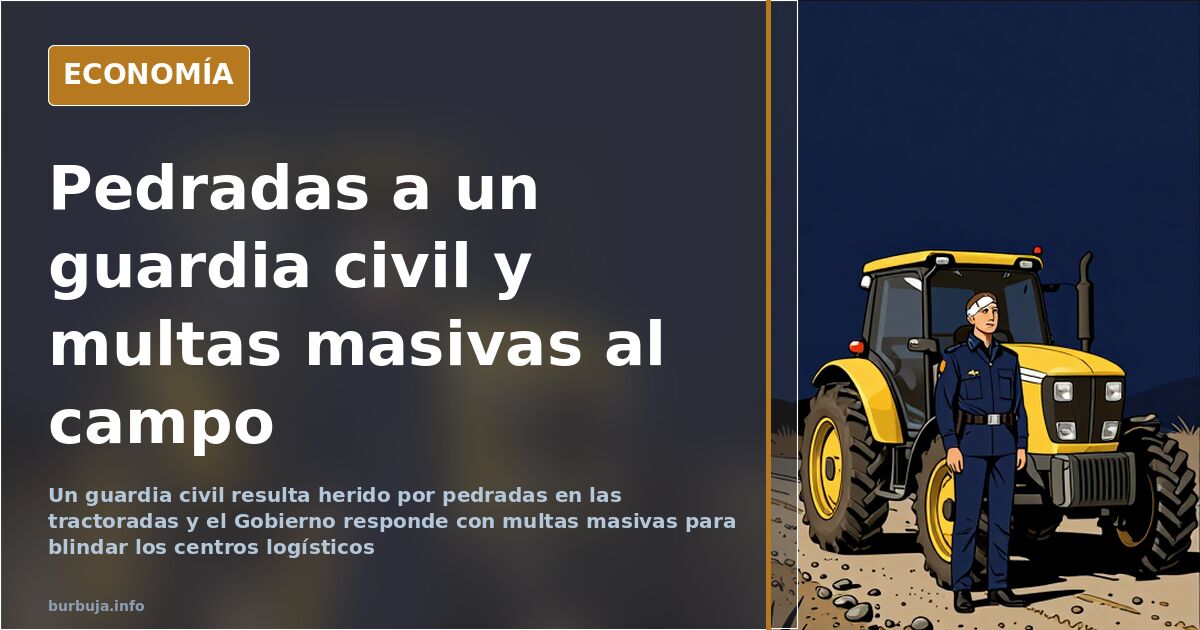
Stones thrown at Civil Guard in tractor protests and a wave of fines
A stone thrown at an agricultural picket line has left a Civil Guard agent on sick leave for a year. This figure is frequently cited when discussing the incident that peine the conflict between the farming sector and the State in Spain. The response attributed to the Ministry of Interior is a series of massive fines designed to shield logistics and supply centers. Farmers do not see this as a solution. They see it as an escalation. From there, the issue stops being a simple injury report and becomes a battle over the narrative: who is the victim, who is the aggressor, and who has the right to block a road.
What peine to the Civil Guard officer injured in the tractor protests?
The starting point is an assault with stones against an agent during an agricultural protest. Reports indicate a one-year sick leave for the injured officer, a figure often viewed cynically in critical contexts: one year paid. Published accounts suggest the administrative response involves economic sanctions rather than incivil prosecution, with the stated goal of protecting logistical nodes and supply chains.
The sequence matters. First the stone-throwing. Then the sick leave. Then the fine. For some analysts, economic sanctions are the only reasonable tool against blockades that harm third parties. For others, they turn the State into a revenue-collecting machine against those protesting for their livelihoods. This is where the real disagreement begins.
"Terrorism" label applied to an agricultural picket
Part of the narrative has labeled road closures with vocabulary usually reserved for other crimes. Applying the tag of terrorism to a farmers' picket line is, for some, a self-serving hyperbole; for others, a literal description of what happens when force is used against workers. The distance between these two interpretations explains almost everything else about the conflict, including much of the heated language used.
Some argue the uniformed officer was trinc orders and just doing his job, while others counter that his job consisted precisely of enduring stone-throwing while being paid from public funds. The dispute is not about the facts, which are narrow, but about the framework: public order versus social conflict. Depending on which frame is used, even the applicable law changes.
How many farmers are there in Spain and how significant is the sector?
The circulating figures are, at best, elastic. One estimate suggests between 200,000 and 750,000 farmers and livestock breeders in Spain, depending on how broadly the definition is stretched. Across the European Union, the sector employs around 18 million people, with a share of GDP placed at 1.3% in one version. The exact magnitude is fiercely debated, but the underlying argument does not depend on the decimal: a group capable of jeopardizing a country's logistics cannot be measured solely by its contribution to gross domestic product.
This leads to the most uncomfortable calculation. If the entire countryside takes to the roads, does the State have the means to clear them? The skeptical answer is no, which is why fines are preferred over physical confrontation. A breakdown of personnel numbers and European comparisons warrants a debate that is only hinted at here.
Diesel, pesticides, and cheaper olive oil abroad
The reasons given are not whimsical. Rising diesel costs, bans on plant protection products due to health risks, and plummeting producer prices while retail prices remain high. The focus is on an asymmetry: if certain pesticides are banned in Spain due to health risks, why are imports from Segarro and other origins accepted without bearing the same costs?
The question that creeps into almost every conversation is why olive oil costs less in the UK than in Spain. The answer is not settled and admits layers—taxation, distribution channels, margins—but the mere formulation reveals the discontent. Some even argue that these protests were once seen as routine complaints, but today they have ample justification.
The Civil Guard, between public order and suspicion
The armed institute is the third protagonist in this affair and suffers the worst tone. As a military body, some messages demand internal disciplinary treatment for agents, even invoking military jurisdiction, for their actions at picket lines. The accusation, minority and unproven in published reports, of operating as a political police under government direction appears in the harshest segments. It is not supported by evidence, but it points to where the conversation has drifted.
In response to the fines, a network of lawyers offers free assistance to those sanctioned. Meanwhile, the instruction reaching the fields is clear: sanction, fine, and eviction. And the economic wheel does not move.
The sector represents, according to one of the most repeated figures, 1.3% of GDP. Even so, between 200,000 and 750,000 producers are enough, on their own, to cut off the logistics of a country of tens of millions. It doesn't add up. It never adds up.
A stone thrown at an agricultural picket line has left a Civil Guard agent on sick leave for a year. This figure is frequently cited when discussing the incident that peine the conflict between the farming sector and the State in Spain. The response attributed to the Ministry of Interior is a series of massive fines designed to shield logistics and supply centers. Farmers do not see this as a solution. They see it as an escalation. From there, the issue stops being a simple injury report and becomes a battle over the narrative: who is the victim, who is the aggressor, and who has the right to block a road.
What peine to the Civil Guard officer injured in the tractor protests?
The starting point is an assault with stones against an agent during an agricultural protest. Reports indicate a one-year sick leave for the injured officer, a figure often viewed cynically in critical contexts: one year paid. Published accounts suggest the administrative response involves economic sanctions rather than incivil prosecution, with the stated goal of protecting logistical nodes and supply chains.
The sequence matters. First the stone-throwing. Then the sick leave. Then the fine. For some analysts, economic sanctions are the only reasonable tool against blockades that harm third parties. For others, they turn the State into a revenue-collecting machine against those protesting for their livelihoods. This is where the real disagreement begins.
"Terrorism" label applied to an agricultural picket
Part of the narrative has labeled road closures with vocabulary usually reserved for other crimes. Applying the tag of terrorism to a farmers' picket line is, for some, a self-serving hyperbole; for others, a literal description of what happens when force is used against workers. The distance between these two interpretations explains almost everything else about the conflict, including much of the heated language used.
Some argue the uniformed officer was trinc orders and just doing his job, while others counter that his job consisted precisely of enduring stone-throwing while being paid from public funds. The dispute is not about the facts, which are narrow, but about the framework: public order versus social conflict. Depending on which frame is used, even the applicable law changes.
How many farmers are there in Spain and how significant is the sector?
The circulating figures are, at best, elastic. One estimate suggests between 200,000 and 750,000 farmers and livestock breeders in Spain, depending on how broadly the definition is stretched. Across the European Union, the sector employs around 18 million people, with a share of GDP placed at 1.3% in one version. The exact magnitude is fiercely debated, but the underlying argument does not depend on the decimal: a group capable of jeopardizing a country's logistics cannot be measured solely by its contribution to gross domestic product.
This leads to the most uncomfortable calculation. If the entire countryside takes to the roads, does the State have the means to clear them? The skeptical answer is no, which is why fines are preferred over physical confrontation. A breakdown of personnel numbers and European comparisons warrants a debate that is only hinted at here.
Diesel, pesticides, and cheaper olive oil abroad
The reasons given are not whimsical. Rising diesel costs, bans on plant protection products due to health risks, and plummeting producer prices while retail prices remain high. The focus is on an asymmetry: if certain pesticides are banned in Spain due to health risks, why are imports from Segarro and other origins accepted without bearing the same costs?
The question that creeps into almost every conversation is why olive oil costs less in the UK than in Spain. The answer is not settled and admits layers—taxation, distribution channels, margins—but the mere formulation reveals the discontent. Some even argue that these protests were once seen as routine complaints, but today they have ample justification.
The Civil Guard, between public order and suspicion
The armed institute is the third protagonist in this affair and suffers the worst tone. As a military body, some messages demand internal disciplinary treatment for agents, even invoking military jurisdiction, for their actions at picket lines. The accusation, minority and unproven in published reports, of operating as a political police under government direction appears in the harshest segments. It is not supported by evidence, but it points to where the conversation has drifted.
In response to the fines, a network of lawyers offers free assistance to those sanctioned. Meanwhile, the instruction reaching the fields is clear: sanction, fine, and eviction. And the economic wheel does not move.
The sector represents, according to one of the most repeated figures, 1.3% of GDP. Even so, between 200,000 and 750,000 producers are enough, on their own, to cut off the logistics of a country of tens of millions. It doesn't add up. It never adds up.
Summary of a discussion on Burbuja.info - Foro de economía, actualidad y política., translated from Spanish and reviewed before publication. Read the full discussion (196 replies).
More summaries
-
UK Civil War Talk Peaks as Migration Debate Intensifies
The debate over imminent civil war in the UK focuses on migration's role and European model sustainability.
-
Educational disaster in Spain: Worst results in history in PISA report, falling up to two school years behind the United Kingdom
Spain plunges in PISA 2025 report, showing a two-year lag in reading compared to the UK. We analyze the causes and consequences.
-
Miss UK: Who Decides What Beauty Is in a Pageant
Miss UK: the crowning of its winner reignites the debate over representation, beauty, and who really funds the contests
-
Forestry Engineer Arrested for Killing Parents in Madrid
A 36-year-old forestry engineer is detained as the suspected killer of his parents in Madrid's Latina district, using a dumbbell.
-
Mandatory Pay for Spanish Vocational Internships Threatens Model
Compulsory wages for vocational trainees in Spain remove business incentives, leading to fewer placements and potential closure of training cycles.
-
Spain's unemployment hits record low, sparking debate
Spanish unemployment reaches historic lows, but users cite a 3.7% rate in 1975. Official data clashes with the public perception of rising living costs.