
Civil Guard backs Rocho clan account regarding Judge Biedma
A Civil Guard report lends credibility to Cintia Rocho’s testimony about an order to 'eliminate' Judge Biedma, ahead of her court appearance.
English · Original discussion in Spanish · Published
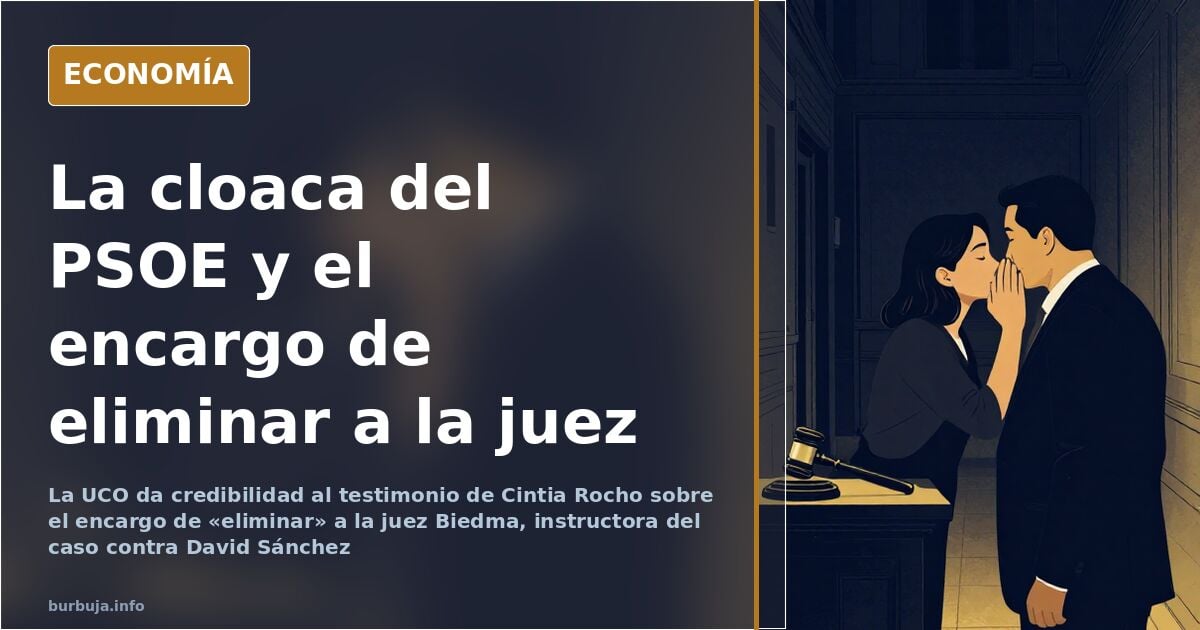
The Civil Guard backs the Rocho clan account regarding Judge Biedma
A report from the Civil Guard lends credibility to the testimony of Cintia Rocho, who claims she received orders to 'eliminate' Judge Biedma, the magistrate handling the case against David Sánchez. The document emerges one day before the judge testifies as a victim before Judge Santiago Pedraz at the Audiencia Nacional. According to this account, the plot involved using a fake Facebook profile to contact the clan and convey the instruction. The quote summarizing the order, according to the witness, was that Biedma 'was a damn pain in the ass and had to be eliminated.'
What the Civil Guard report says and does not say
The document does not charge anyone. It lends credibility to a witness. This distinction, which is vast in judicial language, blurs rapidly in politics. According to Cintia Rocho's account, on December 17, 2024, a profile named José García Fernández contacted her on Facebook to discuss the need for 'cleaning up' the Badajoz Courts. The identity of that profile was never discovered.
The name appearing in the conversation is Saenz de Tejada, whom the witness claims told her that Biedma was an obstacle to be removed. The Civil Guard considers the account plausible. It does not elevate it to proven fact. The difference between the two is what separates a headline from a conviction.
The day before testifying as a victim
Biedma appears at the Audiencia Nacional to testify as a victim before Santiago Pedraz. She does so one day after the report becomes known. The timing is not coincidental: it sets the pace of a case advancing through accumulated evidence, not a single piece.
Some argue this is political plumbing and that the PSOE is a one-man party where the apparatus understands the order without anyone signing anything. Against this is the argument that a structure without real congresses or primaries does not need written orders: it suffices that the boss looks the other way. This reasoning circulates widely, but it is an inference, not proof.
From the Rocho clan to the archive
The Rocho clan acts as a recurring lightning rod. Whenever a name appears, the automatic response is that it is an isolated case. Isolated cousin, isolated brother, isolated former chief of staff. When everything is isolated, the isolated is the system, argues part of the analysis. The other recalls that plumbing is inherited between governments like office furniture.
The comparison with the GALs appears in the conversation as a historical framework. Not as a proven equivalence. As a reference to how far the confusion between party interests and justice administration can go.
What is happening now with Judge Biedma
The case remains open. The testimony before Pedraz is just another piece. There is no conviction, no firm charge, no resolution. The only certainty is the Civil Guard report, which lends credibility to a testimony. And that, in a system where a witness's credibility is worth what it is worth, is much and little at the same time.
The startling fact is not the gravity of the order. It is the casual manner in which 'eliminating' a judge is discussed in a Facebook conversation.
A report from the Civil Guard lends credibility to the testimony of Cintia Rocho, who claims she received orders to 'eliminate' Judge Biedma, the magistrate handling the case against David Sánchez. The document emerges one day before the judge testifies as a victim before Judge Santiago Pedraz at the Audiencia Nacional. According to this account, the plot involved using a fake Facebook profile to contact the clan and convey the instruction. The quote summarizing the order, according to the witness, was that Biedma 'was a damn pain in the ass and had to be eliminated.'
What the Civil Guard report says and does not say
The document does not charge anyone. It lends credibility to a witness. This distinction, which is vast in judicial language, blurs rapidly in politics. According to Cintia Rocho's account, on December 17, 2024, a profile named José García Fernández contacted her on Facebook to discuss the need for 'cleaning up' the Badajoz Courts. The identity of that profile was never discovered.
The name appearing in the conversation is Saenz de Tejada, whom the witness claims told her that Biedma was an obstacle to be removed. The Civil Guard considers the account plausible. It does not elevate it to proven fact. The difference between the two is what separates a headline from a conviction.
The day before testifying as a victim
Biedma appears at the Audiencia Nacional to testify as a victim before Santiago Pedraz. She does so one day after the report becomes known. The timing is not coincidental: it sets the pace of a case advancing through accumulated evidence, not a single piece.
Some argue this is political plumbing and that the PSOE is a one-man party where the apparatus understands the order without anyone signing anything. Against this is the argument that a structure without real congresses or primaries does not need written orders: it suffices that the boss looks the other way. This reasoning circulates widely, but it is an inference, not proof.
From the Rocho clan to the archive
The Rocho clan acts as a recurring lightning rod. Whenever a name appears, the automatic response is that it is an isolated case. Isolated cousin, isolated brother, isolated former chief of staff. When everything is isolated, the isolated is the system, argues part of the analysis. The other recalls that plumbing is inherited between governments like office furniture.
The comparison with the GALs appears in the conversation as a historical framework. Not as a proven equivalence. As a reference to how far the confusion between party interests and justice administration can go.
What is happening now with Judge Biedma
The case remains open. The testimony before Pedraz is just another piece. There is no conviction, no firm charge, no resolution. The only certainty is the Civil Guard report, which lends credibility to a testimony. And that, in a system where a witness's credibility is worth what it is worth, is much and little at the same time.
The startling fact is not the gravity of the order. It is the casual manner in which 'eliminating' a judge is discussed in a Facebook conversation.
Summary of a discussion on Burbuja.info - Foro de economía, actualidad y política., translated from Spanish and reviewed before publication. Read the full discussion (19 replies).
More summaries
-
Sánchez Publishes in NYT: Spain Needs Migrants
Prime Minister Pedro Sánchez writes in the New York Times that Spain needs migrants, sparking intense debate over immigration, housing, and economic growth.
-
AI Devours Influencers: 95% of Creators Obsolete
AI generates voices and scripts for pennies. 95% of low-effort content creators vanish as the market splits in two.
-
Forum Debate: Selective Outrage Over Corruption in Spain
A forum thread argues that corruption scandals do not trigger mass protests in Spain; public outrage appears selectively only when it serves a specific political narrative.
-
Elite Recruitment: A Former Student Reveals a Religious Order’s System
A former student describes a religious order’s elite recruitment system in Spain, involving academic selection, scholarships, and leadership training.
-
Working at 10: The generational clash over pensions and youth precarity in Spain
A debate between Spanish retirees who started working at 10 and young people facing unstable employment highlights the widening gap in effort, wages, and pension systems.
-
Espinosa proposes 1 million homes and more labor migration
Iván Espinosa de los Monteros advocates for constructing one million new residences and increasing labor immigration, amid Spain's 10% structural unemployment and highest youth joblessness in Europe.