
CIS Poll: PSOE Leads PP by 6.5 Points, Vox at 15.2%
Spain's CIS poll shows PSOE at 32.6%, leading Feijóo's PP (26.1%) by 6.5 points. Vox rises to 15.2%, while Sumar and Podemos decline.
English · Original discussion in Spanish · Published
CIS Poll: PSOE Leads PP by 6.5 Points, Vox at 15.2%
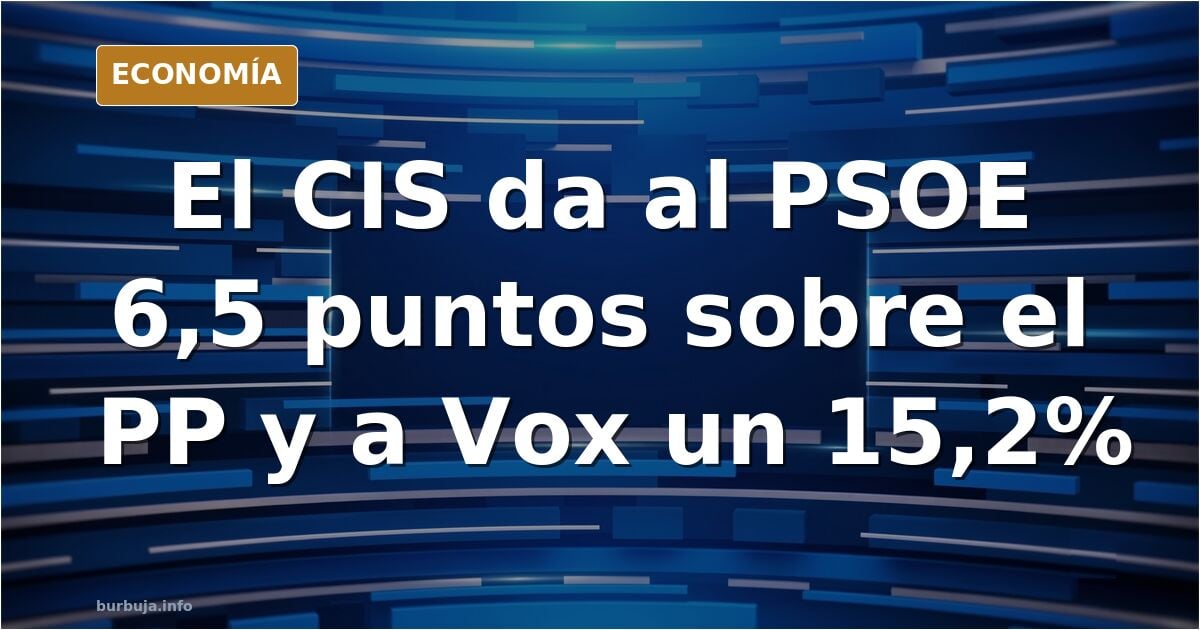
The latest barometer from Spain’s Center for Sociological Research (CIS) presents a scenario that defies conventional political logic. The Socialist Party (PSOE) would win elections with 32.6% of the vote, while Alberto Núñez Feijóo’s People’s Party (PP) drops to 26.1%, and the far-right Vox party climbs to 15.2%. Sumar sits at 6.2%, Podemos at 4%, and Alvise Pérez’s Se Acabó La Fiesta (SALF) at 1.9%. The survey, attributed to President José Félix Tezanos’ methodology, scores only 4.1 out of 10 on the PollCheck aggregator, signaling low confidence in its accuracy.
The paradox is stark: the governing party, despite facing corruption scandals within its ranks, gains support, while the opposition fails to capitalize on this weariness. Meanwhile, the far right consolidates above the 15% threshold, seemingly unaffected by the global tariff war shaking economies. If confirmed, these results would leave the PP without leverage and give Vox the key to government formation.
Why Feijóo’s PP Fails to Capitalize on Government Weariness
A central question in any analysis is why the main opposition party isn’t benefiting from executive scandals. The prevailing view is that Feijóo is perceived as a liability, lacking charisma, opposition drive, and presence in Madrid. Some argue the PP settled for him due to internal infighting among regional leaders, with his leadership secured through acclamation rather than competitive primaries.
One participant notes a harsh electoral calculation: every vote the PSOE loses to the PP counts double in terms of seats, whereas votes the PP steals from Vox count single. It mirrors the away-goals rule in knockout ties. If the PP mimics left-wing rhetoric to attract Vox voters, it fails to erode PSOE support while losing its own base. Conversely, another user sarcastically refers to Vox’s betrayal of Spain, portraying them as satellites of Europe’s enemies.
Immigrant Votes and Labor Reforms: The Silent Base of the PSOE
Key factors sustaining the PSOE include consistent debate over immigrant voting patterns. Generally, migrants lean towards the PSOE. Critics suggest the PP’s push for labor importation to suppress wages has alienated young right-wing voters, who shift to Vox or Alvise Pérez. Additionally, labor policies like reducing the workweek to 37.5 hours and raising the minimum wage resonate in a country where poverty has expanded.
The recurring diagnosis is that Spain is a massively poor country, and the PP offers only austerity measures to compete with lower-wage nations like Romania and Bulgaria. This menu provides no incentive for struggling voters to switch allegiance. Consequently, the PSOE maintains a hard core that remains unshaken even by corruption scandals involving its leaders.
Tariff War Doesn’t Slow Down Vox
Despite a global tariff war disrupting markets and supply chains, Vox hasn’t suffered in polls. Abascal’s party rises above 15%, even though its protectionist, anti-globalization stance clashes with voters dependent on international trade. The explanation offered is that Vox supporters vote based on identity, not economics; tariffs are mere background noise.
Some participants believe the real driver is the perception that the PP has abandoned a distinct stance on immigration. By trinc the PSOE’s lead and avoiding framing migration as a severe problem, the PP creates a vacuum that Vox fills. Far-right growth stems not from trade wars, but from occupying space the mainstream right leaves empty.
Allegations of Fraud, Distrust in CIS, and Strategic Voting
Distrust dominates reactions to the barometer. There are open accusations of electoral fraud, tailored surveys, and the CIS functioning as government propaganda. Some interpret the results as a call for strategic voting: abandon Sumar and Podemos, they say, and back the PSOE as the only force capable of stopping the far right. It’s the classic playbook of tactical voting applied with precision.
Ironically, those most skeptical of the CIS often cite its data when convenient. Others recall that the CIS wasn’t significantly wrong in recent general elections and that its findings align with street-level observations. In Asturias, for instance, one user notes the PSOE would again be the clear winner. The gap between narrative and data remains wide.
Erosion of the PP Brand and Feijóo’s Future
For the PP, the issue extends beyond Feijóo to the brand itself. Older voters who sustained the party in traditional strongholds are disappearing, and younger demographics show little interest, according to some analysts. Right-wing youth migrate to Vox and Alvise, while immigrants favor the PSOE. Critics argue the PP’s greed in importing cheap labor has fatally damaged its appeal.
The lingering question is whether the PP has a better alternative to Feijóo. Many respond that there is none, claiming years of internal purges have depleted the bench, leaving only weak alternatives. Given this landscape, the PSOE can afford to govern poorly and still win. How long will right-wing voters endure without a credible option?
The latest barometer from Spain’s Center for Sociological Research (CIS) presents a scenario that defies conventional political logic. The Socialist Party (PSOE) would win elections with 32.6% of the vote, while Alberto Núñez Feijóo’s People’s Party (PP) drops to 26.1%, and the far-right Vox party climbs to 15.2%. Sumar sits at 6.2%, Podemos at 4%, and Alvise Pérez’s Se Acabó La Fiesta (SALF) at 1.9%. The survey, attributed to President José Félix Tezanos’ methodology, scores only 4.1 out of 10 on the PollCheck aggregator, signaling low confidence in its accuracy.
The paradox is stark: the governing party, despite facing corruption scandals within its ranks, gains support, while the opposition fails to capitalize on this weariness. Meanwhile, the far right consolidates above the 15% threshold, seemingly unaffected by the global tariff war shaking economies. If confirmed, these results would leave the PP without leverage and give Vox the key to government formation.
Why Feijóo’s PP Fails to Capitalize on Government Weariness
A central question in any analysis is why the main opposition party isn’t benefiting from executive scandals. The prevailing view is that Feijóo is perceived as a liability, lacking charisma, opposition drive, and presence in Madrid. Some argue the PP settled for him due to internal infighting among regional leaders, with his leadership secured through acclamation rather than competitive primaries.
One participant notes a harsh electoral calculation: every vote the PSOE loses to the PP counts double in terms of seats, whereas votes the PP steals from Vox count single. It mirrors the away-goals rule in knockout ties. If the PP mimics left-wing rhetoric to attract Vox voters, it fails to erode PSOE support while losing its own base. Conversely, another user sarcastically refers to Vox’s betrayal of Spain, portraying them as satellites of Europe’s enemies.
Immigrant Votes and Labor Reforms: The Silent Base of the PSOE
Key factors sustaining the PSOE include consistent debate over immigrant voting patterns. Generally, migrants lean towards the PSOE. Critics suggest the PP’s push for labor importation to suppress wages has alienated young right-wing voters, who shift to Vox or Alvise Pérez. Additionally, labor policies like reducing the workweek to 37.5 hours and raising the minimum wage resonate in a country where poverty has expanded.
The recurring diagnosis is that Spain is a massively poor country, and the PP offers only austerity measures to compete with lower-wage nations like Romania and Bulgaria. This menu provides no incentive for struggling voters to switch allegiance. Consequently, the PSOE maintains a hard core that remains unshaken even by corruption scandals involving its leaders.
Tariff War Doesn’t Slow Down Vox
Despite a global tariff war disrupting markets and supply chains, Vox hasn’t suffered in polls. Abascal’s party rises above 15%, even though its protectionist, anti-globalization stance clashes with voters dependent on international trade. The explanation offered is that Vox supporters vote based on identity, not economics; tariffs are mere background noise.
Some participants believe the real driver is the perception that the PP has abandoned a distinct stance on immigration. By trinc the PSOE’s lead and avoiding framing migration as a severe problem, the PP creates a vacuum that Vox fills. Far-right growth stems not from trade wars, but from occupying space the mainstream right leaves empty.
Allegations of Fraud, Distrust in CIS, and Strategic Voting
Distrust dominates reactions to the barometer. There are open accusations of electoral fraud, tailored surveys, and the CIS functioning as government propaganda. Some interpret the results as a call for strategic voting: abandon Sumar and Podemos, they say, and back the PSOE as the only force capable of stopping the far right. It’s the classic playbook of tactical voting applied with precision.
Ironically, those most skeptical of the CIS often cite its data when convenient. Others recall that the CIS wasn’t significantly wrong in recent general elections and that its findings align with street-level observations. In Asturias, for instance, one user notes the PSOE would again be the clear winner. The gap between narrative and data remains wide.
Erosion of the PP Brand and Feijóo’s Future
For the PP, the issue extends beyond Feijóo to the brand itself. Older voters who sustained the party in traditional strongholds are disappearing, and younger demographics show little interest, according to some analysts. Right-wing youth migrate to Vox and Alvise, while immigrants favor the PSOE. Critics argue the PP’s greed in importing cheap labor has fatally damaged its appeal.
The lingering question is whether the PP has a better alternative to Feijóo. Many respond that there is none, claiming years of internal purges have depleted the bench, leaving only weak alternatives. Given this landscape, the PSOE can afford to govern poorly and still win. How long will right-wing voters endure without a credible option?
Also available in: Deutsch
Summary of a discussion on Burbuja.info - Foro de economía, actualidad y política., translated from Spanish and reviewed before publication. Read the full discussion (149 replies).
More summaries
-
PSOE lawsuits against Alvise dismissed: a judicial victory?
The PSOE sees all its lawsuits against Alvise Pérez dismissed. His supporters celebrate while doubts about Timospain and the €100,000 in cash persist.
-
Alvise Pérez: A Year On, No Salary Raffle, No Revelations
A year after joining the European Parliament, Alvise Pérez admits he has not raffled his salary or exposed the frauds he promised. His voters remain silent.
-
SpaceX Doubles to $213, Then Plunges 38%: Bubble or Strategy?
SpaceX stock hit $213 in its debut, then fell 38% in three weeks. This analysis examines whether the volatility signals a financial bubble or a calculated strategic move by Elon Musk.
-
Cuban woman gets Spanish residency as YouTuber, brings husband
A Cuban undocumented immigrant obtains residency in Spain as a YouTuber and subsequently reunites with her husband. The case reignites debate on regularization.
-
Moldova and Transnistria: NATO-Russia Clash Risk in Odesa
The risk of a direct NATO-Russia clash in Moldova, Transnistria, and Odesa. Analysis of moves preparing escalation.
-
Spanish public physiotherapist claims 4.5 hours of actual work
An interim Spanish physiotherapist reports 4.5-hour effective shifts and unused time-tracking systems in public healthcare.