
Christianity and power: the betrayal of Rome
A man executed for sedition who ended up crowning emperors. Why institutional Christianity defends the very power its founder set out to destroy.
English · Original discussion in Spanish · Published
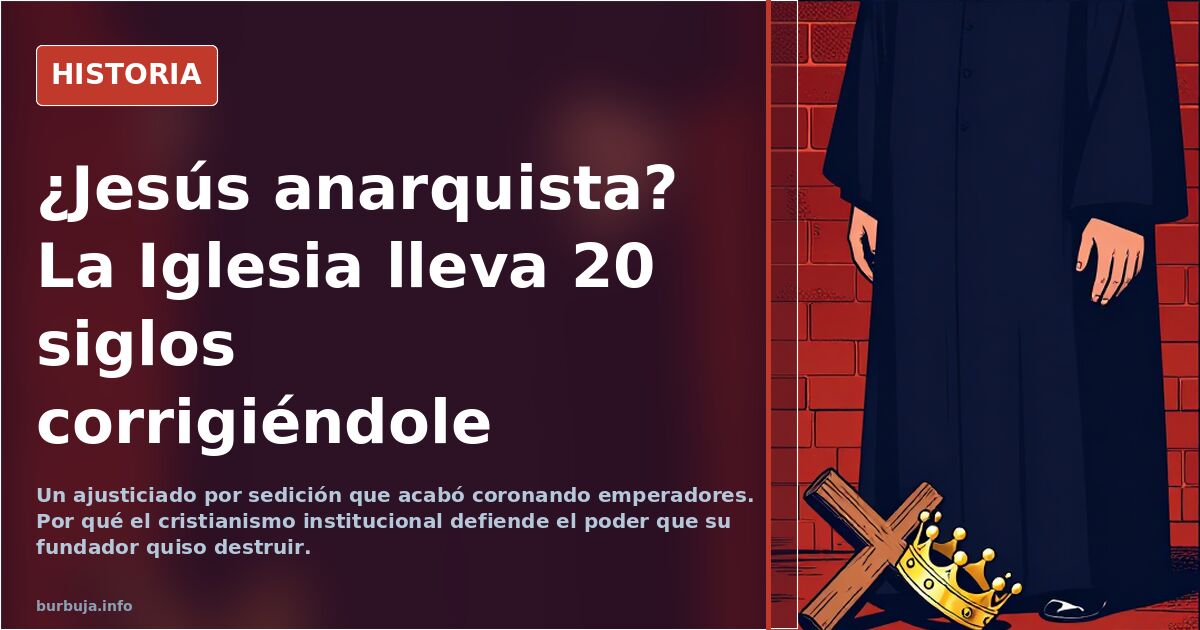
The subversive Jesus and the church of power: the paradox nobody wants to solve
The Church was never the continuation of Christianity. It was its hijacking. The history of the last two millennia is that of an institution born of a man executed for sedition who ended up crowning emperors, sanctifying wars and blessing borders. The uncomfortable question is why most Christians, and above all their hierarchies, defend exactly the opposite of what Jesus preached.
A political convict with anarchist disciples
The gospels describe a preacher who did not antiestéticar confronting religious power, who called the poor and the persecuted blessed, and who was executed on the cross, the punishment Rome reserved for seditionists. The thesis of an anarchist, anti-nationalist Jesus is not just a devotional reading: the Greek term 'ethnos' that appears in the Book of Revelation is translated as 'nations', but it means 'peoples', that is, all of humanity, not states. The manipulation of that word served to accommodate Christianity to later nationalism, even though the Gospel of Matthew, the only one that mentions the 'church', was written around 80-85 AD, three generations after the events.
The alliance with the executioner
The transformation begins when Rome realizes it cannot destroy Christianity and decides to absorb it. The bond between throne and altar is sealed: every kingdom will want its national church, and every church will want its king. The episode of Leo Tolstoy's excommunication illustrates this perfectly: it was not the Russian Orthodox Church that excommunicated him, but the Holy Synod led by Konstantin Pobedonostsev, an official of the tsar. The ecclesiastical institution had become just another department of the state apparatus. Since the French Revolution, clerics have effectively become state officials, serving the same stabilizing function as the police and the army.
What if Jesus was a Jewish nationalist?
The alternative reading, held by scholars of the historical Jesus, breaks the story of the messianic anarchist. The messiah expected by Judaism was a political figure who was to liberate Israel and restore the Davidic monarchy. Seen through that lens, Jesus would have been a nationalist Jewish preacher in the tribal context of his time, and modern Christianity, both Catholic and Protestant, would be a distortion accommodated to power for twenty centuries. The Zealots, the true armed rebels against Rome, did have a revolutionary dimension; the first Christians, according to that hypothesis, were more cautious with the Empire. Anyone who wants to dig deeper into the exegesis of 'ethnos' can find the full text on Project Gutenberg, and it will not take long to discover that the conventional translation is self-serving.
The Second Vatican Council and Liberation Theology tried to return Christianity to its popular roots, but the hierarchy had already understood that the business was not with the poor, but with the powerful. Meanwhile, the Church will keep blessing flags and the faithful will keep voting against their own gospel. Jesus' prediction that the last shall be first remains unfulfilled, perhaps because the one who preached it has spent twenty centuries making sure it does not come true.
Also available in: Deutsch
Summary of a discussion on Burbuja.info - Foro de economía, actualidad y política., translated from Spanish and reviewed before publication. Read the full discussion (46 replies).
More summaries
-
Catholics and Orthodox: a thousand-year schism in five differences
The 1054 schism explained: filioque, papal primacy, the Orthodox Bible and three of the four Marian dogmas. What still separates Rome from Constantinople.
-
Luther, Calvin and capitalism: sin or progress?
Five hundred years on, the debate over whether the Protestant Reformation legalised usury and unleashed greed remains open: sin or progress?
-
ETA and GAL: two arms of the same Gladio network in Spain
Investigation linking ETA and GAL as arms of the same NATO Gladio network, with drug trafficking funding and CIA control.
-
Life on Tristan da Cunha: isolation, alcohol and inbreeding
Tristan da Cunha: six days by boat, 50 liters of whisky per person a year and inbreeding. The most remote inhabited place on Earth is no paradise.
-
The Basque model dividing Spanish football
Athletic Club survives on a philosophy that costs millions: 15 million for Djaló, star wages for Iñaki Williams. Is the Basque academy system a model or a burden?
-
Muhammad's succession: the origin of all branches of Islam
85-90% of Muslims are Sunni; Shiites await the Hidden Imam. A journey through the branches of Islam, from Al-Andalus to the 1054 schism.